


[Policy Recommendations] Expectations for a System that Spans Diseases, Ministries, and Agencies for the Effective Promotion of Patient and Public Involvement (PPI) in Research and Development (June 30, 2026)
date : 6/30/2026

![[Policy Recommendations] Expectations for a System that Spans Diseases, Ministries, and Agencies for the Effective Promotion of Patient and Public Involvement (PPI) in Research and Development (June 30, 2026)](https://hgpi.org/en/wp-content/uploads/sites/2/HGPI_20260527_For-the-Effective-Promotion-of-PPI-in-Research-and-Development-1.png)
Health and Global Policy Institute (HGPI) has released policy recommendations titled, “Expectations for a System that Spans Diseases, Ministries, and Agencies for the Effective Promotion of Patient and Public Involvement (PPI) in Research and Development.”
Recommendation 1: Formulate a government policy on the definition, concepts, and evaluation of PPI
The Government of Japan should clearly indicate the definition of PPI’s ideal form in R&D that aligns with the Japanese context, along with the principles to emphasize, presented in the form of strategies, guidelines, and standards. As the need for PPI in measures from AMED and the Pharmaceuticals and Medical Devices Agency (PMDA) is expected to grow in the future, we hope to see the Government indicate a clear and cross-cutting approach that encompasses such measures. Rather than formulating those approaches once and considering them to be complete, they should be updated in an ongoing manner and based on changes in the times, progress in discussions on PPI, accumulated knowledge, and discussions with patients, others with lived experience, and citizens.
Furthermore, because involvement must be based on the characteristics of and circumstances in each area, in addition to creating a flexible and step-by-step design that is premised on multi-tiered involvement, it will also be necessary to establish an evaluation framework that takes into full account researchers as well as patients, others with lived experience, and citizens.
To ensure that researchers, patients, people with lived experience of health concerns, and citizens can understand the specifics of the Government’s PPI policy and implement it, practical guidelines should also be developed and updated regularly. It will also be vital that the practical guidelines provide clear details on appropriate compensation for patient partners for the time, experience, and knowledge they provide and to cover their expenses, and that the guidelines emphasize the need for reasonable accommodations for enabling diverse forms of involvement.
Recommendation 2: Construct a PPI promotion framework that spans diseases and supports involvement from a diversity of individuals
When promoting PPI, a system should be established that reflects the implementation status and characteristics of each disease area without overly emphasizing specific diseases, individuals, or organizations. Before such a system can be established, we must first build a framework that can be used to accumulate and share best practices and that tracks PPI implementation status in each disease area, starting with the track record of PPI promotion efforts led by AMED. We have high expectations for such a framework to elevate standards for PPI in R&D throughout Japan by highlighting areas in need of further support, visualizing experience and knowledge, and broadly disseminating knowledge.
It will also be important to expand opportunities to match researchers and patients or others with lived experience by research objective, and to develop training and mutual learning opportunities for both sides. In addition to establishing a framework that ensures a broad range of people can participate as individuals without having to rely on groups or organizations, it will also be necessary to provide opportunities for patients, others with lived experience, and citizens to acquire skills and knowledge for involvement in R&D to prevent burdening specific individuals through over-reliance and to broaden the base of involvement. When advancing such initiatives, steps should be taken to actively utilize the knowledge and infrastructure of patient advocacy organizations, non-profit organizations, and other neutral parties that support PPI.
In addition to advocating for the need for these mechanisms through these recommendations, moving forward, HGPI plans to transmit information about opportunities for involvement in R&D, training, and mutual learning through our patient and lived-experience involvement platform, Japan’s Patient Expert Platform (J-PEP).
Recommendation 3: Establish a promotion system that spans ministries and agencies with the Cabinet Office in mind
While the promotion of PPI is expected to proceed steadily for the time being, centered on areas under the jurisdiction of the MHLW and AMED, in the medium- to long-term, we hope to see these efforts expanded to include R&D and widespread adoption in drug discovery fields targeting a wider range of people, as well as to broader areas of science, technology, and innovation policy. To accomplish this, efforts to examine definitions, concepts, and evaluation frameworks (as described in Recommendation 1) and to gather and share best practices (as described in Recommendation 2) should not only involve specific ministries or governing bodies, but should be undertaken in a manner that spans ministries and agencies.
Therefore, for Recommendation 3, we propose establishing a system designed with the framework of the Science, Technology and Innovation initiative from the Cabinet Office foremost in mind. For example, a permanent working group could be established at the Cabinet Office to serve as a liaison conference, comprising researchers, representatives of patients and others with lived experience, and supporting organizations that advance PPI. In addition to sharing information on PPI implementation status for research projects in areas overseen by each ministry and agency as well as among non-governmental organizations, that group should be responsible for examining definitions and evaluation criteria and for compiling and disseminating best practices. The working group should also serve as a forum for government and civil society to collaborate and share about the direction of PPI promotion in Japan as a whole and drive concrete progress in PPI for each stage. Their activities for concrete progress should include determining how to best support PPI for researchers and academic societies in addition to patients and others with lived experience. As is the case with PPI, care must be taken when drafting the establishment guidelines for such deliberation bodies to prevent their membership from becoming fixed and their discussions from becoming closed. In addition to emphasizing the need for such a framework, through these recommendations, HGPI would also like to take tentative steps toward establishing such discussion forums in the future.
For details, please view the PDF provided below.
These policy recommendations had been compiled in HGPI’s capacity as an independent health policy think-tank. It does not, in any capacity, represent the opinions of any participating expert, speaker, related party, or organization to which those parties are affiliated.
![[Policy Recommendations] Expectations for a System that Spans Diseases, Ministries, and Agencies for the Effective Promotion of Patient and Public Involvement (PPI) in Research and Development](/assets/img/katsudo/icon_pdf_l.png)
Related Posts
-
2026-05-15
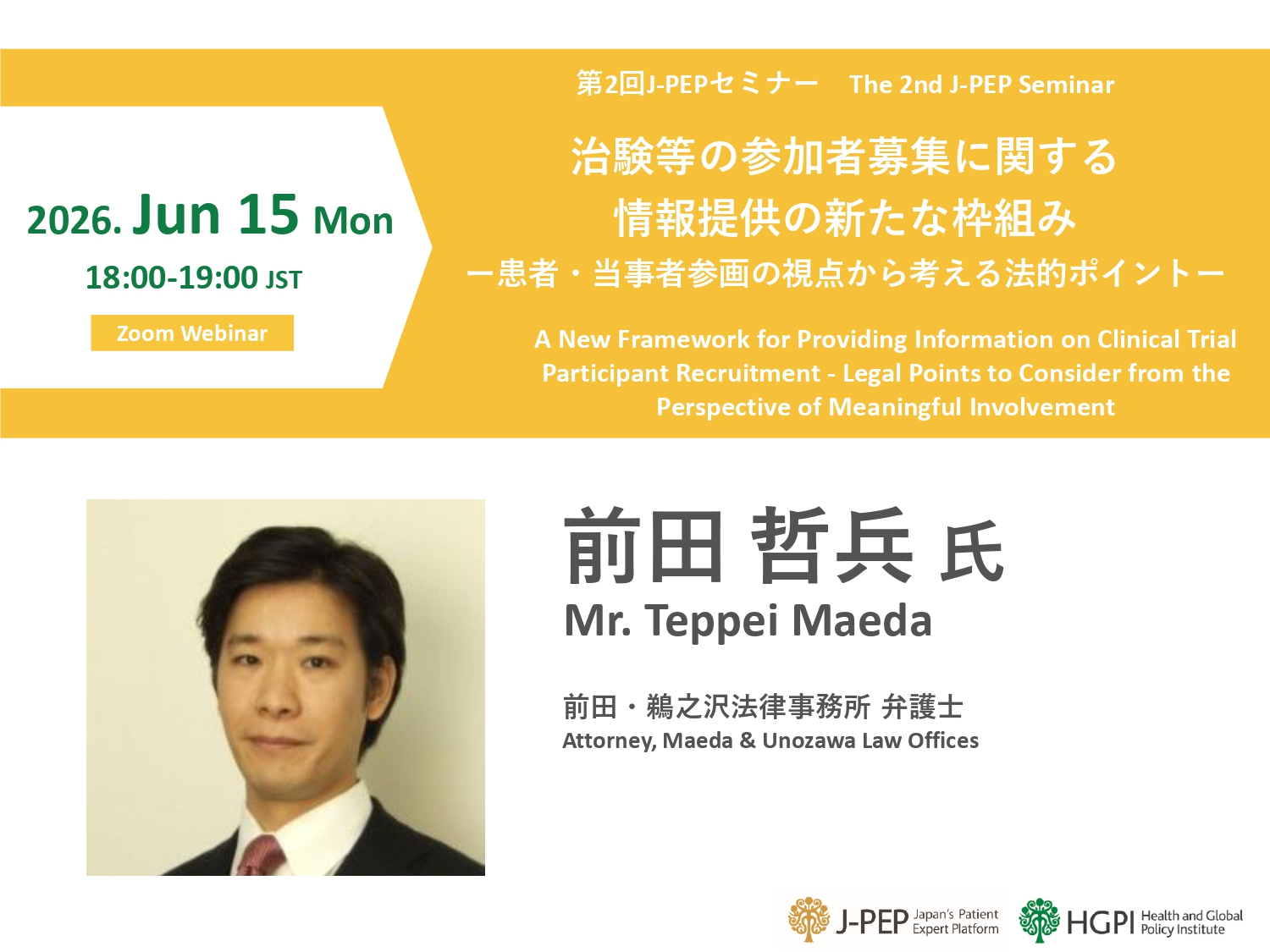
[Registration Closed] (Webinar) The 2nd J-PEP Seminar – A New Framework for Providing Information on Clinical Trial Participant Recruitment - Legal Points to Consider from the Perspective of Meaningful Involvement (June 15, 2026)
-
2026-03-05
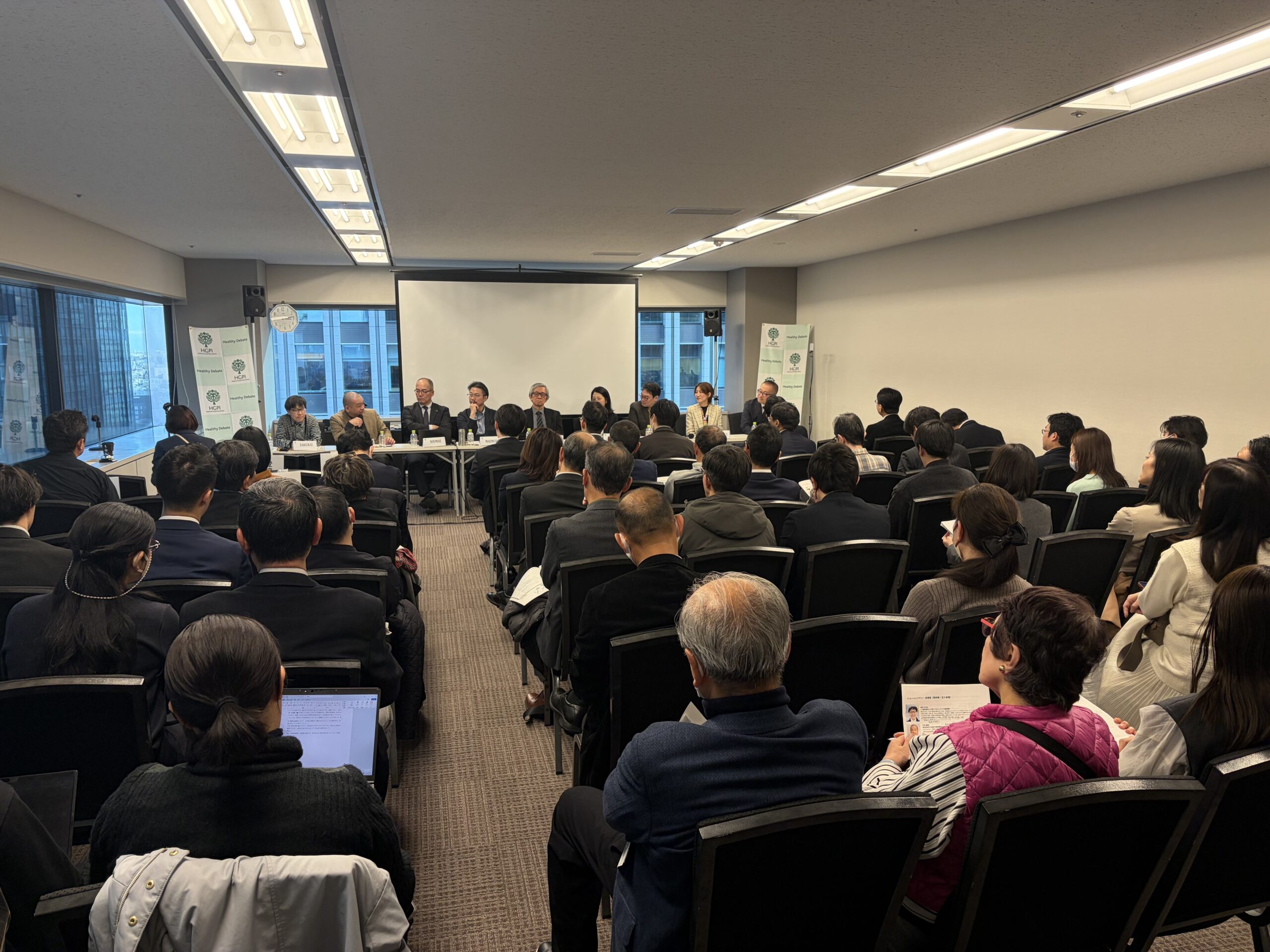
[Event Report] Meaningful Involvement Promotion Project Urgent Symposium “The New Takaichi Administration and Central Social Insurance Medical Council Reform – Ensuring Patients’ Voices are Heard” (January 22, 2026)
-
2026-02-03
[Event Report] The Meaningful Involvement Promotion Project “An Open Dialogue Between People With Lived Experience and Policymakers” (January 7, 2026)
-
2025-11-13
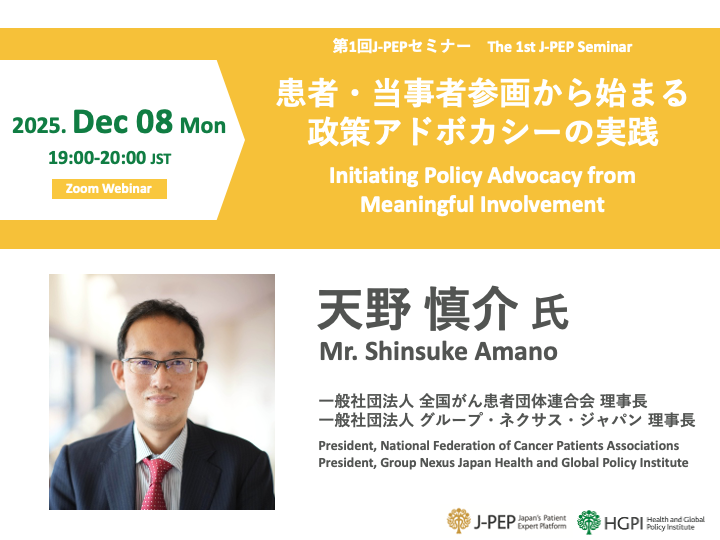
[Registration Closed] (Webinar) The 1st J-PEP Seminar – Initiating Policy Advocacy from Meaningful Involvement (December 8, 2025)
-
2025-08-08
[Announcement] Release of the J-PEP Introductory Video and Flyer (August 8, 2025)
-
2025-06-20
[Activity Report] Guidance on Promoting Meaningful Involvement for People with Psychosocial or Developmental Disabilities Issued with Cooperation From HGPI (April 22, 2025)
-

2024-12-01
[Activity Report] Announcing the Launch of the Japan’s Patient Expert Platform (J-PEP) Website (December 1, 2024)
-
2024-09-27
[HGPI Policy Column] (No. 48) From the Meaningful Involvement Promotion Project: The Resolution on Social Participation at the 77th World Health Assembly
Top Research & Recommendations Posts
Featured Posts
-
2026-05-18
[Registration Closed] Kick-off Panel Discussion “From Africa and Japan, Drawing from Perspectives Around the World:A Platform for Cultivating a Philosophical Health Dialogue Together” (June 15, 2026)
![[Registration Closed] Kick-off Panel Discussion “From Africa and Japan, Drawing from Perspectives Around the World:A Platform for Cultivating a Philosophical Health Dialogue Together” (June 15, 2026)](https://hgpi.org/en/wp-content/uploads/sites/2/HGPI_20260615_Eyecathch_panel-discussion-From-Japan-and-Africa-in-Discussion-with-the-World_2.png)
-
2026-08-28
[Announcement] The 3rd Kiyoshi Kurokawa Award: Call for Nominations (Deadline: November 30, 2026)
![[Announcement] The 3rd Kiyoshi Kurokawa Award: Call for Nominations (Deadline: November 30, 2026)](https://hgpi.org/en/wp-content/uploads/sites/2/Kiyoshi-Kurokawa-Award_3rd_nominations_eyecatch_caseB_ENG_web_20260929_v0.5.jpg)
-
2026-09-01
[Registration Closed] HGPI Salon 2025-2026 Looking Ahead to the Future of Japan’s Social Security System “Session 6: Japan’s Health Policy through the Lens of Global Security” (October 13, 2026)
![[Registration Closed] HGPI Salon 2025-2026 Looking Ahead to the Future of Japan’s Social Security System “Session 6: Japan’s Health Policy through the Lens of Global Security” (October 13, 2026)](https://hgpi.org/en/wp-content/uploads/sites/2/HGPISalon2025-20266.png)
-
2026-09-17
[Registration Open] (Webinar) The 145th HGPI Seminar “Toward Better AMR Measures at Elderly Care Facilities—Considering Infectious Disease Control in a Super-Aged Society From a Policy Perspective” (October 27, 2026)
![[Registration Open] (Webinar) The 145th HGPI Seminar “Toward Better AMR Measures at Elderly Care Facilities—Considering Infectious Disease Control in a Super-Aged Society From a Policy Perspective” (October 27, 2026)](https://hgpi.org/en/wp-content/uploads/sites/2/HGPIseminar145.png)
-
2026-10-06
[Registration Open] (Webinar) The 146th HGPI Seminar “How We Can Build a Society That Supports Choices Around Organ Donation: Exploring Decision-Making by Citizens and a Multi-Layered Approach Through Strategic Social Marketing” (November 9, 2026)
![[Registration Open] (Webinar) The 146th HGPI Seminar “How We Can Build a Society That Supports Choices Around Organ Donation: Exploring Decision-Making by Citizens and a Multi-Layered Approach Through Strategic Social Marketing” (November 9, 2026)](https://hgpi.org/en/wp-content/uploads/sites/2/HGPI_20261001_Eyecatch_HGPIseminer-146th-1.png)
