
[Research Report] AMR Policy Update #6: The New Global Action Plan on AMR (Part 1)
date : 6/15/2026
Tags: AMR

![[Research Report] AMR Policy Update #6: The New Global Action Plan on AMR (Part 1)](https://hgpi.org/en/wp-content/uploads/sites/2/HGPI_20260610_AMR-Policy-Column6.jpg)
<POINTS>
- AMR is a global health threat with deep inequities. Bacterial AMR alone caused an estimated 1.14 million deaths in 2021 and could drive up to 39 million by 2050, with the burden falling hardest on low- and middle-income countries.
- A decade of implementation exposed key gaps. Of 178 National Action Plans, only 68% are implemented and 11% are domestically funded. The 2015 GAP-AMR also lacked time-bound targets and over-emphasized stewardship over equitable access.
- In 2026, WHA79 adopted a new 2026–2036 GAP-AMR. The first overhaul since 2015 and developed by the Quadripartite (WHO, FAO, WOAH, UNEP), it reaffirms the importance of One Health and aims for a more accountable, equitable, and measurable framework.
Introduction
Antimicrobial resistance (AMR) is widely recognized as one of the defining public health challenges of the twenty-first century. In 2021, bacterial AMR alone directly caused an estimated 1.14 million human deaths and was associated with 4.7 million related deaths globally, with the heaviest burden falling on low- and middle-income countries (LMICs). Without decisive action, AMR could reduce global life expectancy by 1.8 years within a decade, while AMR-related deaths may reach up to 39 million deaths by 2050.
Against this backdrop, the Seventy-ninth World Health Assembly (WHA79), convened in Geneva from 18 May 2026, marks a turning point. On 23 May 2026, Member States adopted an updated Global Action Plan on Antimicrobial Resistance (GAP-AMR) for 2026–2036, the first comprehensive overhaul of the global AMR response since 2015. The new plan was developed jointly by the Quadripartite: the World Health Organization (WHO), the Food and Agriculture Organization of the United Nations (FAO), the World Organisation for Animal Health (WOAH), and the United Nations Environment Programme (UNEP). The plan reflects the importance of the One Health approach as the organizing principle of the global AMR response. It stands as both a reaffirmation of political commitment and a translation of lessons from a decade of implementation into a more accountable, equitable, and measurable framework.
Overview of the 2015 Global Action Plan on AMR (GAP-AMR)
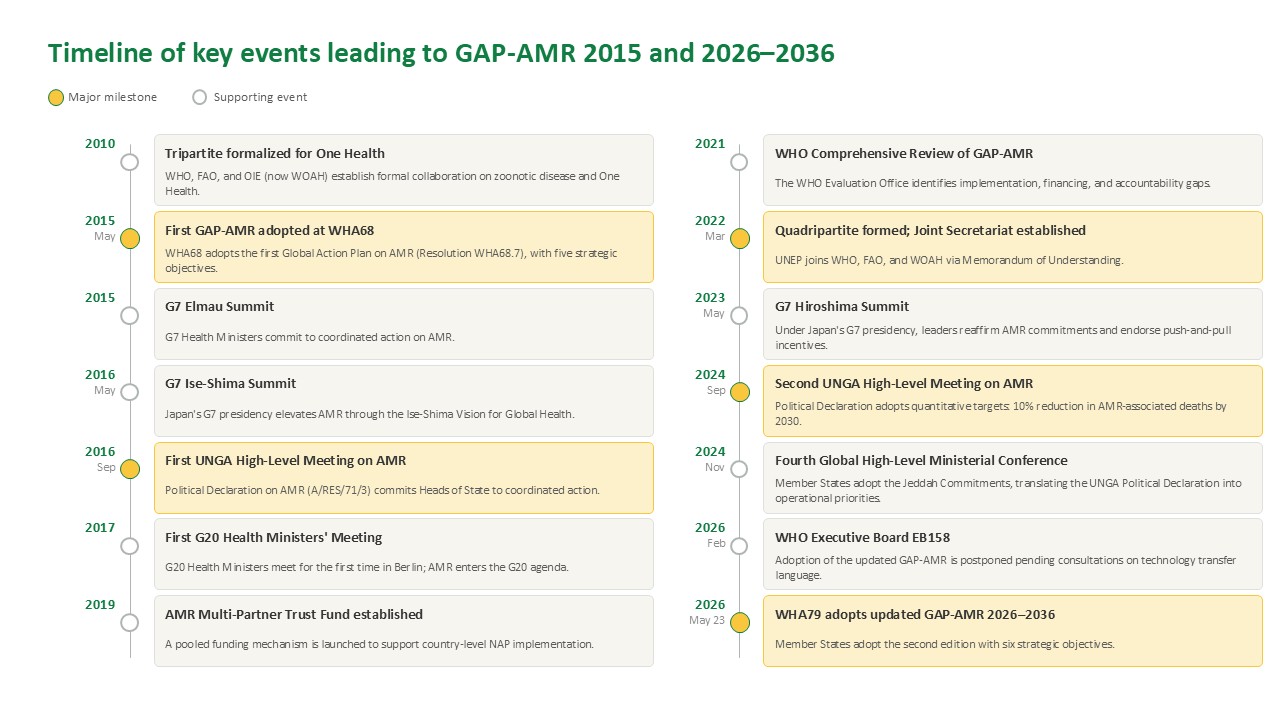
The Global Action Plan on AMR was a result of the 2015 consensus at the Sixty-eighth World Health Assembly (WHA68) that antimicrobial resistance (AMR) posed a profound threat to human health. At its core, the 2015 GAP-AMR was designed to ensure the treatment and prevention of infectious diseases through five strategic objectives:
- Improve awareness through effective communication, education and training
- Strengthen the knowledge and evidence based through surveillance and research
- Reduce the incidence of infection through effective sanitation, hygiene and infection prevention measures
- Optimize the use of antimicrobial medicines in human and animal health
- Develop the economic case for sustainable investment that takes account of the needs of all countries, and increase investment in new medicines, diagnostic tools, vaccines, and other interventions
Member States were urged to develop National Action Plans (NAPs) within two years. While this first GAP established AMR as a recurrent item on the global health agenda, it lacked specific, time-bound numeric targets, serving more as a blueprint than a binding roadmap for national implementation.
Over the following decade, the 2015 GAP-AMR was reinforced by a series of high-level political milestones. The first United Nations General Assembly (UNGA) High-Level Meeting on AMR in 2016 produced a political declaration committing Heads of State to a coordinated response. AMR was subsequently taken up across successive G7 and G20 health agendas, with the G7 Hiroshima Leaders’ Communiqué in 2023 reaffirming commitments to push and pull incentives for antimicrobial R&D and to antimicrobial access and stewardship ahead of the 2024 UN High-Level Meeting on AMR.
At the same time, the global governance structure supporting AMR countermeasures continued to evolve. The 2016 UN General Assembly High Level Meeting called for the establishment of the Interagency Coordination Group on AMR (IACG), whose 2019 report “No Time to Wait” requested stronger coordinated One Health Action among various agencies. It also recommended the need for permanent governance structures for AMR, such as the Global Leaders Group on AMR (GLG) and a joint secretariat. The GLG was launched in 2020, and in 2022, the establishment of the Quadripartite Joint Secretariat on AMR institutionalized cross-sectoral coordination at the global level, providing a more robust governance structure than in previous years.
Progress and Gaps
Although 178 countries have developed NAPs, only 68% are currently being implemented, and a mere 11% have dedicated domestic funding. In low- and middle-income countries (LMICs), the gap is even wider; as of 2024, only 10% of countries reported specific financial provisions for their multisectoral plans.
While the launch of the Global Antimicrobial Resistance and Use Surveillance System (GLASS) in 2015 substantially increased data-sharing capacity, the latest 2025 GLASS data highlights key disparities. Resistance to carbapenems, which are considered last-resort antibiotics, remains critically high, particularly in resource-limited settings where laboratory infrastructure is fragile. Strengthening diagnostic capacity is therefore central to the response: the 2023 World Health Assembly resolution on strengthening diagnostics capacity (WHA76.5) and WHO’s subsequent AMR Diagnostic Initiative both underscore the role of timely, accurate diagnosis in guiding appropriate antimicrobial use.
Furthermore, a key gap of the 2015-2025 Global Action Plan was its narrow focus on stewardship without equal emphasis on equitable access. In fact, in 2021, more people in LMICs died from a lack of access to antibiotics rather than from resistant infections. This gap is especially concerning given that the AMR burden is already disproportionately concentrated in LMICs. For Japan and the broader Asia-Pacific region, connected by extensive trade, travel, and population movement, inadequate investment in AMR in neighboring countries translate into shared health security risks.
References
- World Health Organization. (2026, May 13). Draft updated global action plan on antimicrobial resistance 2026-2036 (A79/5 Add.2). Seventy-ninth World Health Assembly, Provisional agenda item 12.9. https://apps.who.int/gb/ebwha/pdf_files/WHA79/A79_5Add2-en.pdf
- World Health Organization. (2015). Global action plan on antimicrobial resistance. https://www.who.int/publications/i/item/9789241509763
- World Health Organization Evaluation Office. (2021, September). Comprehensive review of the WHO global action plan on antimicrobial resistance: Volume 1: Report. World Health Organization. https://cdn.who.int/media/docs/default-source/documents/about-us/evaluation/gap-amr-final-report-v2.pdf
- United Nations General Assembly. (2016, October 5). Political declaration of the high-level meeting of the General Assembly on antimicrobial resistance (A/RES/71/3). https://digitallibrary.un.org/record/842813
- G7. (2023, May 20). G7 Hiroshima Leaders’ Communiqué. Ministry of Foreign Affairs of Japan. https://www.mofa.go.jp/files/100506878.pdf
- Interagency Coordination Group on Antimicrobial Resistance. (2019). No time to wait: Securing the future from drug-resistant infections (Report to the Secretary-General of the United Nations). World Health Organization. https://www.who.int/docs/default-source/documents/no-time-to-wait-securing-the-future-from-drug-resistant-infections-en.pdf
- Food and Agriculture Organization of the United Nations, United Nations Environment Programme, World Health Organization, & World Organisation for Animal Health. (2022, March 17). Memorandum of Understanding on the Quadripartite alliance for One Health. https://www.qjsamr.org/multistakeholder-partnership-platform/our-work
- Chen, W., Zeng, Y., Zheng, J., Wang, J., Gu, W., Li, M., Cheng, Z., Qian, J., Zhang, X., Kabali, E., Lv, C., Chen, Y., Yang, G., Zhou, N., Tan, X., Zhu, C., Tun, H. M., Mohsin, M., Rahman, T., . . . Zhu, Y. (2026). Evaluation of antimicrobial resistance governance across 193 countries to inform the 2026 Global Action Plan update. Nature Medicine, 32(4), 1362–1373. https://doi.org/10.1038/s41591-026-04257-1
- World Health Organization. (2025, October). Global call to action to address antimicrobial resistance: An appeal for keeping our medicines against infectious diseases effective to save lives. https://cdn.who.int/media/docs/default-source/antimicrobial-resistance/amr-gcp-asa/global-call-to-action-to-address-amr—oct-2025.pdf
- World Health Organization. (2025). Global antibiotic resistance surveillance report 2025. https://www.who.int/publications/i/item/9789240116337
- World Health Organization, Executive Board. (2023). Strengthening diagnostics capacity (EB152(6)). Resolution recommended by the 152nd session of the Executive Board for adoption by the Seventy-sixth World Health Assembly. https://apps.who.int/gb/ebwha/pdf_files/EB152/B152(6)-en.pdf
- World Health Organization. (2024). Antimicrobial resistance diagnostic initiative. https://www.who.int/publications/i/item/9789240072015
- Global Antibiotic Research and Development Partnership. (2025, October 6). GARDP statement on Global AMR Action Plan update. https://gardp.org/gardp-statement-on-the-global-action-plan-on-amr-update/
Authors
Gail Co (Program Specialist, Health and Global Policy Institute)
Eri Cahill (Associate, Health and Global Policy Institute)
Yui Kohno (Manager, Health and Global Policy Institute)
Top Research & Recommendations Posts
Featured Posts
-
2026-05-18
[Registration Closed] Kick-off Panel Discussion “From Africa and Japan, Drawing from Perspectives Around the World:A Platform for Cultivating a Philosophical Health Dialogue Together” (June 15, 2026)
![[Registration Closed] Kick-off Panel Discussion “From Africa and Japan, Drawing from Perspectives Around the World:A Platform for Cultivating a Philosophical Health Dialogue Together” (June 15, 2026)](https://hgpi.org/en/wp-content/uploads/sites/2/HGPI_20260615_Eyecathch_panel-discussion-From-Japan-and-Africa-in-Discussion-with-the-World_2.png)
-
2026-08-28
[Announcement] The 3rd Kiyoshi Kurokawa Award: Call for Nominations (Deadline: November 30, 2026)
![[Announcement] The 3rd Kiyoshi Kurokawa Award: Call for Nominations (Deadline: November 30, 2026)](https://hgpi.org/en/wp-content/uploads/sites/2/Kiyoshi-Kurokawa-Award_3rd_nominations_eyecatch_caseB_ENG_web_20260929_v0.5.jpg)
-
2026-09-01
[Registration Closed] HGPI Salon 2025-2026 Looking Ahead to the Future of Japan’s Social Security System “Session 6: Japan’s Health Policy through the Lens of Global Security” (October 13, 2026)
![[Registration Closed] HGPI Salon 2025-2026 Looking Ahead to the Future of Japan’s Social Security System “Session 6: Japan’s Health Policy through the Lens of Global Security” (October 13, 2026)](https://hgpi.org/en/wp-content/uploads/sites/2/HGPISalon2025-20266.png)
-
2026-09-17
[Registration Open] (Webinar) The 145th HGPI Seminar “Toward Better AMR Measures at Elderly Care Facilities—Considering Infectious Disease Control in a Super-Aged Society From a Policy Perspective” (October 27, 2026)
![[Registration Open] (Webinar) The 145th HGPI Seminar “Toward Better AMR Measures at Elderly Care Facilities—Considering Infectious Disease Control in a Super-Aged Society From a Policy Perspective” (October 27, 2026)](https://hgpi.org/en/wp-content/uploads/sites/2/HGPIseminar145.png)
-
2026-10-06
[Registration Open] (Webinar) The 146th HGPI Seminar “How We Can Build a Society That Supports Choices Around Organ Donation: Exploring Decision-Making by Citizens and a Multi-Layered Approach Through Strategic Social Marketing” (November 9, 2026)
![[Registration Open] (Webinar) The 146th HGPI Seminar “How We Can Build a Society That Supports Choices Around Organ Donation: Exploring Decision-Making by Citizens and a Multi-Layered Approach Through Strategic Social Marketing” (November 9, 2026)](https://hgpi.org/en/wp-content/uploads/sites/2/HGPI_20261001_Eyecatch_HGPIseminer-146th-1.png)
