


[Publication Report] Future of the Healthcare System Project “Policy roadmaps for acting early on NCDs” (March, 2026)
date : 4/22/2026

![[Publication Report] Future of the Healthcare System Project “Policy roadmaps for acting early on NCDs” (March, 2026)](https://hgpi.org/en/wp-content/uploads/sites/2/HGPI_PHSSR-Report_20260421.png)
The Partnership for Health System Sustainability and Resilience (PHSSR) was launched in 2020 as a project based on a collaborative partnership among the London School of Economics (LSE), the World Economic Forum (WEF), and other partners in industry with the objective of reviewing health systems in each country in response to Coronavirus Disease 2019 (COVID-19). Health and Global Policy Institute (HGPI), together with Keio University, participates in PHSSR as the Japan secretariat.
*For more information about PHSSR, please visit the PHSSR.jp website.
In March 2026, the PHSSR Japan team published policy roadmaps for acting early on NCDs (non-communicable diseases). In developing these roadmaps, analysis was conducted through international comparisons and engagement with experts and stakeholders, and the findings were compiled as a policy roadmap for addressing NCDs in Japan. Based on these findings, and in response to the increasing health and social burdens from NCDs due to increased life expectancy, the need for three shifts were identified: from treatment-centered to prevention, from fragmentation to integration, and from quantity to value. Furthermore, through a systematic evaluation across seven domains, the report presents concrete directions for building a more resilient and sustainable healthcare system, one that supports people’s dignity and social participation.
Contents
- List of figures and tables
- List of abbreviations
- Acknowledgements
- Introduction
- Methodology and stakeholders consulted
- Executive summary
- Domain 1: Population health
- Domain 2: Governance
- Domain 3: Service delivery
- Domain 4: Financing
- Domain 5: Workforce
- Domain 6: Medicines and technology
- Domain 7: Environmental Sustainability
- References
The evaluation was conducted through a multi-faceted approach, utilizing Japan’s extensive healthcare databases and international comparative data, and with an advisory board comprising experts across all seven domains, NCD-specific specialists, as well as patients, affected individuals, and the media.
Advisory board (at time of participation in March 2025, Titles omitted)
Domain 1: Population Health
Naoki Kondo (Professor and Chair, Department of Social Epidemiology, Graduate School of Medicine and School of Public Health, Kyoto University)
Domain 2: Governance
Keizo Takemi (Member of the House of Councillors / Former Minister of Health, Labour and Welfare)
Ryozo Nagai (President, Jichi Medical University)
Domain 3: Service Delivery
Shigekazu Komoto (Professor, School of Medicine, Hokkaido University / Former Director, Cancer and Disease Control Division, Ministry of Health, Labour and Welfare)
Domain 4: Finance
Masahiro Sano (Deputy president, National Federation of Health Insurance Societies (Kenporen))
Domain 5: Workforce
Yasuhiro Suzuki (President, International University of Health and Welfare / Former Vice-Minister for Health, Ministry of Health, Labour and Welfare)
Domain 6: Medicines and Technology
Takuko Sawada (Director and Vice Chairperson of the Board, Shionogi & Co., Ltd.)
Domain 7: Environmental Sustainability
Masahiro Hashizume (Professor, Department of Global Health Policy, Graduate School of Medicine, The University of Tokyo)
Cross Domain
Jun Sasaki (Chief Executive Officer and Director at Yushoukai Medical Corporation / Expert Member, the Council for Promotion of Regulatory Reform)
Koichi Fukunaga (Professor, Pulmonary Division, Department of Medicine, Keio University, School of Medicine)
Mamoru Ichikawa (A Healthcare Communicator / Executive Board Member, Japan Medical Journalists Association)
Naomi Sakurai (President, Cancer Solutions Co., Ltd. / Expert Member, the Council for Promotion of Regulatory Reform)
Shoichiro Tsugane (Professor, Graduate School of Public Health, International University of Health and Welfare / Former Director of the Centre for Public Health Sciences, National Cancer Center, Former Director of the National Institute of Health and Nutrition)
Tomonori Okamura (Professor, Department of Preventive Medicine and Public Health, Keio University School of Medicine / President, The Japanese Society of Cardiovascular Disease Prevention / Committee Member, the Health Japan 21 (Third Term) Promotion Special Committee, Ministry of Health, Labour and Welfare)
In Japan, as the baby boom generation ages and annual healthcare expenditure reaches 46.7 trillion yen, the challenge of ensuring sustainability has become even more urgent. Rather than relying solely on theoretical frameworks, this report provides concrete, actionable recommendations based on evidence and verified through international comparison. By analyzing and clarifying what works and what does not within existing initiatives, and by proposing concrete solutions, the report aims to support the development of a healthcare system that not only extends life, but also empowers people with dignity, purpose, and vitality throughout their lives. We hope that the publication of this report will generate global momentum for healthcare reform.
![[Policy Recommendations] Policy roadmaps for acting early on NCDs](/assets/img/katsudo/icon_pdf_l.png)
Related Posts
-
2025-08-28
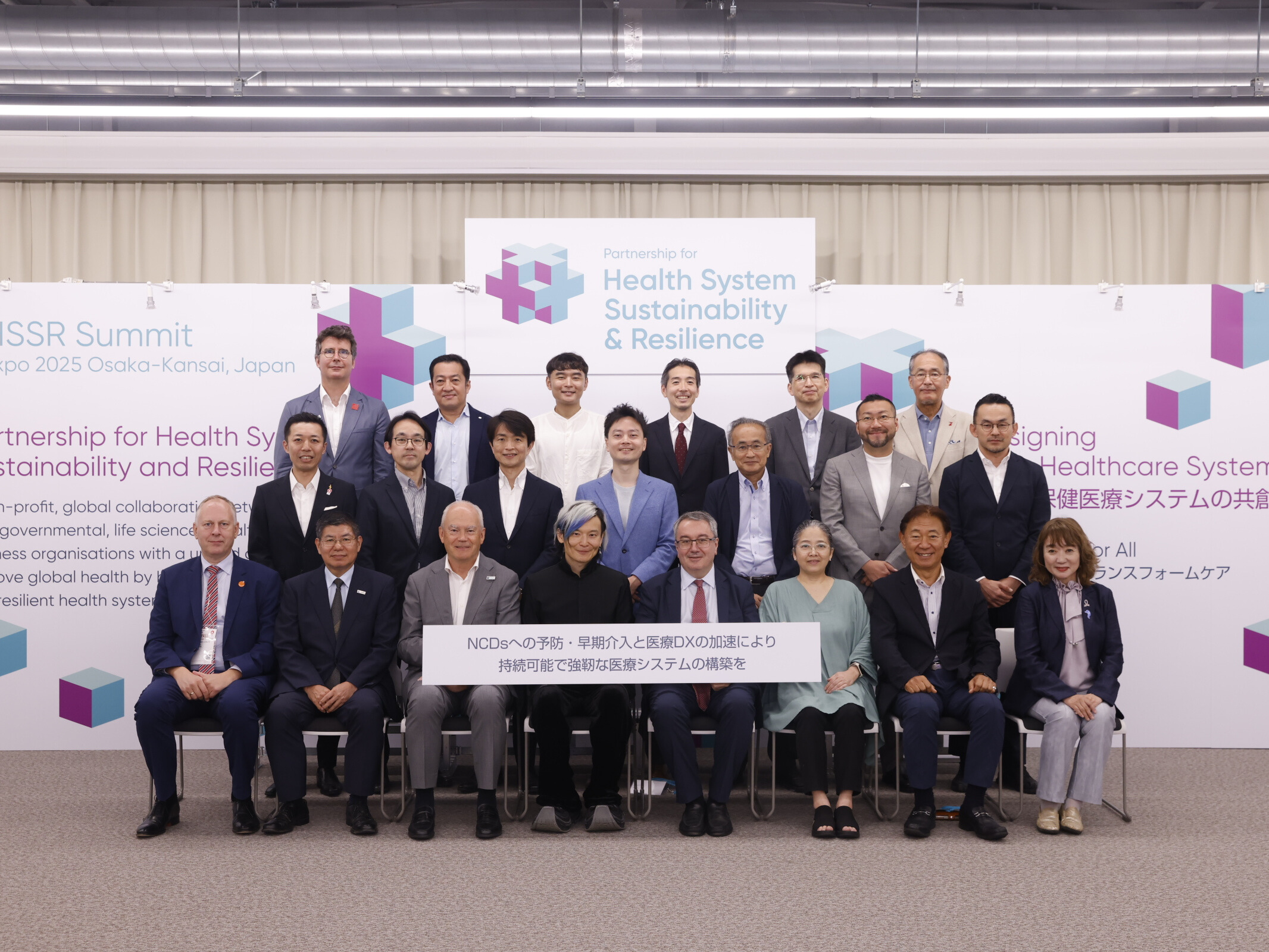
[Event Report] EXPO 2025 Thematic Project “Resonance of Life” PHSSR Summit 2025 “Co-designing Stronger Health Systems – Transforming Care for All” (June 30, 2025)
-
2022-12-06
[Publication Report] The Future of the Healthcare System Project Presents “Partnership for Health System Sustainability and Resilience” Report (December 5, 2022)
Top Research & Recommendations Posts
Featured Posts
-
2026-05-18
[Registration Closed] Kick-off Panel Discussion “From Africa and Japan, Drawing from Perspectives Around the World:A Platform for Cultivating a Philosophical Health Dialogue Together” (June 15, 2026)
![[Registration Closed] Kick-off Panel Discussion “From Africa and Japan, Drawing from Perspectives Around the World:A Platform for Cultivating a Philosophical Health Dialogue Together” (June 15, 2026)](https://hgpi.org/en/wp-content/uploads/sites/2/HGPI_20260615_Eyecathch_panel-discussion-From-Japan-and-Africa-in-Discussion-with-the-World_2.png)
-
2026-08-28
[Announcement] The 3rd Kiyoshi Kurokawa Award: Call for Nominations (Deadline: November 30, 2026)
![[Announcement] The 3rd Kiyoshi Kurokawa Award: Call for Nominations (Deadline: November 30, 2026)](https://hgpi.org/en/wp-content/uploads/sites/2/Kiyoshi-Kurokawa-Award_3rd_nominations_eyecatch_caseB_ENG_web_20260929_v0.5.jpg)
-
2026-09-01
[Registration Closed] HGPI Salon 2025-2026 Looking Ahead to the Future of Japan’s Social Security System “Session 6: Japan’s Health Policy through the Lens of Global Security” (October 13, 2026)
![[Registration Closed] HGPI Salon 2025-2026 Looking Ahead to the Future of Japan’s Social Security System “Session 6: Japan’s Health Policy through the Lens of Global Security” (October 13, 2026)](https://hgpi.org/en/wp-content/uploads/sites/2/HGPISalon2025-20266.png)
-
2026-09-17
[Registration Open] (Webinar) The 145th HGPI Seminar “Toward Better AMR Measures at Elderly Care Facilities—Considering Infectious Disease Control in a Super-Aged Society From a Policy Perspective” (October 27, 2026)
![[Registration Open] (Webinar) The 145th HGPI Seminar “Toward Better AMR Measures at Elderly Care Facilities—Considering Infectious Disease Control in a Super-Aged Society From a Policy Perspective” (October 27, 2026)](https://hgpi.org/en/wp-content/uploads/sites/2/HGPIseminar145.png)
-
2026-10-06
[Registration Open] (Webinar) The 146th HGPI Seminar “How We Can Build a Society That Supports Choices Around Organ Donation: Exploring Decision-Making by Citizens and a Multi-Layered Approach Through Strategic Social Marketing” (November 9, 2026)
![[Registration Open] (Webinar) The 146th HGPI Seminar “How We Can Build a Society That Supports Choices Around Organ Donation: Exploring Decision-Making by Citizens and a Multi-Layered Approach Through Strategic Social Marketing” (November 9, 2026)](https://hgpi.org/en/wp-content/uploads/sites/2/HGPI_20261001_Eyecatch_HGPIseminer-146th-1.png)
