


[Event Report and Discussion Points] Positioning AI-Assisted Diagnosis as a Pillar of National Strategy: Multi-Stakeholder Discussion Points for a Sustainable Healthcare System (May 25, 2026)
date : 8/20/2026

![[Event Report and Discussion Points] Positioning AI-Assisted Diagnosis as a Pillar of National Strategy: Multi-Stakeholder Discussion Points for a Sustainable Healthcare System (May 25, 2026)](https://hgpi.org/en/wp-content/uploads/sites/2/HGPI_ai-20260417-top-scaled-1.jpg)
*The English version of the report has been published. (August 20, 2026)
Health and Global Policy Institute (HGPI) has published a discussion paper titled “Positioning AI-Assisted Diagnosis as a Pillar of National Strategy: Multi-Stakeholder Discussion Points for a Sustainable Healthcare System.”
This paper identifies and organizes key issues that should be discussed across four sectors — citizens and patients, government, academia, and industry — in order to accelerate the societal implementation of AI diagnostic support tools, including Software as a Medical Device (SaMD). The paper was independently compiled by HGPI based on discussions held at an expert meeting convened on Friday, April 17, 2026, under the Chatham House Rule, individual interviews with Advisory Board members, and research conducted independently by the organization.
■Overview of the Discussion Paper
The paper positions AI diagnostic support as a tool to assist physician decision-making, and identifies two key directions through which it can improve the quality of care: streamlining day-to-day clinical workflows (such as reducing the burden on healthcare professionals and improving care efficiency) and supplementing clinical expertise, for example by enabling the detection of rare diseases at the primary care stage.
The paper further highlights the importance of pursuing both near-term incremental improvements within existing regulatory frameworks and long-term non-linear institutional reform in parallel, as essential to accelerating societal implementation.
Building on these foundational observations, the paper organizes key issues to be discussed among industry, government, academia, and civil society into the following six areas:
- Evidence Generation: Public funding for clinical research on AI medical devices should be expanded, and evidence-generation methodologies suited to the AI era should be developed.
- Pharmaceuticals and Medical Devices Agency (PMDA) Review Capacity and Regulatory Frameworks including Challenge Applications: Review capacity should be strengthened to keep pace with the rapid evolution of AI medical devices, and operational improvements should be made to existing frameworks that have been criticized as difficult to navigate.
- Post-Market Surveillance: Approaches to managing the continuous performance changes of AI medical devices should be developed, and current operational rules in clinical settings, including double reading requirements and advertising regulations, should be reviewed.
- Building Public and Patient Trust: To address trust — identified as the foremost barrier to AI adoption — a neutral information-sharing platform involving multiple stakeholders should be established.
- Reimbursement Gaps and Economic Incentives: In addition to revising reimbursement evaluations, a multi-layered support framework combining diverse economic incentives, such as provisional insurance coverage, mixed billing arrangements, subsidies, and vouchers, should be considered.
- Data Infrastructure and Promoting Development in Rare Disease Areas: To reduce diagnostic delays in rare disease areas, support for primary care integration, revision of the orphan medical device designation system to reflect AI/SaMD characteristics, and development of data utilization infrastructure should be pursued.
The issues presented in this paper do not represent consensus conclusions. They are intended to serve as material for deliberation in policy discussions (including the development of the Third Basic Plan for Medical Devices) as well as in discussions among academic societies, clinical settings, industry, and patient organizations.
The full text of the discussion paper is available at the bottom of this webpage.
■Background of Publishing the Discussion Paper
Against a backdrop of an aging population and increasingly diverse healthcare needs, the transformation of healthcare through digital technologies is accelerating worldwide. AI diagnostic support tools, including SaMD, have attracted growing attention for their potential to improve care quality, enhance diagnostic efficiency, and reduce the burden on healthcare professionals. In Japan, AI-assisted tools such as endoscopy image analysis have begun to be introduced; however, with approximately 41 AI medical devices having received regulatory approval as of 2024 (compared to over 1,000 in the United States) there remains significant room for growth.
The Japanese government has also been advancing policies to promote the adoption of digital health technologies, including AI medical devices. The Third Basic Plan for Medical Devices is scheduled for revision in fiscal year 2027, with an interim report published in March 2026. At the same time, accelerating societal implementation will require ongoing multi-stakeholder dialogue on issues such as demonstrating the clinical value of AI diagnostic support, incorporating these tools into clinical practice guidelines, and building public and patient trust.
In response, HGPI established a multi-stakeholder Advisory Board comprising experts from industry, government, academia, and civil society, and undertook the convening of an expert meeting and the development of this multi-stakeholder discussion paper to advance policy dialogue on accelerating the societal implementation of AI diagnostic support.
■Process of Publishing the Discussion Paper
In preparing this discussion paper, HGPI gathered knowledge and perspectives broadly from across industry, government, academia, and civil society prior to convening the expert meeting.
Domestically, HGPI reviewed policy issues related to AI medical devices in the context of the Basic Plan for Medical Devices and revisions to the medical fee schedule. Internationally, cases of clinical implementation and integration into clinical practice guidelines in the United States, United Kingdom, Republic of Korea, and other countries were examined. In addition, individual interviews with experts provided further in-depth perspectives on specific challenges and potential solutions from a practical standpoint across each sector.
Drawing on these findings, an expert meeting was held on Friday, April 17, 2026, with Advisory Board members and other specialists. The meeting addressed the following topics: demonstrating the clinical value of AI diagnostic support; barriers to clinical adoption and potential solutions; reducing diagnostic delays for intractable and rare diseases; and the roles expected of each stakeholder.
■Expert Meeting
Experts from industry, government, academia, and civil society convened for a lively exchange of views on the challenges of implementing AI diagnostic support and the roles expected of each sector.
The meeting opened with remarks by Mr. Ryoji Noritake, Chair of HGPI. Video messages were then delivered by Ms. Hanako Jimi, Member of the House of Councilors, Liberal Democratic Party, and Mr. Gaku Hashimoto, Member of the House of Representatives, Liberal Democratic Party, under the theme “Expectations for Each Stakeholder in the Era of AI-Assisted Diagnosis.
This was followed by a presentation by Mr. Sho Nagata, Director of the Office of Medical Device Policy, Office for Promotion of Medical Industry and Healthcare Information Planning, Bureau of Health Policy, Ministry of Health, Labour and Welfare, on the outline of the interim report of the Third Basic Plan for Medical Devices. Building on this presentation, a roundtable discussion among Advisory Board members covered five themes from the perspectives of each sector: building public and patient trust; demonstrating and evaluating clinical value; integration into clinical practice guidelines; reducing diagnostic delays in intractable and rare disease areas; and the effectiveness of economic incentives.

【Event Information】
- Date & Time: Friday, April 17, 2026 13:30-15:30
- Venue: International House of Japan
- Format: In-Person / Closed-Door Meeting (Chatham House Rule)
- Language: Japanese
- Organizer: Health and Global Policy Institute
- Participants: Approximately 30 participants, including patients and individuals with lived experience, policymakers, representatives from relevant government ministries and agencies, relevant academic societies, and industry.
■Advisory Board Members (Titles omitted, in Japanese alphabetical order)
Hiroshi Oguro (Representative Director, Japan Patients Association)
Sho Okiyama (Founder and CEO, Aillis, Inc. / Representative Director, AI Safety Promotion Organization)
Yasuhiro Suzuki (President, International University of Health and Welfare)
Tomohiro Tada (President, Council for AI Medical Devices)
Kenichi Tsujita (Professor of Cardiology, Kumamoto University/Representative Director, Integrated ATTR-CM Partnership on AI Cardiac Technology)
Yukiko Nishimura (President, Advocacy Service for Rare and Intractable Diseases (ASrid))
Misako Hamamura (President, Alexion Pharma GK)
Ryuichiro Yagi (CEO and Co-CMO, Korbato Health Co., Ltd.)
■Supporting Organizations (in Japanese alphabetical order)
Astellas Pharma Inc.
Alexion Pharma GK
Pfizer Japan Inc.
■ Delivery of the Discussion Paper
On Wednesday, May 27, 2026, HGPI delivered this discussion paper to Mr. Hirobumi Niki, Vice-Minister of Health, Labour and Welfare.
The delivery was conducted with the aim of bringing together perspectives from clinical settings, patients and citizens, industry, government, and academia on the societal implementation of AI diagnostic support, and of channeling these organized issues to policymakers to inform future policy discussions.
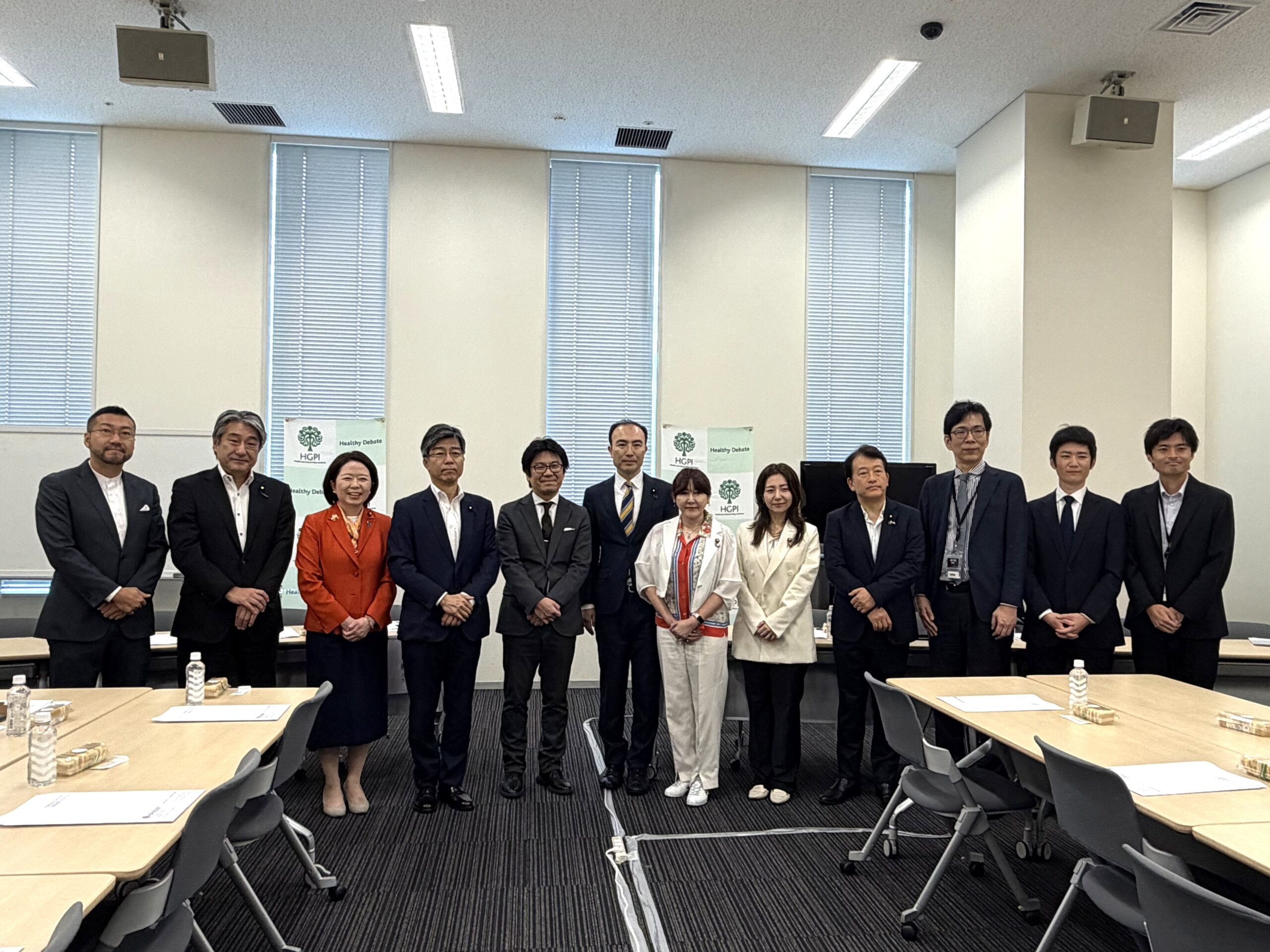
On the day of the visit, representing the Advisory Board of this initiative, Mr. Sho Okiyama, Founder and CEO, Aillis, Inc. / Representative Director, AI Safety Promotion Organization; Mr. Tomohiro Tada, Chairman of the Japan Association of Medical Artificial Intelligence Devices (JAMAID); Ms. Yukiko Nishimura, Executive Director of ASrid; Mr. Ryoji Noritake, Chair of HGPI; and Ms. Yui Kono, Manager at HGPI, visited Vice-Minister Niki.

![[Discussion Points] Positioning AI-Assisted Diagnosis as a Pillar of National Strategy: Multi-Stakeholder Discussion Points for a Sustainable Healthcare System](/assets/img/katsudo/icon_pdf_l.png)
Top Research & Recommendations Posts
Featured Posts
-
2026-05-18
[Registration Closed] Kick-off Panel Discussion “From Africa and Japan, Drawing from Perspectives Around the World:A Platform for Cultivating a Philosophical Health Dialogue Together” (June 15, 2026)
![[Registration Closed] Kick-off Panel Discussion “From Africa and Japan, Drawing from Perspectives Around the World:A Platform for Cultivating a Philosophical Health Dialogue Together” (June 15, 2026)](https://hgpi.org/en/wp-content/uploads/sites/2/HGPI_20260615_Eyecathch_panel-discussion-From-Japan-and-Africa-in-Discussion-with-the-World_2.png)
-
2026-08-28
[Announcement] The 3rd Kiyoshi Kurokawa Award: Call for Nominations (Deadline: November 30, 2026)
![[Announcement] The 3rd Kiyoshi Kurokawa Award: Call for Nominations (Deadline: November 30, 2026)](https://hgpi.org/en/wp-content/uploads/sites/2/Kiyoshi-Kurokawa-Award_3rd_nominations_eyecatch_caseB_ENG_web_20260929_v0.5.jpg)
-
2026-09-01
[Registration Closed] HGPI Salon 2025-2026 Looking Ahead to the Future of Japan’s Social Security System “Session 6: Japan’s Health Policy through the Lens of Global Security” (October 13, 2026)
![[Registration Closed] HGPI Salon 2025-2026 Looking Ahead to the Future of Japan’s Social Security System “Session 6: Japan’s Health Policy through the Lens of Global Security” (October 13, 2026)](https://hgpi.org/en/wp-content/uploads/sites/2/HGPISalon2025-20266.png)
-
2026-09-17
[Registration Open] (Webinar) The 145th HGPI Seminar “Toward Better AMR Measures at Elderly Care Facilities—Considering Infectious Disease Control in a Super-Aged Society From a Policy Perspective” (October 27, 2026)
![[Registration Open] (Webinar) The 145th HGPI Seminar “Toward Better AMR Measures at Elderly Care Facilities—Considering Infectious Disease Control in a Super-Aged Society From a Policy Perspective” (October 27, 2026)](https://hgpi.org/en/wp-content/uploads/sites/2/HGPIseminar145.png)
-
2026-10-06
[Registration Open] (Webinar) The 146th HGPI Seminar “How We Can Build a Society That Supports Choices Around Organ Donation: Exploring Decision-Making by Citizens and a Multi-Layered Approach Through Strategic Social Marketing” (November 9, 2026)
![[Registration Open] (Webinar) The 146th HGPI Seminar “How We Can Build a Society That Supports Choices Around Organ Donation: Exploring Decision-Making by Citizens and a Multi-Layered Approach Through Strategic Social Marketing” (November 9, 2026)](https://hgpi.org/en/wp-content/uploads/sites/2/HGPI_20261001_Eyecatch_HGPIseminer-146th-1.png)
