


[HGPI Policy Column] (No.68) – From the Intractable and Rare Diseases Project “Part 2 – Making Intractable and Rare Diseases a Priority Issue for the International Community: The WHA Resolution’s Vision for a Global Action Plan and Japan’s Role”
date : 1/26/2026

![[HGPI Policy Column] (No.68) – From the Intractable and Rare Diseases Project “Part 2 – Making Intractable and Rare Diseases a Priority Issue for the International Community: The WHA Resolution’s Vision for a Global Action Plan and Japan’s Role”](https://hgpi.org/en/wp-content/uploads/sites/2/Eyecatch_Column_RD_2-1.png)
<POINTS>
- In May 2025, Member States of the 78th World Health Assembly (WHA) adopted a Resolution on intractable and rare diseases that aims to eliminate global disparities in access to diagnosis, management, support, treatment, and research, and to promote equity and inclusion. To achieve these goals, the Resolution urges Member States to implement comprehensive approaches that are based on multisectoral and multilateral collaboration.
- The Resolution provides a starting point for linking developments in the international community to concrete change in each country and region. With this framework as a foundation, each country and region is encouraged to make steady progress on measures for intractable and rare diseases in its own national context.
- While leveraging basic national frameworks for intractable and rare diseases such as the Act on Medical Care for Patients with Intractable Diseases or the Basic Policy for Comprehensively Promoting Medical Care for Patients With Intractable Diseases, which has been revised repeatedly in accordance with that Act, expectations are high for Japan to further deepen societal understanding of intractable and rare diseases. It will also be vital to expand policies in a manner that involves collaboration among a diversity of actors in industry, government, academia, and civil society.
In our previous installment, we examined the background and significance of the Resolution on intractable and rare diseases adopted by Member States of the 78th World Health Assembly (WHA) and outlined its relationship to the 2021 United Nations Resolution on rare diseases. This second installment will examine the roles that the WHA Resolution expects of governments and the Director-General of the World Health Organization (WHO) as well as the new roles and possibilities that are open to Japan.
Directions set by the WHA Resolution
The WHA Resolution aims to ensure the needs and rights of people living with intractable and rare diseases are fully recognized by society, to ensure those parties receive fair treatment, and to ensure their wishes and decisions are respected. To achieve this, it urges Member States to launch collaborative initiatives in various fields and with diverse actors to reduce global disparities in access to diagnosis, management, support, treatment, and research.
At the same time, the Resolution outlines a global action framework specific to the health sector so each government can act with clear objectives and manage progress. Anticipation is high for the Resolution to advance progress on achieving Universal Health Coverage (UHC) in which no one is left behind and to manifest the future that is envisioned for the mid- to long-term. Such frameworks are likely to foster greater public understanding of intractable and rare diseases, accelerate diagnosis, encourage R&D and investments in new treatment methods, and reinforce the foundation for sharing resources and expertise around the world.
Actions requested of Member States by the WHA Resolution
While taking national context and priorities into account, the WHA Resolution strongly urges Member States to advance the initiatives described below. Here, we have summarized the main points of the desired actions.
- Support a global action plan: Provide the knowledge and resources necessary for the WHO to formulate a Global Action Plan on Rare Diseases (GAPRD) and proactively engage in that effort from the planning stage.
- Integration in national health planning: Integrate intractable and rare diseases into national health plans; formulate evidence-based policies for primary and secondary prevention, diagnosis, treatment, and social support; and implement concrete initiatives. In particular, ensure equitable access to timely, cost-effective, and accurate diagnosis through universal screening programs, including those for newborns.
- Expand measures for mental health and well-being for families and caregivers: Establish programs promoting mental health and psychosocial support for people living with intractable and rare diseases and policies and initiatives that elevate well-being for families and caregivers.
- Achieve UHC and reduce out-of-pocket burden: Accelerate initiatives for achieving UHC by 2030 and ensure all people, including those living with intractable and rare diseases, can access essential healthcare, medicines, diagnostics, health technologies, etc. throughout the life course. When doing so, reduce or eliminate economic hardships caused by high out-of-pocket health expenditure.
- Strengthen health systems, particularly primary healthcare: Strengthen health systems, especially primary healthcare, to provide universal access to a wide range of high-quality health services for people living with intractable and rare diseases, especially children.
- Promote human resource development and foster awareness: Include content on preventing, diagnosing, treating and managing intractable and rare diseases in pre-service education for students and in lifelong learning for healthcare professionals.
- Improve access to water, sanitation, and hygiene (WASH): Remove the physical, institutional, social and attitudinal obstacles for Water, Sanitation, and Hygiene (WASH) that prevent people living with intractable and rare diseases, families, and caregivers from accessing safe drinking water and hygienic environments, and achieve equitable access in both urban and rural areas.
- Utilize digital technologies: Improve access to specialists and treatment, especially in remote areas or areas where medical resources are limited, through the use of telemedicine, data-sharing platforms, and other digital technologies.
- Promote patient and public involvement: Promote the involvement of patient advocacy organizations and organizations led by people living with disabilities, including groups led by people living with intractable and rare diseases, in the policy-making process.
- Establish structures for governance: Establish dedicated national task forces or coordination bodies as appropriate to oversee the implementation of policies for intractable and rare diseases and to ensure accountability and effective management.
- Establish Centers of Excellence: Encourage the establishment of Centers of Excellence (CoE) to serve as specialized hubs for care, research, and training for intractable and rare diseases.
- Establish registries: Establish a national registry for intractable and rare diseases, or collaborate with existing international registries to strengthen data collection capacity, while respecting data protection and privacy.
- Consider implementing the ICD-11 and similar codification systems: Consider introducing the International Classification of Diseases, 11th edition (ICD-11) and interoperable codification systems such as the Orphanet nomenclature as early as possible to enable recording, reporting, and monitoring of intractable and rare diseases.
To promote comprehensive initiatives related to intractable and rare diseases in areas like R&D and innovation, the Resolution also urges Member States to strengthen collaboration among industry, government, academia, and civil society; to mobilize resources such as domestic and international public and private funds; to promote equitable and timely access to medicines; to maintain high-level political visibility in intractable and rare diseases; and to conduct regular evaluations on action plans and the implementation status of initiatives.
Actions requested of the Director-General of the WHO by the WHA Resolution
The WHA Resolution also expresses high expectations for the Director-General of the WHO to play a key role in advancing measures for intractable and rare diseases in the international community. For example, the Director-General is requested to summarize and analyze existing standards, guidelines, and protocols related to intractable and rare diseases and to prepare an initial technical report, as well as to establish an infrastructure utilizing artificial intelligence (AI) and other digital technologies.
The Director-General is also requested to develop and submit a GAPRD that is aligned with the WHO’s Global Health Strategy and Fourteenth General Programme of Work 2025–2028 (GPW14). The Resolution also requests that the GAPRD draft be submitted for discussion at the 162nd session of the WHO Executive Board in January 2028 with the aim of having it adopted at the 81st World Health Assembly, which is scheduled for May 2028. Finally, the Resolution requests that the Director-General submit periodic progress reports on initiatives outlined in the Resolution, including the formulation of the GAPRD, at the WHA over a five-year period from 2026 to 2030, starting with the 79th WHA in 2026, followed by the 81st WHA in 2028 and the 83rd WHA in 2030.
The position of the WHA Resolution in Japan
The WHA Resolution provides a key opportunity to link developments in the international community to concrete change in each country and region. While leveraging foundational frameworks for intractable and rare diseases such as the Act on Medical Care for Patients with Intractable Diseases or the Basic Policy for Comprehensively Promoting Medical Care for Patients with Intractable Diseases, which has been revised repeatedly in accordance with that Act, Japan should further deepen societal understanding toward intractable and rare diseases. Expanding policies through collaboration with a diversity of stakeholders representing industry, government, academia, and civil society will also be important.
Making it possible for all people living with intractable and rare diseases, families, and caregivers to receive early diagnosis and appropriate management to achieve fuller, healthier lives is a shared objective that surpasses the boundaries of countries and regions. Now more than ever, each of us must fulfill a role in our individual capacity to realize this objective.
Please note that the original English text of the WHA Resolution can be found at the WHO website here.
Authors
Favour Omileke (Program Specialist, HGPI)
Orie Yamashita (Associate, HGPI)
Yui Kohno (Manager, HGPI)
Related Posts
-
2026-01-13
[HGPI Policy Column] (No.67) — From the Intractable and Rare Diseases Project "Part 1 – Making Intractable and Rare Diseases a Priority Issue for the International Community: The WHA Resolution’s Vision for a Global Action Plan and Japan’s Role"
-
2025-04-11
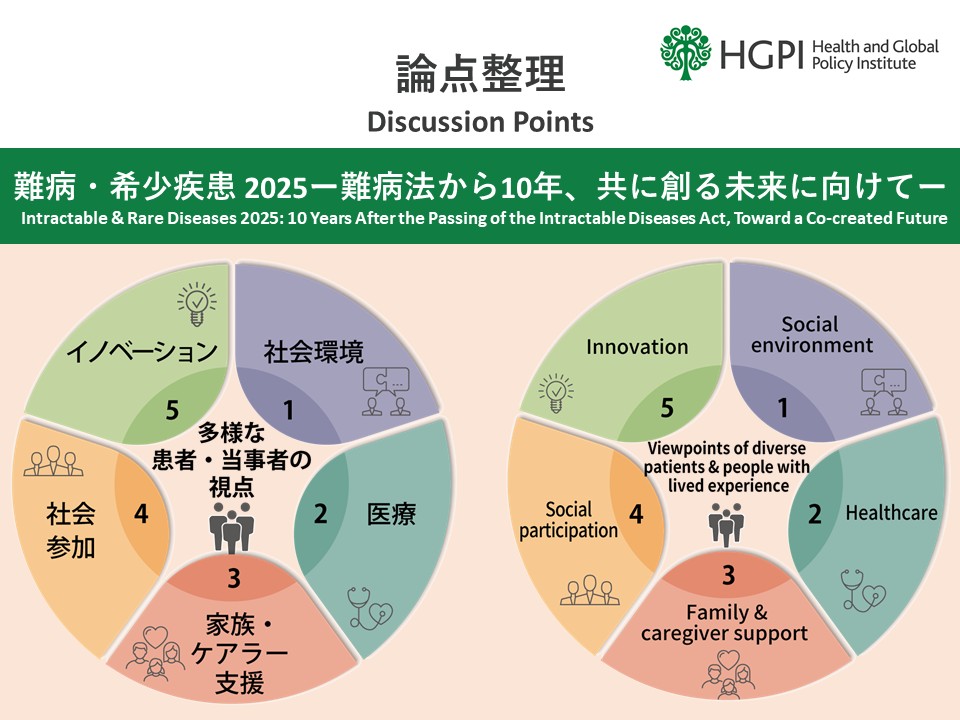
[Discussion Points] Intractable & Rare Diseases Project Discussion Paper “Intractable & Rare Diseases 2025: 10 Years After the Passing of the Intractable Diseases Act, Toward a Co-created Future” (March 28, 2025)
-
2024-08-23
[Event Report] Intractable Disease Day Symposium: Future Measures for Intractable Diseases from the Perspectives of Patients and Citizens (May, 23 2024)
-
2025-12-09
[HGPI Policy Column] (No.66) — From the Planetary Health Project “Part 16: The Global Plastics Treaty: Discourse on Human Health in International Environmental Law”
Top Research & Recommendations Posts
Featured Posts
-
2026-05-18
[Registration Closed] Kick-off Panel Discussion “From Africa and Japan, Drawing from Perspectives Around the World:A Platform for Cultivating a Philosophical Health Dialogue Together” (June 15, 2026)
![[Registration Closed] Kick-off Panel Discussion “From Africa and Japan, Drawing from Perspectives Around the World:A Platform for Cultivating a Philosophical Health Dialogue Together” (June 15, 2026)](https://hgpi.org/en/wp-content/uploads/sites/2/HGPI_20260615_Eyecathch_panel-discussion-From-Japan-and-Africa-in-Discussion-with-the-World_2.png)
-
2026-08-28
[Announcement] The 3rd Kiyoshi Kurokawa Award: Call for Nominations (Deadline: November 30, 2026)
![[Announcement] The 3rd Kiyoshi Kurokawa Award: Call for Nominations (Deadline: November 30, 2026)](https://hgpi.org/en/wp-content/uploads/sites/2/Kiyoshi-Kurokawa-Award_3rd_nominations_eyecatch_caseB_ENG_web_20260929_v0.5.jpg)
-
2026-09-01
[Registration Closed] HGPI Salon 2025-2026 Looking Ahead to the Future of Japan’s Social Security System “Session 6: Japan’s Health Policy through the Lens of Global Security” (October 13, 2026)
![[Registration Closed] HGPI Salon 2025-2026 Looking Ahead to the Future of Japan’s Social Security System “Session 6: Japan’s Health Policy through the Lens of Global Security” (October 13, 2026)](https://hgpi.org/en/wp-content/uploads/sites/2/HGPISalon2025-20266.png)
-
2026-09-17
[Registration Open] (Webinar) The 145th HGPI Seminar “Toward Better AMR Measures at Elderly Care Facilities—Considering Infectious Disease Control in a Super-Aged Society From a Policy Perspective” (October 27, 2026)
![[Registration Open] (Webinar) The 145th HGPI Seminar “Toward Better AMR Measures at Elderly Care Facilities—Considering Infectious Disease Control in a Super-Aged Society From a Policy Perspective” (October 27, 2026)](https://hgpi.org/en/wp-content/uploads/sites/2/HGPIseminar145.png)
-
2026-10-06
[Registration Open] (Webinar) The 146th HGPI Seminar “How We Can Build a Society That Supports Choices Around Organ Donation: Exploring Decision-Making by Citizens and a Multi-Layered Approach Through Strategic Social Marketing” (November 9, 2026)
![[Registration Open] (Webinar) The 146th HGPI Seminar “How We Can Build a Society That Supports Choices Around Organ Donation: Exploring Decision-Making by Citizens and a Multi-Layered Approach Through Strategic Social Marketing” (November 9, 2026)](https://hgpi.org/en/wp-content/uploads/sites/2/HGPI_20261001_Eyecatch_HGPIseminer-146th-1.png)
