


[Research Report] The 2023 Public Opinion Survey on Satisfaction in Healthcare in Japan and Healthcare Applications of Generative AI (January 11, 2024)
date : 1/11/2024

![[Research Report] The 2023 Public Opinion Survey on Satisfaction in Healthcare in Japan and Healthcare Applications of Generative AI (January 11, 2024)](https://hgpi.org/en/wp-content/uploads/sites/2/hc-survey-2023-top.jpg)
In December 2023, Health and Global Policy Institute (HGPI) conducted a nationwide survey titled, “The 2023 Public Opinion Survey on Satisfaction in Healthcare in Japan and Healthcare Applications of Generative AI” among 1,000 men and women 20 years of age and over.
[Summary of survey items]
- Items related to demographics: Age, gender, and location (region) of residence
- Satisfaction in healthcare: Overall satisfaction in healthcare and the healthcare system in Japan today, including healthcare access, healthcare safety, and decision-making related to the healthcare system (conducted since 2006)
- Generative AI: Current use of AI and generative AI and interest, expectations, and concerns toward healthcare applications of AI and generative AI
■ Key survey findings
Degree of satisfaction in healthcare
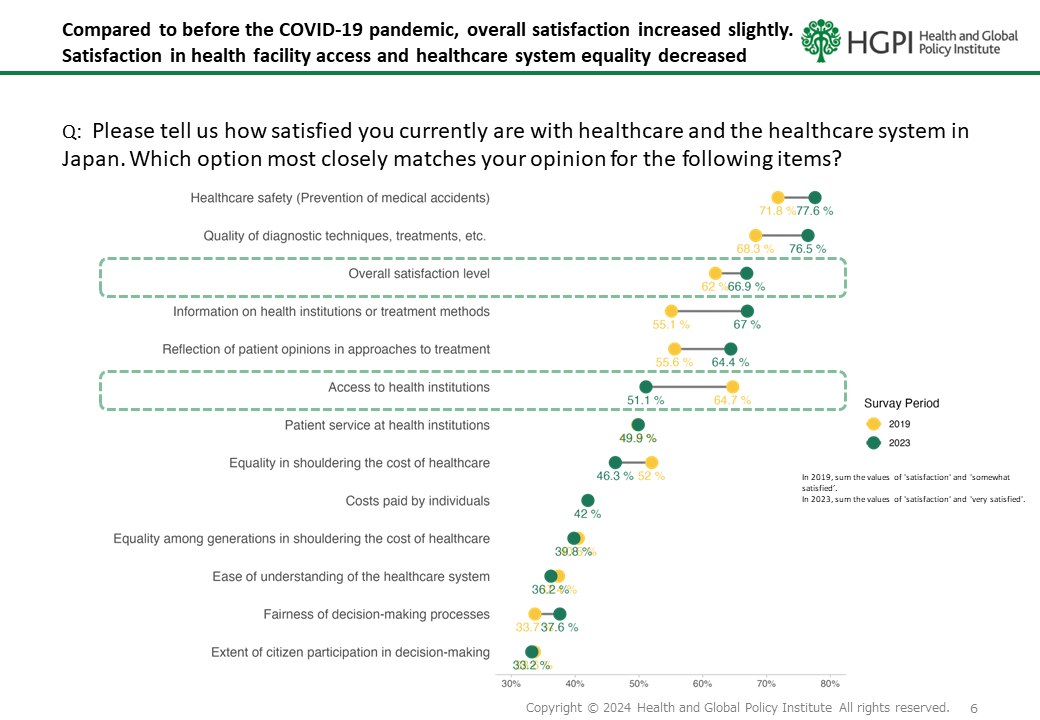
- Regarding overall satisfaction, over two-thirds (66.9%) of respondents were “Satisfied” or “Very satisfied” with healthcare in Japan. Comparing this finding to that of our survey conducted in 2019, before the Coronavirus Disease 2019 (COVID-19) pandemic, overall satisfaction increased slightly (from 62.0% to 66.9%).
- While overall satisfaction increased, satisfaction in “Access to healthcare facilities” decreased (from 64.7% to 51.1%).
Healthcare applications of generative AI
- Among all respondents, 12.2% use generative AI (Population: Japanese men and women 20 years of age and over)
- Around one-third (32.7%) said they are interested in healthcare applications of generative AI
- Over half (51.1%) think generative AI will enhance healthcare efficiency
- Half of respondents said their impression of healthcare applications of generative AI was neither positive nor negative
- When asked which aspects of healthcare applications of generative AI were concerning, 60.6% of respondents selected “Somewhat concerned” or “Strongly concerned” for “Liability for medical accidents,” making it the most frequent response selected
■ Future implications for healthcare in Japan based on findings
- The lack of change in satisfaction in healthcare before and after the COVID-19 pandemic suggests that the public has a high view of the pandemic response from domestic health institutions. Looking at satisfaction levels toward specific items, however, there was a decrease in satisfaction toward healthcare access. This may have been influenced by respondents’ awareness toward restrictions placed on medical examinations due to the COVID-19 pandemic or news reports on those restrictions. Future developments in domestic healthcare policy such as those related to work style reforms for physicians or the reporting system for family doctor services may transform the situation surrounding access to care. The effects of lower satisfaction in healthcare access on satisfaction in Japan’s healthcare system overall will require close attention in the future.
- Given these circumstances, there are growing expectations for healthcare applications of generative AI to streamline healthcare and improve services.
- A wide range applications of generative AI in healthcare are currently being examined, such as applications that may improve healthcare services through use among healthcare professionals or enhance access to medical information through use among patients. Interest in such applications of generative AI in healthcare were unrelated to respondent age and methods of effectively utilizing generative AI should be given further examination in the future.
- On the other hand, half of respondents said their impression of generative AI was neither positive nor negative, so it is easy to imagine scenarios in which technical issues or similar problems could cause people to distrust generative AI like when the system for using My Number cards as health insurance cards was introduced. Steps to establish systems for the utilization of generative AI in healthcare must be accelerated by clarifying which parties are responsible when medical accidents occur, by establishing rules for private personal information, and by assigning an administrative body. Those systems must be utilized in a manner that streamlines healthcare while maintaining trust.
[Survey Overview]
Survey period: From December 4, 2023 to December 7, 2023
Format: Online survey
Total number of surveys distributed: 13,004
Number of respondents: 1,502 (Response rate: 11.55%)
Number of responses collected: 1,000 (Collection ended once 1,000 valid responses were submitted)
Target: Japanese people 20 years of age and over
Sampling: Adjusted by age, gender, and place of residence
For details, please see the PDF below.
![[Research Report] The 2023 Public Opinion Survey on Satisfaction in Healthcare in Japan and Healthcare Applications of Generative AI](/assets/img/katsudo/icon_pdf_l.png)
Related Posts
-
2023-02-07
[Research Report] The Public Opinion Survey on Satisfaction in Healthcare and Public Involvement in Health Policy (February 7, 2023)
-
2019-12-16
[Research Report] 2019 Survey on Healthcare in Japan
-
2018-10-31
[Research Report] 2018 Survey on Healthcare in Japan
-
2018-02-08
[Research Report] 2017 Public Survey on Healthcare in Japan
-
2016-12-01
(Research Report) 2016 Public Opinion Survey on Healthcare Policy
Top Research & Recommendations Posts
Featured Posts
-
2026-05-18
[Registration Closed] Kick-off Panel Discussion “From Africa and Japan, Drawing from Perspectives Around the World:A Platform for Cultivating a Philosophical Health Dialogue Together” (June 15, 2026)
![[Registration Closed] Kick-off Panel Discussion “From Africa and Japan, Drawing from Perspectives Around the World:A Platform for Cultivating a Philosophical Health Dialogue Together” (June 15, 2026)](https://hgpi.org/en/wp-content/uploads/sites/2/HGPI_20260615_Eyecathch_panel-discussion-From-Japan-and-Africa-in-Discussion-with-the-World_2.png)
-
2026-08-28
[Announcement] The 3rd Kiyoshi Kurokawa Award: Call for Nominations (Deadline: November 30, 2026)
![[Announcement] The 3rd Kiyoshi Kurokawa Award: Call for Nominations (Deadline: November 30, 2026)](https://hgpi.org/en/wp-content/uploads/sites/2/Kiyoshi-Kurokawa-Award_3rd_nominations_eyecatch_caseB_ENG_web_20260929_v0.5.jpg)
-
2026-09-01
[Registration Closed] HGPI Salon 2025-2026 Looking Ahead to the Future of Japan’s Social Security System “Session 6: Japan’s Health Policy through the Lens of Global Security” (October 13, 2026)
![[Registration Closed] HGPI Salon 2025-2026 Looking Ahead to the Future of Japan’s Social Security System “Session 6: Japan’s Health Policy through the Lens of Global Security” (October 13, 2026)](https://hgpi.org/en/wp-content/uploads/sites/2/HGPISalon2025-20266.png)
-
2026-09-17
[Registration Open] (Webinar) The 145th HGPI Seminar “Toward Better AMR Measures at Elderly Care Facilities—Considering Infectious Disease Control in a Super-Aged Society From a Policy Perspective” (October 27, 2026)
![[Registration Open] (Webinar) The 145th HGPI Seminar “Toward Better AMR Measures at Elderly Care Facilities—Considering Infectious Disease Control in a Super-Aged Society From a Policy Perspective” (October 27, 2026)](https://hgpi.org/en/wp-content/uploads/sites/2/HGPIseminar145.png)
-
2026-10-06
[Registration Open] (Webinar) The 146th HGPI Seminar “How We Can Build a Society That Supports Choices Around Organ Donation: Exploring Decision-Making by Citizens and a Multi-Layered Approach Through Strategic Social Marketing” (November 9, 2026)
![[Registration Open] (Webinar) The 146th HGPI Seminar “How We Can Build a Society That Supports Choices Around Organ Donation: Exploring Decision-Making by Citizens and a Multi-Layered Approach Through Strategic Social Marketing” (November 9, 2026)](https://hgpi.org/en/wp-content/uploads/sites/2/HGPI_20261001_Eyecatch_HGPIseminer-146th-1.png)
