


[Event Report] Online Seminar “Implementing Chronic Kidney Disease (CKD) Measures into Society: Towards a Data-Driven Health System” (April 21, 2026)
date : 5/29/2026
Tags: Kidney Disease, NCDs

![[Event Report] Online Seminar “Implementing Chronic Kidney Disease (CKD) Measures into Society: Towards a Data-Driven Health System” (April 21, 2026)](https://hgpi.org/en/wp-content/uploads/sites/2/HGPI_20260421_CKDonlineseminar-1-1.png)
Health and Global Policy Institute Kidney Disease Project held Online Seminar entitled “Implementing Chronic Kidney Disease (CKD) Measures into Society: Towards a Data-Driven Health System”. We welcomed Dr. Shingo Fukuma, Advisory Board Member and Research Fellow of the HGPI Kidney Disease Project, who delivered a lecture on the perspectives and policy directions needed in the CKD field going forward. Reflecting on the achievements of the Kidney Disease Project in FY2025, the speaker provided a comprehensive overview of the current systems and healthcare services linking post-checkup identification to medical treatment, as well as the challenges underlined by big data analysis, incorporating the latest evidence.
<POINTS>
• In Japan, systems for the early detection of CKD are gradually being established, including the addition of serum creatinine testing to routine health checkups under the Industrial Safety and Health Act. However, even when impaired kidney function is identified through health checkups, only around 3% of individuals subsequently visit a medical institution for CKD care, thereby highlighting that “measurement” does not automatically lead to improved health outcomes.
• Of every 1,000 people identified as having CKD, only around 30 ultimately receive appropriate medical care. The greatest loss in this stepwise drop-off, or “care cascade,” occurs before individuals are formally diagnosed with CKD, that is, in areas beyond the scope of healthcare services.
• The reasons for non-attendance and lack of treatment should not be viewed simply as problems attributable to individual patients. Rather, they should be reconsidered as structural and systematic issues arising from the absence of effective “linkage design” connecting health checkups to medical care, and medical care to appropriate treatment provision.
• In collaboration with insurers, a randomized controlled trial was conducted to evaluate consultation recommendation notices incorporating insights from behavioral science, such as loss aversion, simplified behavioral choices, and commitment strategies. The results showed an approximately four-percentage-point increase in consultation rates, along with improved implementation rates for recommended tests. These findings demonstrated that thoughtful design improvements can enhance the quality of healthcare delivery and provision without requiring large-scale systemic reform.
• Although one-time intervention studies demonstrated positive effects, embedding these approaches into healthcare systems as sustainable practices is essential to ensure continuity and measurability. Based on the concept of a Learning Health System, there is a need to establish mechanisms that continuously cycle through identifying challenges using data, implementing evidence-informed interventions, evaluating outcomes, and refining approaches accordingly.
• Rather than optimizing each component, namely screening, consultation recommendations, clinical care, and behavior change, individually, an integrated design that considers and spans the entire continuum is indispensable. To implement, evaluate, and improve such a design, it is necessary to establish a collaborative foundation in which insurers, local governments, healthcare providers, researchers, and private-sector organizations work together to continuously operate this cycle.
A recording of the online seminar is available at the link below. *Japanese only
[Event Overview]
- Speaker: Dr. Shingo Fukuma (Professor, Department of Epidemiology, Disease Control and Prevention, Hiroshima University Graduate School of Biomedical and Health Sciences/ Professor, Human Health Sciences, Kyoto University Graduate School of Medicine)
- Date & Time: Tuesday, April 21, 2026; 18:30-19:45 JST
- Format: Online (Zoom webinar)
- Language: Japanese
- Participation Fee: Free
- Capacity: 500 participants
■ Speaker’s Profile
Dr. Shingo Fukuma (Professor, Department of Epidemiology, Disease Control and Prevention, Hiroshima University Graduate School of Biomedical and Health Sciences/ Professor, Human Health Sciences, Kyoto University Graduate School of Medicine)
Dr. Shingo Fukuma specializes in clinical epidemiology and data-driven implementation science. He graduated from the Faculty of Medicine at Hiroshima University and completed his doctoral studies in Social Health Medicine at the Kyoto University Graduate School of Medicine. He subsequently served as Assistant Professor, Lecturer, and Associate Professor at Kyoto University Graduate School of Medicine. Since 2024, he has held the position of Professor of Epidemiology and Disease Control at the Graduate School of Biomedical and Health Sciences, Hiroshima University. His research focuses on causal inference using quasi-experimental approaches with large-scale health and medical data, real-world randomized controlled trials (RCTs), and the development of Learning Health Systems (LHS). Centered on chronic kidney disease (CKD) and the prevention of lifestyle-related diseases, his work aims to improve the quality of healthcare, promote positive health behaviors among patients and the public, and advance the design of healthcare and public health systems. He leads implementation research in collaboration with insurers, municipalities, and research institutions both in Japan and internationally.
Related Posts
-
2026-03-11
[Event Report] The 142nd HGPI Seminar “World Kidney Day 2026” Theme in Focus: The Current State of Green Nephrology and Green Dialysis—Balancing Kidney Health and Planetary Health (March 10, 2026)
-
2026-02-04
[Event Report] Advisory Board Meeting “Toward Reliable Policy Implementation for Early Detection and Early Intervention of Chronic Kidney Disease (CKD) in the Occupational Health Sector” (January 27, 2026)
-
2025-12-10
[Event Report] Advisory Board Meeting “Toward Reliable Policy Implementation for Early Detection and Early Intervention of Chronic Kidney Disease (CKD) at the Local Governments” (November 13, 2025)
-
2025-10-06
[Recommendations] Kidney Disease Control Promotion Project “Policy Recommendations on Strengthening Chronic Kidney Disease Strategies: Challenges and Solutions in Seeking Medical Care from the Perspective of Patients and Those Affected” (July 9, 2025)
-
2025-06-04
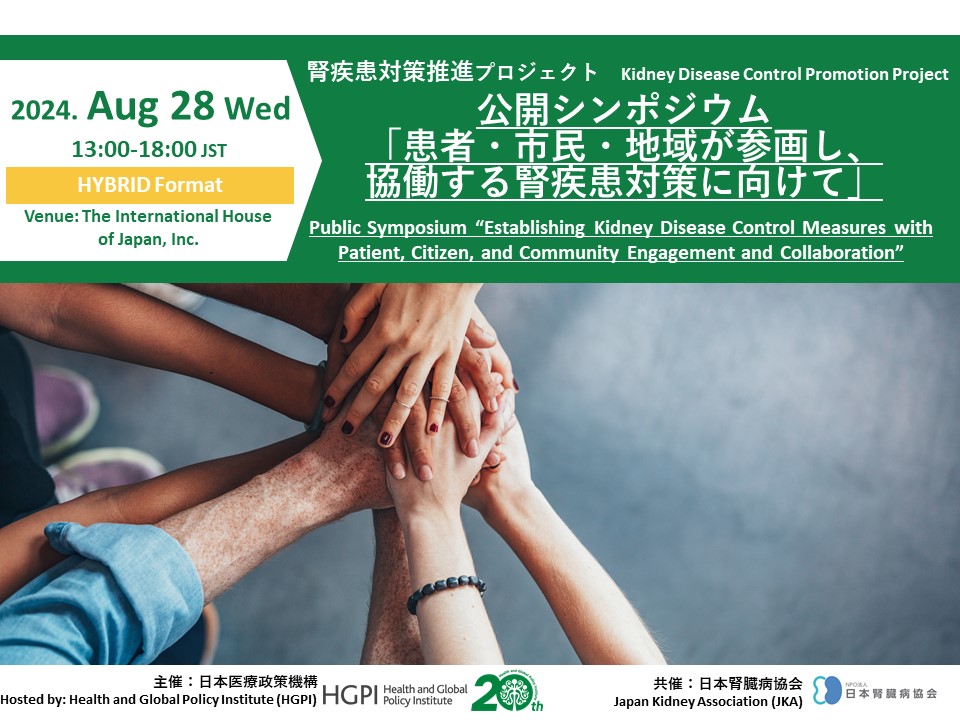
[Event Report] Kidney Disease Control Promotion Project Public Symposium “Establishing Kidney Disease Control Measures with Patient, Citizen, and Community Engagement and Collaboration” (August 28, 2024)
Top Research & Recommendations Posts
Featured Posts
-
2026-05-18
[Registration Closed] Kick-off Panel Discussion “From Africa and Japan, Drawing from Perspectives Around the World:A Platform for Cultivating a Philosophical Health Dialogue Together” (June 15, 2026)
![[Registration Closed] Kick-off Panel Discussion “From Africa and Japan, Drawing from Perspectives Around the World:A Platform for Cultivating a Philosophical Health Dialogue Together” (June 15, 2026)](https://hgpi.org/en/wp-content/uploads/sites/2/HGPI_20260615_Eyecathch_panel-discussion-From-Japan-and-Africa-in-Discussion-with-the-World_2.png)
-
2026-08-28
[Announcement] The 3rd Kiyoshi Kurokawa Award: Call for Nominations (Deadline: November 30, 2026)
![[Announcement] The 3rd Kiyoshi Kurokawa Award: Call for Nominations (Deadline: November 30, 2026)](https://hgpi.org/en/wp-content/uploads/sites/2/Kiyoshi-Kurokawa-Award_3rd_nominations_eyecatch_caseB_ENG_web_20260929_v0.5.jpg)
-
2026-09-01
[Registration Closed] HGPI Salon 2025-2026 Looking Ahead to the Future of Japan’s Social Security System “Session 6: Japan’s Health Policy through the Lens of Global Security” (October 13, 2026)
![[Registration Closed] HGPI Salon 2025-2026 Looking Ahead to the Future of Japan’s Social Security System “Session 6: Japan’s Health Policy through the Lens of Global Security” (October 13, 2026)](https://hgpi.org/en/wp-content/uploads/sites/2/HGPISalon2025-20266.png)
-
2026-09-17
[Registration Open] (Webinar) The 145th HGPI Seminar “Toward Better AMR Measures at Elderly Care Facilities—Considering Infectious Disease Control in a Super-Aged Society From a Policy Perspective” (October 27, 2026)
![[Registration Open] (Webinar) The 145th HGPI Seminar “Toward Better AMR Measures at Elderly Care Facilities—Considering Infectious Disease Control in a Super-Aged Society From a Policy Perspective” (October 27, 2026)](https://hgpi.org/en/wp-content/uploads/sites/2/HGPIseminar145.png)
-
2026-10-06
[Registration Open] (Webinar) The 146th HGPI Seminar “How We Can Build a Society That Supports Choices Around Organ Donation: Exploring Decision-Making by Citizens and a Multi-Layered Approach Through Strategic Social Marketing” (November 9, 2026)
![[Registration Open] (Webinar) The 146th HGPI Seminar “How We Can Build a Society That Supports Choices Around Organ Donation: Exploring Decision-Making by Citizens and a Multi-Layered Approach Through Strategic Social Marketing” (November 9, 2026)](https://hgpi.org/en/wp-content/uploads/sites/2/HGPI_20261001_Eyecatch_HGPIseminer-146th-1.png)
