


[Recommendations] Kidney Disease Control Promotion Project “Policy Recommendations on Strengthening Chronic Kidney Disease Strategies: Challenges and Solutions in Seeking Medical Care from the Perspective of Patients and Those Affected” (July 9, 2025)
date : 10/6/2025
Tags: Kidney Disease, NCDs

![[Recommendations] Kidney Disease Control Promotion Project “Policy Recommendations on Strengthening Chronic Kidney Disease Strategies: Challenges and Solutions in Seeking Medical Care from the Perspective of Patients and Those Affected” (July 9, 2025)](https://hgpi.org/en/wp-content/uploads/sites/2/ckd-ncd-20250709-top_ENG.png)
*A Recommendations paper written in English and its summary paper are published on October 6, 2025.
Health and Global Policy Institute (HGPI) launched the Kidney Disease Control Promotion Project in fiscal year 2022, and has since generated recommendations regarding the necessity of prevention and early intervention for Chronic Kidney Disease (CKD), the importance of collaboration among various professions and institutions, the need for lateral expansion of good practices by local governments, and the necessity of promoting kidney disease countermeasures based on the perspective of patients and those affected.
A study using data from the Health Insurance Association for Architecture and Civil Engineering Companies revealed that among approximately 70,000 people who underwent Specific Health Checkups in fiscal year 2014 and were newly diagnosed with CKD, only about 5% visited a healthcare institution for consultation, while approximately 95% did not. However, there are few studies that have quantitatively analyzed the differences between individuals who did not seek medical consultation after health checkup results indicating CKD, and those who did, using health checkup data, health checkup questionnaires, and health insurance claims data.
In light of this, the institute conducted a Quantitative Survey (part III) and a Qualitative Interview Survey (part IV) with the aim of clarifying the options, decisions, and difficulties experienced by individuals with health checkup findings suggestive of CKD in the process from checkup to treatment. Based on the results of these surveys, an Advisory Board Meeting was held on March 18, 2025, bringing together nephrologists and specialists in occupational health, public health, and health economics. The meeting served to deepen discussions on how to improve future CKD countermeasures, such as examining the target groups for whom post-checkup treatment recommendations should be intensified, and the results were compiled as Policy Recommendations (part V).
Recommendations
- Standards for recommending consultation in cases with suspected CKD under the current health checkup system are applied in a one-size-fits-all manner, and do not adequately account for diverse medical conditions, circumstances such as comorbidities or the degree of reduced kidney function and proteinuria. As such, they are not necessarily effective standards for promoting medical consultation that reflects a patient’s risk of further reduced kidney function. It is therefore necessary to provide consultation recommendations that take into account the comorbidities and risk factors present at the time of health checkup. Evidence-based standards for consultation recommendations should be formulated and unified in interdisciplinary discussions among specialists from a variety of fields.
- CKD presents few subjective symptoms in its early stages, and the population presenting findings suggestive of the disease varies widely in attributes such as age, sex, and socioeconomic circumstances.
- In treating non-communicable diseases (NCDs) including CKD, it is necessary to clarify roles and develop a system applicable across a wide range of diseases that facilitates coordination among clinical departments and disciplines. At the same time, ICT and health professional education should be promoted to ensure that medical care and prescription in all healthcare settings take patients’ kidney function into account.
- It is necessary to collect accumulate lifetime medical and checkup data, organize the data to facilitate long-term kidney function monitoring, and issue appropriate consultation recommendations in response to changes in patients’ conditions.
- It is necessary build momentum in society for evidence-based measures against kidney disorders by through multi-disciplinary and multi-specialist collaboration and cooperation coordinating among specialists across disciplines to generate research results with a focus on consultation-seeking behavior and health disparities, while visualizing the cost-effectiveness of early detection and intervention and reflecting the figures in evaluation metrics.
- To ensure that people found to have proteinuria or reduced kidney function in health checkups seek appropriate treatment, it is necessary to raise awareness from a patient-centered standpoint by providing evidence-based information and guidance on where to seek medical consultation, in collaboration coordination with insurers, occupational physicians, and other professionals.
For details, please view the PDF provided bottom.
![[Recommendations-Summary] Policy Recommendations on Strengthening Chronic Kidney Disease Strategies: Challenges and Solutions in Seeking Medical Care from the Perspective of Patients and Those Affected](/assets/img/katsudo/icon_pdf_l.png)
Related Posts
-
2025-04-25
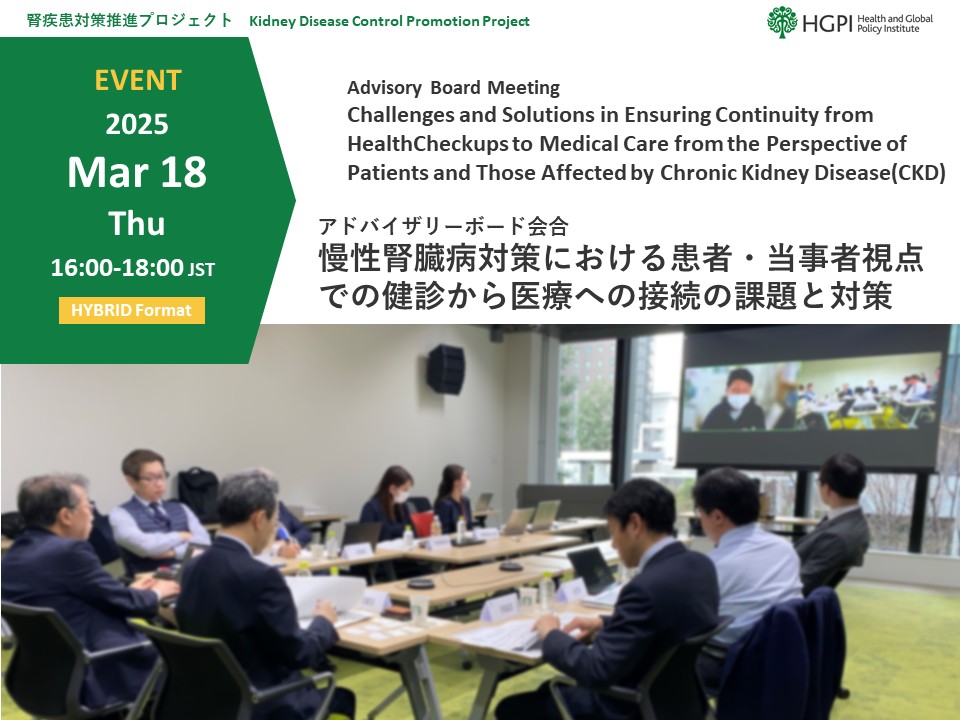
[Event Report] Advisory Board Meeting "Challenges and Solutions in Ensuring Continuity from Health Checkups to Medical Care from the Perspective of Patients and Those Affected by Chronic Kidney Disease (CKD)" (March 18, 2025)
-
2025-06-04
[Event Report] Kidney Disease Control Promotion Project Public Symposium “Establishing Kidney Disease Control Measures with Patient, Citizen, and Community Engagement and Collaboration” (August 28, 2024)
-

2025-04-10
[Lecture Report] Patient Consensus Summit for Chronic and Rare Kidney Diseases (CompCure, January 26, 27, 2025, Brussels, Belgium)
-
2025-03-13
[HGPI Policy Column] (No.54) From the Kidney Disease Control Promotion Project “The Promotion of Kidney Disease Measures Through Multi-Stakeholder Collaboration”
-
2024-12-18
[Policy Recommendations] Policy Recommendations on Strengthening CKD Strategies for Workers: The Importance of Providing Early Detection, Intervention, and Support Through Screenings and Medical Visits (October 28, 2024)
-
2024-07-17
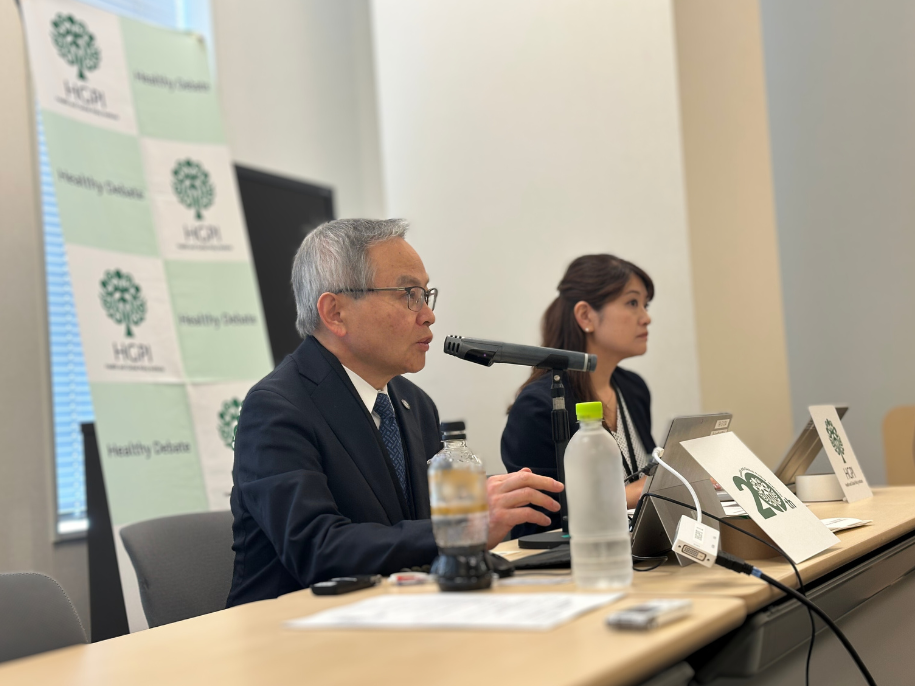
[Event Report] Non-partisan Diet Member Briefing – 30-minute Health Policy Update: “Towards Overcoming Kidney Disease: Strengthening Measures Against CKD” (June 7, 2024)
Top Research & Recommendations Posts
Featured Posts
-
2026-05-18
[Registration Closed] Kick-off Panel Discussion “From Africa and Japan, Drawing from Perspectives Around the World:A Platform for Cultivating a Philosophical Health Dialogue Together” (June 15, 2026)
![[Registration Closed] Kick-off Panel Discussion “From Africa and Japan, Drawing from Perspectives Around the World:A Platform for Cultivating a Philosophical Health Dialogue Together” (June 15, 2026)](https://hgpi.org/en/wp-content/uploads/sites/2/HGPI_20260615_Eyecathch_panel-discussion-From-Japan-and-Africa-in-Discussion-with-the-World_2.png)
-
2026-08-28
[Announcement] The 3rd Kiyoshi Kurokawa Award: Call for Nominations (Deadline: November 30, 2026)
![[Announcement] The 3rd Kiyoshi Kurokawa Award: Call for Nominations (Deadline: November 30, 2026)](https://hgpi.org/en/wp-content/uploads/sites/2/Kiyoshi-Kurokawa-Award_3rd_nominations_eyecatch_caseB_ENG_web_20260929_v0.5.jpg)
-
2026-09-01
[Registration Closed] HGPI Salon 2025-2026 Looking Ahead to the Future of Japan’s Social Security System “Session 6: Japan’s Health Policy through the Lens of Global Security” (October 13, 2026)
![[Registration Closed] HGPI Salon 2025-2026 Looking Ahead to the Future of Japan’s Social Security System “Session 6: Japan’s Health Policy through the Lens of Global Security” (October 13, 2026)](https://hgpi.org/en/wp-content/uploads/sites/2/HGPISalon2025-20266.png)
-
2026-09-17
[Registration Open] (Webinar) The 145th HGPI Seminar “Toward Better AMR Measures at Elderly Care Facilities—Considering Infectious Disease Control in a Super-Aged Society From a Policy Perspective” (October 27, 2026)
![[Registration Open] (Webinar) The 145th HGPI Seminar “Toward Better AMR Measures at Elderly Care Facilities—Considering Infectious Disease Control in a Super-Aged Society From a Policy Perspective” (October 27, 2026)](https://hgpi.org/en/wp-content/uploads/sites/2/HGPIseminar145.png)
-
2026-10-06
[Registration Open] (Webinar) The 146th HGPI Seminar “How We Can Build a Society That Supports Choices Around Organ Donation: Exploring Decision-Making by Citizens and a Multi-Layered Approach Through Strategic Social Marketing” (November 9, 2026)
![[Registration Open] (Webinar) The 146th HGPI Seminar “How We Can Build a Society That Supports Choices Around Organ Donation: Exploring Decision-Making by Citizens and a Multi-Layered Approach Through Strategic Social Marketing” (November 9, 2026)](https://hgpi.org/en/wp-content/uploads/sites/2/HGPI_20261001_Eyecatch_HGPIseminer-146th-1.png)
