


[Research Report] The 2026 Public Opinion Survey on Healthcare in Japan (February 13, 2026)
date : 2/13/2026

![[Research Report] The 2026 Public Opinion Survey on Healthcare in Japan (February 13, 2026)](https://hgpi.org/en/wp-content/uploads/sites/2/HGPI_The2026PublicOpinionSurveyOnHealthcareInJapan_20260213.jpg)
From December 2025 to January 2026, Health and Global Policy Institute (HGPI) conducted a nationwide public opinion survey of 1,000 men and women age 20 years and over. Since 2006, HGPI has regularly conducted public opinion surveys on issues surrounding healthcare and health policy to understand the needs of the public.
In addition to gauging public satisfaction in healthcare as in previous years, this year’s survey included new questions on items such as health management, the use of healthcare services, attitudes toward self-medication, and the future that citizens envision for the healthcare system.
[Survey overview]
- Target demographic: Men and women age 20 and older and living in Japan
- Study format: Online survey
- Total surveys distributed: 33,985
- Responses: 1,587 (Response rate: 4.66%)
- Valid responses: 1,000 (Collection ended once 1,000 valid responses were submitted)
- Survey period: From December 26, 2025 to January 5, 2026
- Sampling: Adjusted by region, age group, and gender
[Overview of survey items]
- Survey participants
- Respondent information
- Satisfaction with healthcare and the healthcare system in Japan
- Health-related habits and healthcare service usage
- Attitudes and values related to health
- Future prospects for the healthcare system
Key survey findings
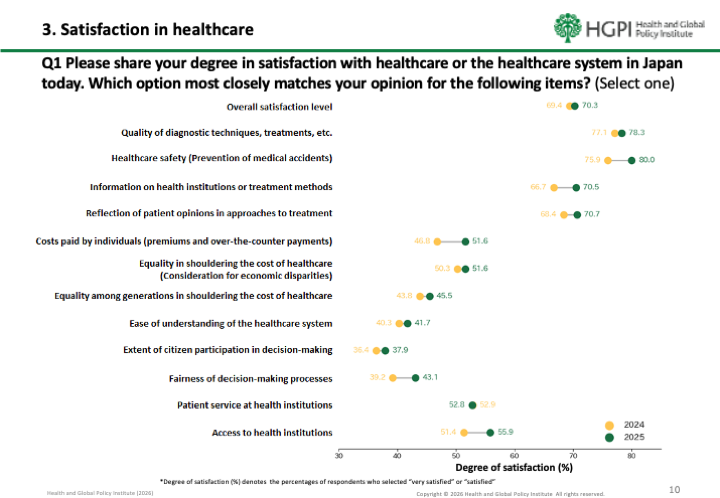
Seventy percent of respondents were satisfied with healthcare and the healthcare system overall
- Seventy percent of respondents selected “satisfied” or “very satisfied” for “quality of diagnostic techniques, treatments, etc.,” “healthcare safety (prevention of medical accidents),” “information on health institutions or treatment methods,” and “reflection of patient opinions in approaches to treatment.”
- Meanwhile, the only item for which less than 40% of respondents selected “satisfied” or “very satisfied” was “extent of citizen participation in decision-making.”
(Click the image to view an enlarged version.)
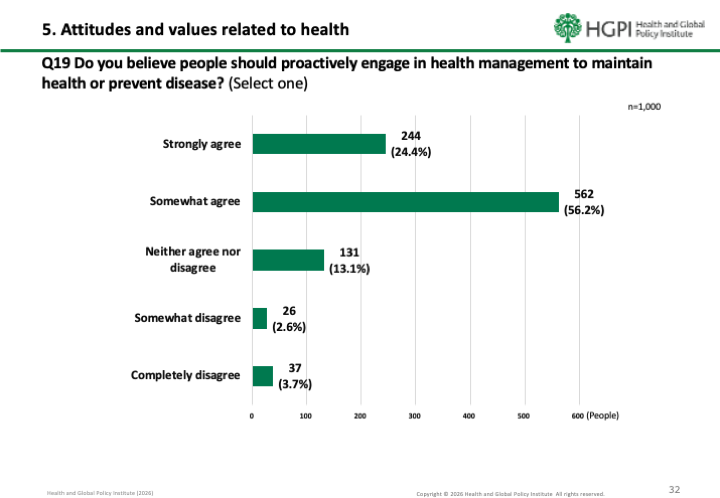
While 80% of respondents feel that people should engage in health management to maintain their own health and prevent disease, only 60% reported attending a medical examination in the past year
- Seventy percent of respondents said they had paid some or a great amount of attention to health management (diet, sleep, exercise, etc.) over the past year.
- Forty percent of respondents record their own health data by hand or with apps. The most popular reasons for doing so were “to track my physical condition,” “to review my daily lifestyle habits,” and “to share with a physician or other healthcare professional at examinations.”
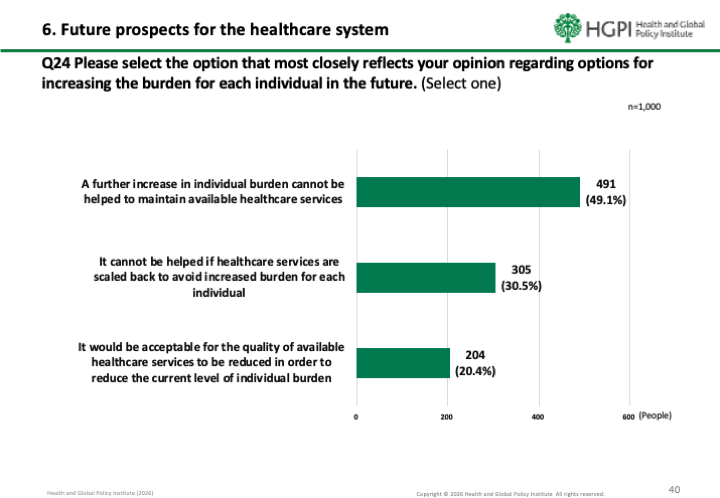
When asked about the future they envision for benefits and burdens in healthcare services, half of respondents said, “A further increase in individual burden cannot be helped to maintain available healthcare services.”
- When asked which forms of increased burden are most acceptable, the most popular response was “out-of-pocket costs at the hospital counter,” followed by “health insurance premiums.”
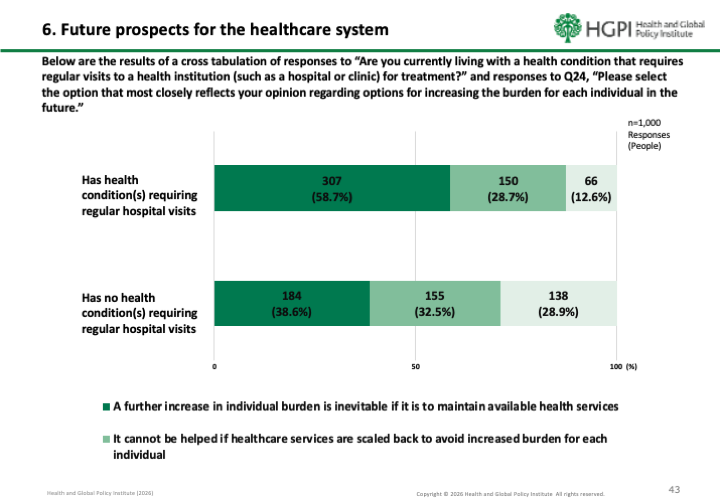
- Among respondents who believe that increased burden is unavoidable to maintain available healthcare services, 60% regularly visit medical facilities while 40% do not.
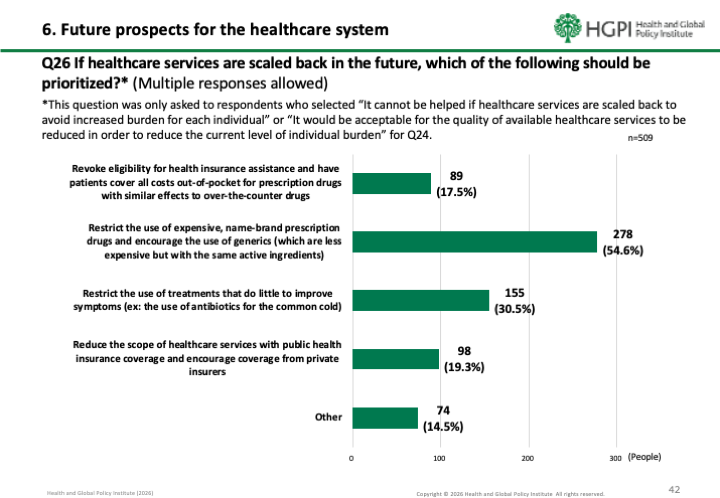
The most popular options to prioritize if healthcare services are scaled back in the future were “encourage the use of generic pharmaceuticals” and “restrict low-value care”
- Respondents who indicated that they would accept scaled-back healthcare services in the future were also asked which items should be prioritized if that were to occur. The most popular responses were “restrict the use of expensive, name-brand prescription drugs and encourage the use of generics” (50%) followed by “restrict the use of treatments that do little to improve symptoms (ex: the use of antibiotics for the common cold)” (30%).
- On the other hand, only 20% of respondents said, “Revoke eligibility for health insurance assistance and have patients cover all costs out-of-pocket for prescription drugs with similar effects to over-the-counter drugs.”
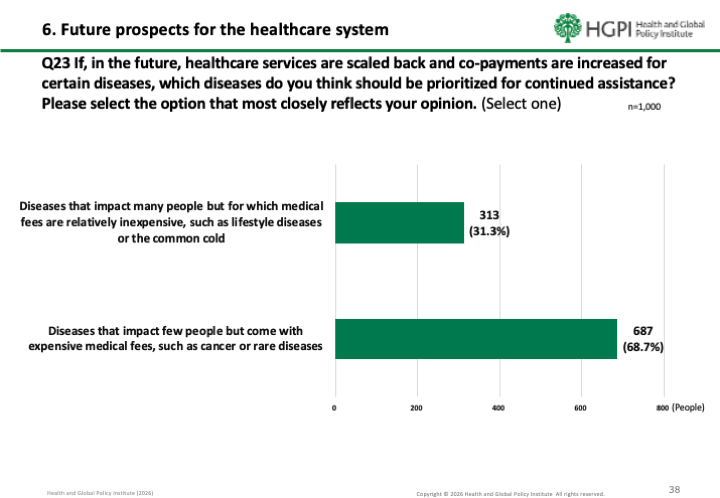
When asked which items should be prioritized when distributing assistance in the future, 70% of respondents said, “Diseases that impact few people but come with expensive medical fees.”
- While 70% of respondents said that “diseases that impact few people but come with expensive medical fees, such as cancer or rare diseases” should be prioritized when deciding where to retain assistance in the event of cutbacks, only 30% said that priority should be given to “diseases that impact many people but for which medical fees are relatively inexpensive, such as lifestyle diseases or the common cold.”
- These options were selected in similar ratios regardless of whether respondents made regular visits to medical facilities or not.
For details, please see the PDF linked below.
![[Research Report] The 2026 Public Opinion Survey on Healthcare in Japan](/assets/img/katsudo/icon_pdf_l.png)
Related Posts
-

2025-03-17
[Research Report] The 2025 Public Opinion Survey on Healthcare in Japan (March 17, 2025)
-
2024-01-11
[Research Report] The 2023 Public Opinion Survey on Satisfaction in Healthcare in Japan and Healthcare Applications of Generative AI (January 11, 2024)
-
2023-02-07
[Research Report] The Public Opinion Survey on Satisfaction in Healthcare and Public Involvement in Health Policy (February 7, 2023)
-
2022-08-12
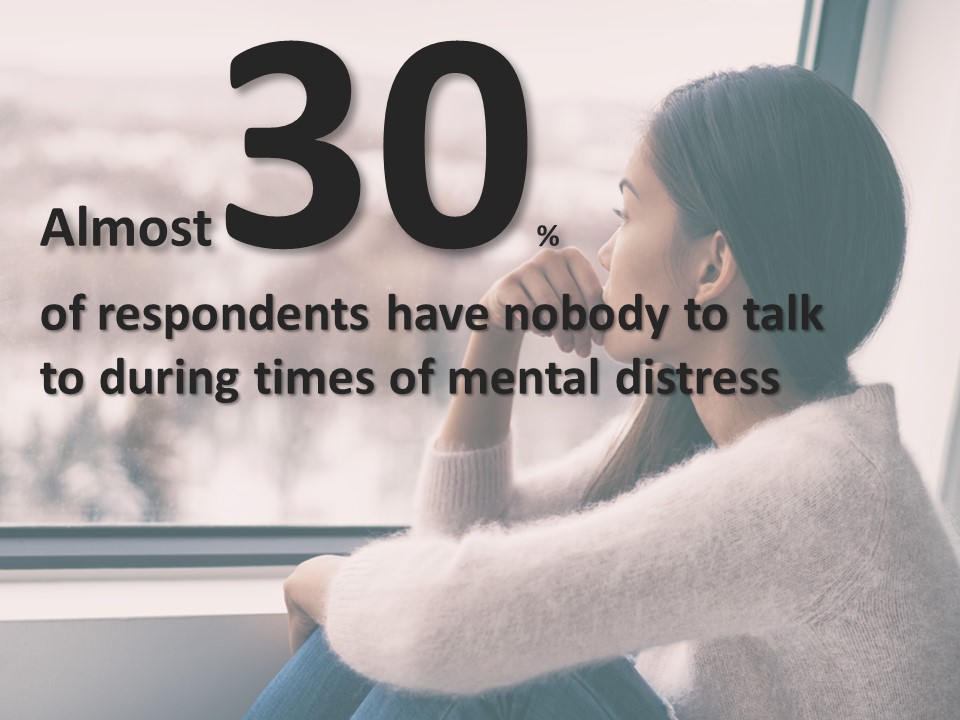
[Research Report] The Public Opinion Survey on Mental Health (August 12, 2022)
-
2019-12-16
[Research Report] 2019 Survey on Healthcare in Japan
-
2018-10-31
[Research Report] 2018 Survey on Healthcare in Japan
-
2018-02-08
[Research Report] 2017 Public Survey on Healthcare in Japan
Top Research & Recommendations Posts
Featured Posts
-
2026-05-18
[Registration Closed] Kick-off Panel Discussion “From Africa and Japan, Drawing from Perspectives Around the World:A Platform for Cultivating a Philosophical Health Dialogue Together” (June 15, 2026)
![[Registration Closed] Kick-off Panel Discussion “From Africa and Japan, Drawing from Perspectives Around the World:A Platform for Cultivating a Philosophical Health Dialogue Together” (June 15, 2026)](https://hgpi.org/en/wp-content/uploads/sites/2/HGPI_20260615_Eyecathch_panel-discussion-From-Japan-and-Africa-in-Discussion-with-the-World_2.png)
-
2026-08-28
[Announcement] The 3rd Kiyoshi Kurokawa Award: Call for Nominations (Deadline: November 30, 2026)
![[Announcement] The 3rd Kiyoshi Kurokawa Award: Call for Nominations (Deadline: November 30, 2026)](https://hgpi.org/en/wp-content/uploads/sites/2/Kiyoshi-Kurokawa-Award_3rd_nominations_eyecatch_caseB_ENG_web_20260929_v0.5.jpg)
-
2026-09-01
[Registration Closed] HGPI Salon 2025-2026 Looking Ahead to the Future of Japan’s Social Security System “Session 6: Japan’s Health Policy through the Lens of Global Security” (October 13, 2026)
![[Registration Closed] HGPI Salon 2025-2026 Looking Ahead to the Future of Japan’s Social Security System “Session 6: Japan’s Health Policy through the Lens of Global Security” (October 13, 2026)](https://hgpi.org/en/wp-content/uploads/sites/2/HGPISalon2025-20266.png)
-
2026-09-17
[Registration Open] (Webinar) The 145th HGPI Seminar “Toward Better AMR Measures at Elderly Care Facilities—Considering Infectious Disease Control in a Super-Aged Society From a Policy Perspective” (October 27, 2026)
![[Registration Open] (Webinar) The 145th HGPI Seminar “Toward Better AMR Measures at Elderly Care Facilities—Considering Infectious Disease Control in a Super-Aged Society From a Policy Perspective” (October 27, 2026)](https://hgpi.org/en/wp-content/uploads/sites/2/HGPIseminar145.png)
-
2026-10-06
[Registration Open] (Webinar) The 146th HGPI Seminar “How We Can Build a Society That Supports Choices Around Organ Donation: Exploring Decision-Making by Citizens and a Multi-Layered Approach Through Strategic Social Marketing” (November 9, 2026)
![[Registration Open] (Webinar) The 146th HGPI Seminar “How We Can Build a Society That Supports Choices Around Organ Donation: Exploring Decision-Making by Citizens and a Multi-Layered Approach Through Strategic Social Marketing” (November 9, 2026)](https://hgpi.org/en/wp-content/uploads/sites/2/HGPI_20261001_Eyecatch_HGPIseminer-146th-1.png)
