


[HGPI Policy Column] (No.67) — From the Intractable and Rare Diseases Project “Part 1 – Making Intractable and Rare Diseases a Priority Issue for the International Community: The WHA Resolution’s Vision for a Global Action Plan and Japan’s Role”
date : 1/13/2026
Tags: HGPI Policy Column, Intractable & Rare Diseases, Other Activities

![[HGPI Policy Column] (No.67) — From the Intractable and Rare Diseases Project “Part 1 – Making Intractable and Rare Diseases a Priority Issue for the International Community: The WHA Resolution’s Vision for a Global Action Plan and Japan’s Role”](https://hgpi.org/en/wp-content/uploads/sites/2/Eyecatch_Column_RD_1.png)
<POINTS>
- Intractable and rare diseases are a global priority in public health that impact at least 300 million people around the world.
- A Resolution on intractable and rare diseases was adopted at the 78th World Health Assembly (WHA) in May 2025. Its main objective is to request that the World Health Organization (WHO) develop a “Global Action Plan on Rare Diseases (GAPRD)” and outline a framework for Member States to develop concrete and feasible initiatives for intractable and rare diseases while taking national context and priorities into account.
- Owing in part to the fact that the mechanisms of intractable and rare diseases are not well-understood, the lack of specialized human resources, knowledge, and funding make these conditions a global burden. As a global issue, intractable and rare diseases require global solutions. The WHA Resolution marks a major step forward for generating policy solutions that address the challenges faced by people living with intractable and rare diseases.
The adoption of a landmark resolution
A resolution on intractable and rare diseases titled, “Rare diseases: a global health priority for equity and inclusion” was formally adopted on May 24, 2025 at the 78th World Health Assembly (WHA). For the 300 million people around the world who live with intractable and rare diseases, this resolution was a long-awaited, historic step demonstrating broad international acknowledgment of their existence and the challenges they face.
Intractable diseases often have unclear mechanisms of occurrence, and are rare diseases that still lack definitive treatments. Moreover, these diseases often require long-term medical care, frequently placing significant physical and emotional burdens on the patients and their families. For many years, patients, families, and researchers and healthcare professionals in areas related to these intractable and rare diseases have been steadfast in voicing their concerns to the international community. Their dedicated efforts led to the adoption of the Resolution, which has been endorsed by over 275 civil society organizations and was co-sponsored by 41 Member States. In particular, Egypt and Spain served as a driving force in this endeavor and fulfilled pivotal roles in broadening support among Member States.
The main objective of the Resolution is for the WHO to formulate a comprehensive and feasible “Global Action Plan on Rare Diseases (GAPRD)” to provide Member States with a concrete action plan and clear path for intractable and rare diseases. More specifically, it aims to catalyze a highly-effective global response by encouraging each Member State to formulate plans that take national context into account and to identify targets to achieve, deadlines to meet, and initiatives to prioritize.
The burden of intractable and rare diseases
On a global level, it cannot be said that the forms of support and treatment needed for intractable and rare diseases are fully understood. This causes people living with intractable and rare diseases to be more likely to experience major psychological burdens, but a lack of understanding of the mechanisms of these conditions often results in delayed diagnosis. At present, reliable testing methods, biomarkers, and effective treatment methods are also limited. This tends to hinder efforts to provide appropriate management, to drive up the cost of diagnosis or treatment, and to cause inequalities in healthcare access depending on the regions or environments in which affected people live. There are also lasting regional and systemic disparities in social security, welfare, and other support systems.
Limits on specialists, knowledge, and medical and financial resources cause people living with intractable and rare diseases around the world to face unique challenges in terms of accessing appropriate management and treatment. These challenges can restrict treatment opportunities or result in insufficient holistic healthcare that supports both physical health and other aspects of daily life.
In response to these circumstances, Rare Diseases International has brought together over 230 civil society organizations, hospitals, and academic institutions to form a global network to support the WHA Resolution on intractable and rare diseases. Global challenges demand global solutions. The Resolution is a significant step in recognizing that the situations faced by people living with intractable and rare diseases are a key public health issue for the international community as well as for the implementation of policy solutions moving forward.
Background to the WHA Resolution
While positioning intractable and rare diseases as a public health priority and developing national strategies for these diseases, through this resolution, the WHO also urges Member States to improve access to diagnosis, management, and treatment and to incorporate measures for intractable and rare diseases into universal health coverage (UHC) frameworks. Expectations are high for these actions to enhance diagnostic accuracy, reduce wait times for diagnosis, and elevate public understanding and awareness of intractable and rare diseases.
The recent WHA Resolution is based on a resolution adopted unanimously by the United Nations General Assembly in December 2021 titled, “Addressing the Challenges of Persons Living with a Rare Disease and Their Families,” but it embodies the concepts of the UN Resolution within the health sector in more concrete terms. While the UN Resolution was a comprehensive framework outlining the various challenges faced by people living with intractable and rare diseases and their families, the WHA Resolution focuses on the health sector and provides a framework for actions that Member States can readily implement by setting clear targets and timelines. In addition, the UN Resolution is based on the premise that initiatives will span multiple fields such as health, welfare, and education, but the WHA Resolution is based on the assumption that the central roles in its implementation will be mainly fulfilled by health authorities in each country. As those serving in the frontlines of healthcare are close at hand in people’s daily lives, expectations are high for concrete changes to be generated from healthcare settings in the future.
Authors
Favour Omileke (Program Specialist, HGPI)
Orie Yamashita (Associate, HGPI)
Yui Kohno (Manager, HGPI)
Related Posts
-
2025-04-11
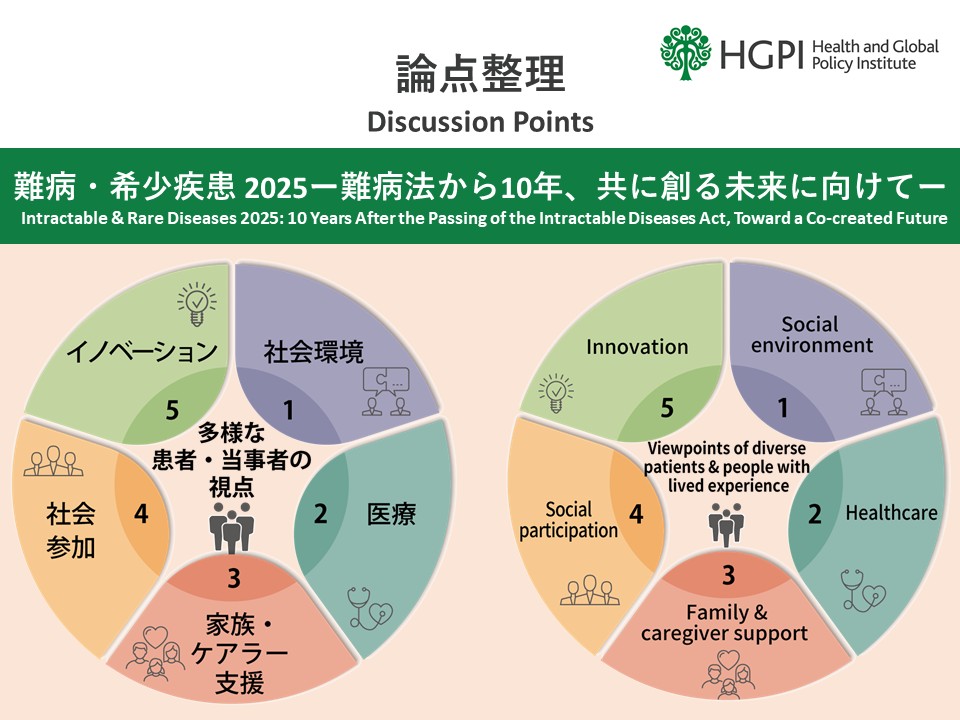
[Discussion Points] Intractable & Rare Diseases Project Discussion Paper “Intractable & Rare Diseases 2025: 10 Years After the Passing of the Intractable Diseases Act, Toward a Co-created Future” (March 28, 2025)
-
2024-08-23
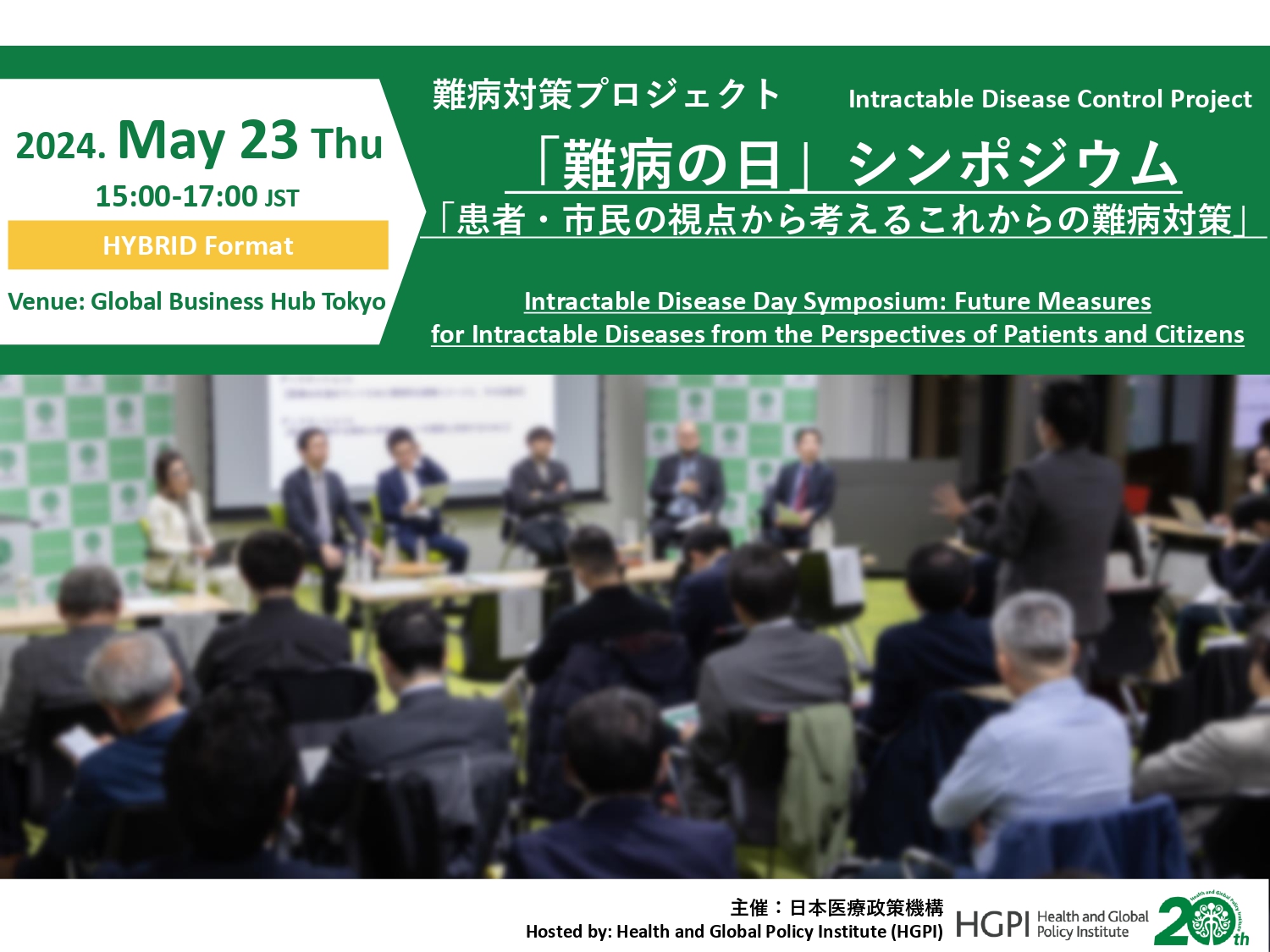
[Event Report] Intractable Disease Day Symposium: Future Measures for Intractable Diseases from the Perspectives of Patients and Citizens (May, 23 2024)
-
2025-12-09
[HGPI Policy Column] (No.66) — From the Planetary Health Project “Part 16: The Global Plastics Treaty: Discourse on Human Health in International Environmental Law”
Top Research & Recommendations Posts
Featured Posts
-
2026-05-18
[Registration Closed] Kick-off Panel Discussion “From Africa and Japan, Drawing from Perspectives Around the World:A Platform for Cultivating a Philosophical Health Dialogue Together” (June 15, 2026)
![[Registration Closed] Kick-off Panel Discussion “From Africa and Japan, Drawing from Perspectives Around the World:A Platform for Cultivating a Philosophical Health Dialogue Together” (June 15, 2026)](https://hgpi.org/en/wp-content/uploads/sites/2/HGPI_20260615_Eyecathch_panel-discussion-From-Japan-and-Africa-in-Discussion-with-the-World_2.png)
-
2026-08-28
[Announcement] The 3rd Kiyoshi Kurokawa Award: Call for Nominations (Deadline: November 30, 2026)
![[Announcement] The 3rd Kiyoshi Kurokawa Award: Call for Nominations (Deadline: November 30, 2026)](https://hgpi.org/en/wp-content/uploads/sites/2/Kiyoshi-Kurokawa-Award_3rd_nominations_eyecatch_caseB_ENG_web_20260929_v0.5.jpg)
-
2026-09-01
[Registration Closed] HGPI Salon 2025-2026 Looking Ahead to the Future of Japan’s Social Security System “Session 6: Japan’s Health Policy through the Lens of Global Security” (October 13, 2026)
![[Registration Closed] HGPI Salon 2025-2026 Looking Ahead to the Future of Japan’s Social Security System “Session 6: Japan’s Health Policy through the Lens of Global Security” (October 13, 2026)](https://hgpi.org/en/wp-content/uploads/sites/2/HGPISalon2025-20266.png)
-
2026-09-17
[Registration Open] (Webinar) The 145th HGPI Seminar “Toward Better AMR Measures at Elderly Care Facilities—Considering Infectious Disease Control in a Super-Aged Society From a Policy Perspective” (October 27, 2026)
![[Registration Open] (Webinar) The 145th HGPI Seminar “Toward Better AMR Measures at Elderly Care Facilities—Considering Infectious Disease Control in a Super-Aged Society From a Policy Perspective” (October 27, 2026)](https://hgpi.org/en/wp-content/uploads/sites/2/HGPIseminar145.png)
-
2026-10-06
[Registration Open] (Webinar) The 146th HGPI Seminar “How We Can Build a Society That Supports Choices Around Organ Donation: Exploring Decision-Making by Citizens and a Multi-Layered Approach Through Strategic Social Marketing” (November 9, 2026)
![[Registration Open] (Webinar) The 146th HGPI Seminar “How We Can Build a Society That Supports Choices Around Organ Donation: Exploring Decision-Making by Citizens and a Multi-Layered Approach Through Strategic Social Marketing” (November 9, 2026)](https://hgpi.org/en/wp-content/uploads/sites/2/HGPI_20261001_Eyecatch_HGPIseminer-146th-1.png)
