


[Policy Recommendations] The Path to a Sustainable Healthcare System: Three Key Objectives for Public Deliberation (January 22, 2026)
date : 1/22/2026

![[Policy Recommendations] The Path to a Sustainable Healthcare System: Three Key Objectives for Public Deliberation (January 22, 2026)](https://hgpi.org/en/wp-content/uploads/sites/2/is-20260122-top_ENG.png)
As medical technologies advance and the population continues to age, achieving a balance between the appropriate evaluation of innovation and the sustainability of the healthcare system is an urgent issue for many countries with public health insurance systems. Japan is no exception; there is a pressing need for policy options to ensure a sustainable and effective healthcare system for future generations and to build social consensus required to realize them.
To address this situation, it is essential to foster shared understanding and common perspectives on the boundaries between healthcare supported by society and that entrusted to individuals or the market. This includes clarifying the respective roles of public health insurance, private health insurance, and self-help while remaining grounded in the philosophy of Universal Health Coverage (UHC). Furthermore, policy discussions are expected to evolve into a trusted and inclusive consensus-building process where a wide range of stakeholders—including patients and those most affected—participate and share responsibility across society.
In light of these challenges, Health and Global Policy Institute (HGPI) has compiled key directions for securing a sustainable healthcare system for the next generation. This summary is based on multiple sessions of multi-stakeholder discussions, involving members from industry, government, academia, and civil society, and highlights three perspectives: “benefits,” “burdens,” and the societal implementation process.”
Three Key Objectives for Public Deliberation
Perspective 1: Reexamine the scope of insurance benefits in light of the growing sophistication of healthcare technology and the transition to a super-aging society
1-1: Exclude low-value healthcare and similar services from insurance coverage and concentrate resources on necessary healthcare
1-2: Optimize benefits for pharmaceuticals and strike a balance between innovation and sustainabilityPerspective 2: Distribute burden in a more equitable manner in anticipation of longer healthy life expectancy and population decline
2-1: Redefine “senior citizen” in relative terms that reflect the increase in healthy life expectancy
2-2: Achieve a more equitable distribution of burden based on the ability-to-pay principle while taking income and assets into account
2-3: Restructure burden around the premise that Japan has entered an era of population declinePerspective 3: Leave the next generation a healthcare system that is based on scientific evidence and the formation of societal consensus
3-1: Strengthen the social infrastructure for generating evidence through collaboration among parties like insurers or examination and payment agencies
3-2: Visualize a multi-tracked system and consolidate shared operations for greater efficiency and transparency
3-3: Establish opportunities for national conversations and encourage involvement from young people and members of the working-age generation
■Discussion members (Titles omitted; in no particular order)
Shinsuke Amano (Chair, The Japan Federation of Cancer Patient Groups/ CEO, Group Nexus Japan)
Nobuki Ando (Former Chairman, Japan Health Insurance Association/ Outside Director, Audit and Supervisory Committee Members, Towa Pharmaceutical Co., Ltd.)
Rei Goto (Professor, Graduate School of Business Administration, Keio University)
Masahiro Sano (Deputy president, National Federation of Health Insurance Societies (Kenporen))
Yasuhiro Suzuki (President, International University of Health and Welfare/ Former Chief Medical and Global Health Officer, Ministry of Health, Labour and Welfare)
Izumi Hamada (Member of the Board, Vice President, Market Access & External Affairs Division, Novo Nordisk Pharma Ltd.)
Kenji Yasukawa (Representative Director, Chairman of the Board, Astellas Pharma Inc.)
Koji Yano (Director, Institute of Social Security Policy, International University of Health and Welfare/ Former Vice-Minister of Finance)
Ryoji Noritake (Chair, Health and Global Policy Institute)
These policy recommendations are based on discussions at meetings HGPI held for this project and has been compiled in HGPI’s capacity as an independent health policy think-tank. It does not, in any capacity, represent the opinions of any participating expert, speaker, related party, or organization to which those parties are affiliated.
For details, please see the PDF below.
![[Policy Recommendations] The Path to a Sustainable Healthcare System: Three Key Objectives for Public Deliberation](/assets/img/katsudo/icon_pdf_l.png)
Related Posts
-
2025-12-12
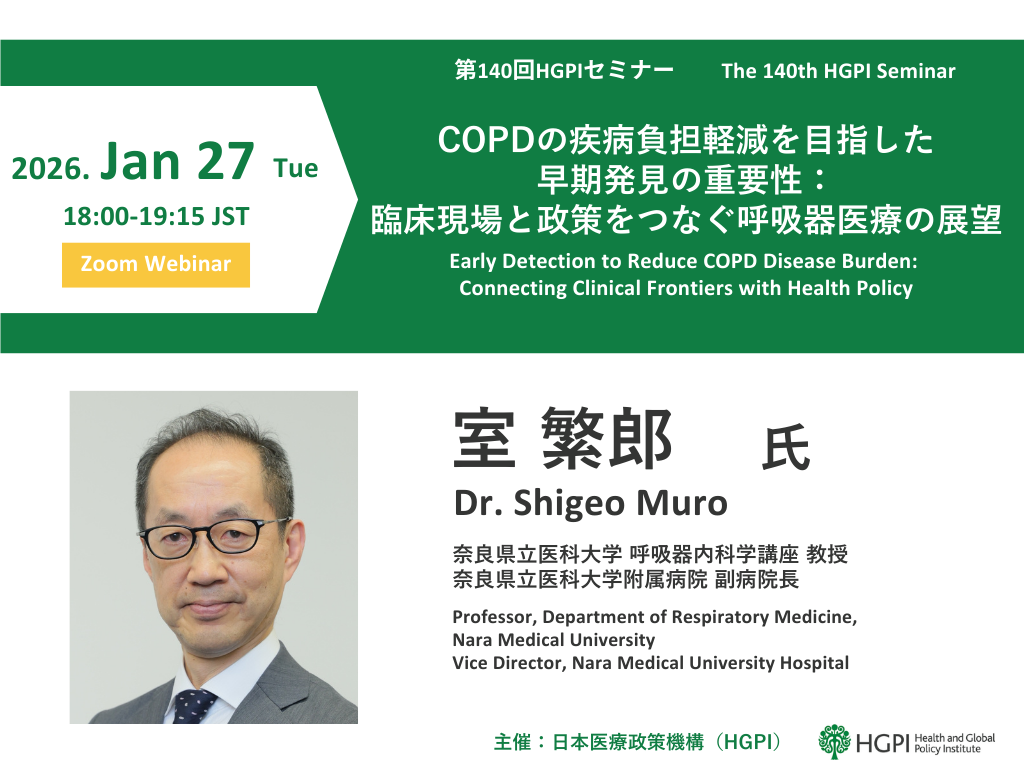
[Registration Closed] (Webinar) The 140th HGPI Seminar “Early Detection to Reduce COPD Disease Burden: Connecting Clinical Frontiers with Health Policy” (January 27, 2026)
-

2025-12-09
[Event Report] “Future of the Healthcare System” Series - 2nd Advisory Meeting: Reimagining Public Engagement for Sustainable Health Systems (November 20, 2025)
-
2025-09-29
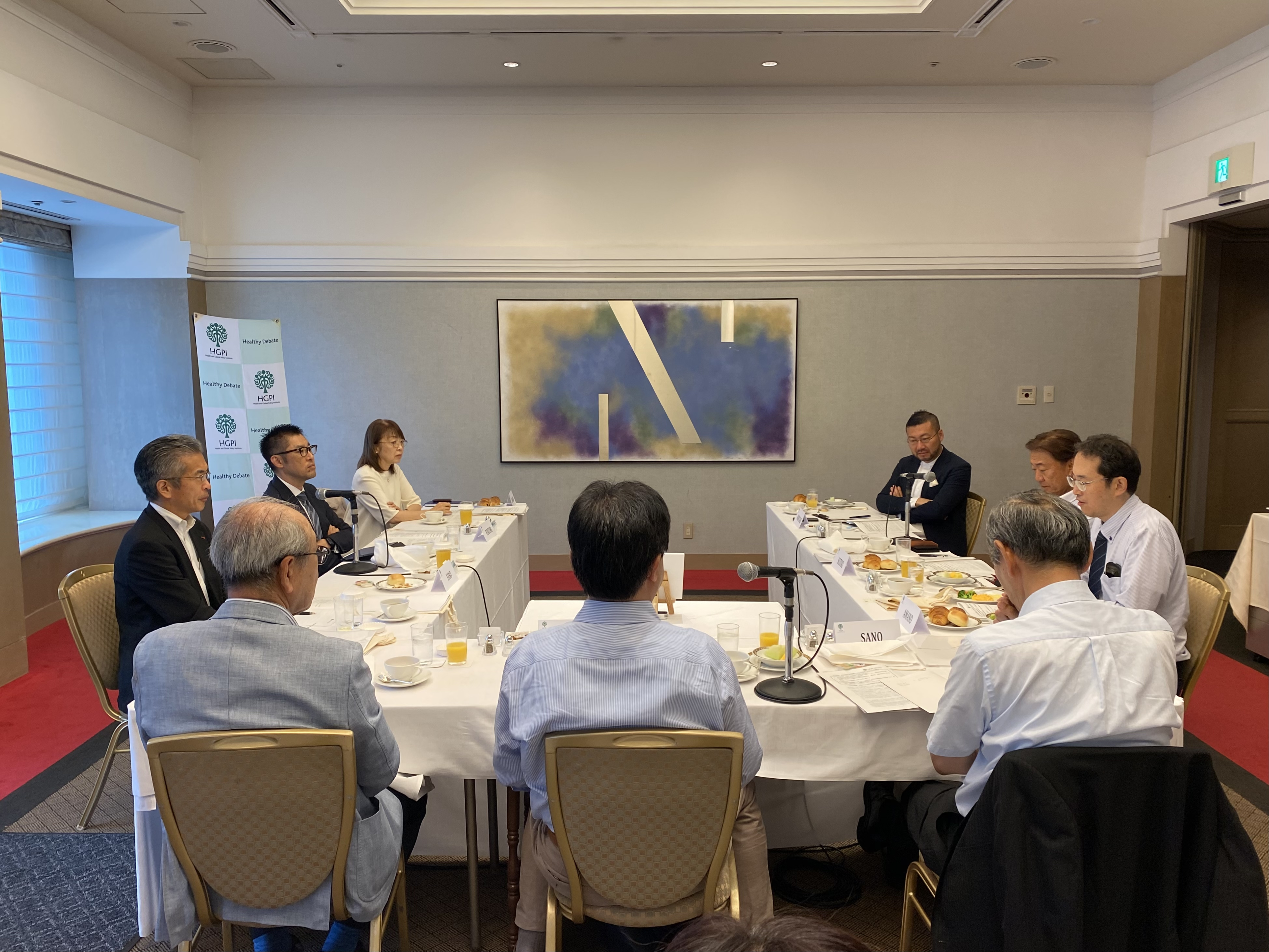
[Event Report] “Future of the Healthcare System” Series - 1st Advisory Meeting: Reimagining Public Engagement for Sustainable Health Systems (September 9, 2025)
-
2025-12-26
[Recommendations] “Balancing Sustainability and Innovation in the Healthcare System” (December 26, 2025)
-
2025-12-02
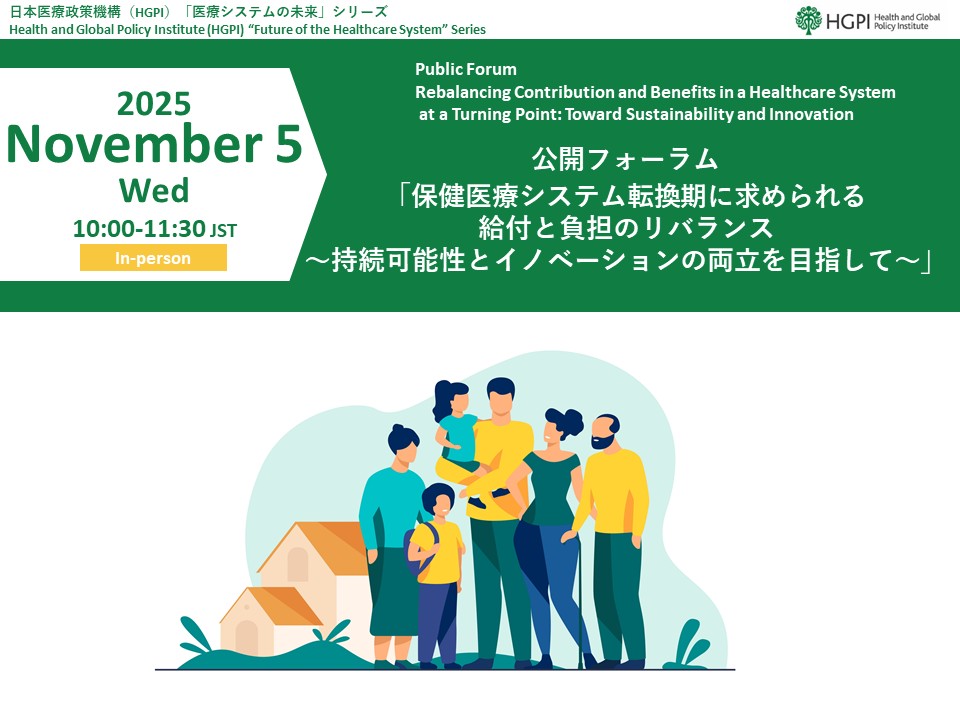
[Event Report] Public Forum “Rebalancing Contribution and Responsibility in a Healthcare System at a Turning Point: Toward Sustainability and Innovation” (November 5, 2025)
-
2025-07-22
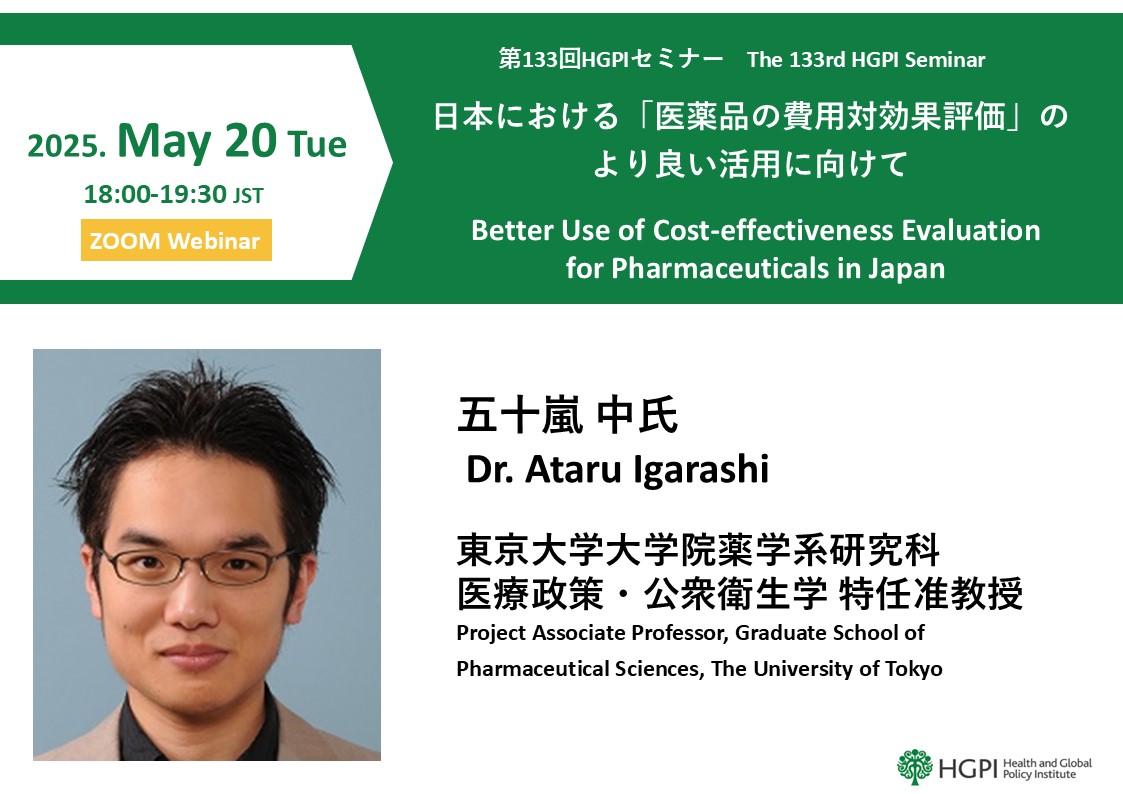
[Event Report] The 133rd HGPI Seminar -HGPI Expert Policy Advocacy Platform- “Better Use of Cost-effectiveness Evaluation for Pharmaceuticals in Japan” (May 20, 2025)
Top Research & Recommendations Posts
Featured Posts
-
2026-05-18
[Registration Closed] Kick-off Panel Discussion “From Africa and Japan, Drawing from Perspectives Around the World:A Platform for Cultivating a Philosophical Health Dialogue Together” (June 15, 2026)
![[Registration Closed] Kick-off Panel Discussion “From Africa and Japan, Drawing from Perspectives Around the World:A Platform for Cultivating a Philosophical Health Dialogue Together” (June 15, 2026)](https://hgpi.org/en/wp-content/uploads/sites/2/HGPI_20260615_Eyecathch_panel-discussion-From-Japan-and-Africa-in-Discussion-with-the-World_2.png)
-
2026-08-28
[Announcement] The 3rd Kiyoshi Kurokawa Award: Call for Nominations (Deadline: November 30, 2026)
![[Announcement] The 3rd Kiyoshi Kurokawa Award: Call for Nominations (Deadline: November 30, 2026)](https://hgpi.org/en/wp-content/uploads/sites/2/Kiyoshi-Kurokawa-Award_3rd_nominations_eyecatch_caseB_ENG_web_20260929_v0.5.jpg)
-
2026-09-01
[Registration Closed] HGPI Salon 2025-2026 Looking Ahead to the Future of Japan’s Social Security System “Session 6: Japan’s Health Policy through the Lens of Global Security” (October 13, 2026)
![[Registration Closed] HGPI Salon 2025-2026 Looking Ahead to the Future of Japan’s Social Security System “Session 6: Japan’s Health Policy through the Lens of Global Security” (October 13, 2026)](https://hgpi.org/en/wp-content/uploads/sites/2/HGPISalon2025-20266.png)
-
2026-09-17
[Registration Open] (Webinar) The 145th HGPI Seminar “Toward Better AMR Measures at Elderly Care Facilities—Considering Infectious Disease Control in a Super-Aged Society From a Policy Perspective” (October 27, 2026)
![[Registration Open] (Webinar) The 145th HGPI Seminar “Toward Better AMR Measures at Elderly Care Facilities—Considering Infectious Disease Control in a Super-Aged Society From a Policy Perspective” (October 27, 2026)](https://hgpi.org/en/wp-content/uploads/sites/2/HGPIseminar145.png)
-
2026-10-06
[Registration Open] (Webinar) The 146th HGPI Seminar “How We Can Build a Society That Supports Choices Around Organ Donation: Exploring Decision-Making by Citizens and a Multi-Layered Approach Through Strategic Social Marketing” (November 9, 2026)
![[Registration Open] (Webinar) The 146th HGPI Seminar “How We Can Build a Society That Supports Choices Around Organ Donation: Exploring Decision-Making by Citizens and a Multi-Layered Approach Through Strategic Social Marketing” (November 9, 2026)](https://hgpi.org/en/wp-content/uploads/sites/2/HGPI_20261001_Eyecatch_HGPIseminer-146th-1.png)
