


[Event Report] The 133rd HGPI Seminar -HGPI Expert Policy Advocacy Platform- “Better Use of Cost-effectiveness Evaluation for Pharmaceuticals in Japan” (May 20, 2025)
date : 7/22/2025
Tags: Future of the Health Care System, HGPI Seminar, Innovation and Sustainability

![[Event Report] The 133rd HGPI Seminar -HGPI Expert Policy Advocacy Platform- “Better Use of Cost-effectiveness Evaluation for Pharmaceuticals in Japan” (May 20, 2025)](https://hgpi.org/en/wp-content/uploads/sites/2/HGPI_133rd_20250520_eyecatch-1.jpg)
In FY2022, Health and Global Policy Institute (HGPI) launched the “HGPI Expert Policy Advocacy Platform” to facilitate the creation and promotion of policy recommendations presented by individual HGPI Fellows and others associated with HGPI. These recommendations address urgent topics recognized by our Fellows and undergo careful examination from HGPI’s internal review committee. After approval, they are presented as policy recommendations from HGPI to provide options to citizens interested in policy. Through this Platform, we hope to produce a wide variety of both feasible and creative solutions to pressing health policy issues.
The theme of the 133rd HGPI Seminar was “Better Use of Cost-Effectiveness Evaluation for Pharmaceuticals in Japan.” There, HGPI Fellow Dr. Ataru Igarashi introduced policy recommendations presented through the HGPI Expert Policy Advocacy Platform on May 7, 2025. Returning to the original concepts behind Japan’s current health system, Dr. Igarashi spoke about necessary future discussions on cost-effectiveness evaluation (CEE) in Japan and the importance of considering criteria for effectiveness and value from various perspectives.
<POINTS>
- A shift in attitudes toward healthcare and money occurred due to the COVID-19 pandemic. There is now a growing need to draw a line between public and out-of-pocket healthcare funding and to add contrast to healthcare.
- The concept of cost-effectiveness is attracting renewed attention as a criterion for adding contrast to healthcare in the face of limited financial resources.
- However, standards for the effectiveness and value of healthcare do not allow for uniform measurements. Relevant stakeholders and citizens must hold continuous discussions on topics like evaluation indicators and system designs that reflect diverse positions and values.
■ Background for the initial implementation of CEE for pharmaceuticals
The Ministry of Health, Labour and Welfare (MHLW) introduced a system for conducting cost-effectiveness evaluation (CEE) on prescription drugs in April 2019. This system made it possible for the prices of certain prescription drugs to be adjusted according to CEE results even after initial pricing. In Japan, CEE is used to compare new drugs and existing drugs in terms of effectiveness and cost. In general, effectiveness and value is assessed using an indicator called quality-adjusted life year (QALY). While discussions on QALY are split, this seminar focused on what perspectives will be necessary when considering CEE and which points to keep in mind to make effective use of the existing system.
■ How the COVID-19 pandemic changed attitudes toward healthcare and money
The foundational concept that underpins the design of Japan’s universal health insurance system is, “Ensuring all citizens can receive almost all medical services at low cost.” This is why healthcare has been assigned the highest priority as a social value to the point that at times, it was considered necessary to go so far as to draw financial resources from other areas to cover any shortfalls in healthcare funding. However, the COVID-19 pandemic triggered a significant shift in social attitudes toward the balance between healthcare and daily life. While large investments are being made in infectious disease control and vaccination policies, impacts on the daily lives of citizens and industries outside of healthcare have started to manifest. Society now has a shared awareness toward issues such as how much public funding we should invest in healthcare or how to best allocate limited financial resources.
Despite their previous status as forbidden topics, this awareness led to active whole-of-society discussions on healthcare and money. In that context, there is growing recognition of the need to draw a line between public and out-of-pocket funding for healthcare, in what could be referred to as “healthcare with contrast.” In fact, certain public opinion polls have found that some believe insurance coverage should be revoked for minor health services, and there are some movements among individuals to reassess the value of healthcare.
Given this context, CEE is attracting renewed attention as a criterion that can be used to add contrast to healthcare.
* Originally, “universal health insurance” refers to a system in which all citizens can access affordable and necessary medical services.
■ Cost and performance in CEE
In Japan, CEE is used to evaluate the effectiveness and safety of new drugs through comparisons with existing drugs. In general, to calculate cost-effectiveness, the difference in cost (determined by subtracting existing drug cost from new drug cost) is divided by the difference in effectiveness (determined by subtracting existing drug performance from new drug performance).
If it were possible to evaluate drugs only based on cost and performance, cost effectiveness would be plain to see. However, there are actually many items that require consideration in the background of this equation. For example, how do we define which drugs are “existing drugs”? To determine “performance,” whose data do we use, and when should that data be gathered? There can be a great deal of variation in CEE results depending on how “cost,” “existing drugs,” and “performance” are defined or interpreted.
It is ideal for the introduction of CEE to begin with sorting pharmaceuticals by those for which it is possible to consider cost performance from a broad perspective and those for which it is not. However, in practice, in the application of cost effectiveness, there is a tendency toward generating evidence that will win support from many people for the application of cost effectiveness itself or for a drug price, so cost and performance are only examined within a limited scope by the time discussions conclude. Given the uncertain nature of clinical trials and the fact that CEE is derived from results from clinical trials, it must also be kept in mind that CEE is also highly uncertain.
■ The need for new evaluation indicators to encompass multi-faceted values and address financial toxicity in healthcare
When examining how to best implement CEE, a variety of evaluation indicators must be considered. This variety of evaluation indicators is depicted in a single chart called the value flower, which summarizes twelve elements of value. Decisions regarding pharmaceutical pricing should be made with multi-faceted perspectives (such as that portrayed by the value flower) taken into account from the outset. Among those elements of value, those that are related to finances or cost have significant impacts on the daily lives of citizens. For example, if healthcare or pharmaceuticals become expensive, it may prevent people from receiving appropriate care and cause damage to individual health. There are also cases in which people experience difficulties in daily life due to the financial burden of prioritizing the cost of medical care. These difficulties are referred to as “financial toxicity.” A domestic survey of people living with ovarian cancer found that approx. 80% of respondents were experiencing financial toxicity.
There are also important elements of value in healthcare other than those related to economic aspects, such as quality of life (QOL) and impact on family members. In a survey of students that asked about rare disease treatments, many respondents emphasized elevated QOL and reduced burdens on family members as important elements of healthcare value, providing a glimpse of the multi-faceted values that are inherent to healthcare as well as the diverse values of citizens.
In Japan, people have viewed healthcare as something that everyone has equal access to based on a world-class universal health insurance system. In reality, it is difficult to say that healthcare is reaching everyone who truly needs it. Furthermore, the value of healthcare varies depending on each individual’s personal background and social circumstances. In the future, it may be necessary for us to improve the healthcare and evaluation systems in a manner that takes the diverse values of citizens into account.
[Event Overview]
- Speaker:
Dr. Ataru Igarashi (HGPI Fellow/ Project Associate Professor, Graduate School of Pharmaceutical Sciences, The University of Tokyo/ Visiting Associate Professor, Graduate School of Data Science, Yokohama City University) - Date & Time: Tuesday, May 20, 2025; 18:00-19:30 JST
- Format: Online (Zoom webinar)
- Language: Japanese
- Participation Fee: Free
- Capacity: 500 participants
■Profile:
Ataru Igarashi (HGPI Fellow/ Project Associate Professor, Graduate School of Pharmaceutical Sciences, The University of Tokyo/ Visiting Associate Professor, Graduate School of Data Science, Yokohama City University)
Ataru IGARASHI, Ph.D., is an associate professor at Yokohama City University School of Medicine, Unit of Public Health and Preventive Medicine. In 2002, he graduated from the Faculty of Pharmaceutical Sciences, The University of Tokyo. He started his career at The University of Tokyo as an assistant professor just after he received his Ph.D. degree in 2008. His areas of expertise are health economics and pharmacoeconomics. His research on vaccination policy, anti-smoking policy and pharmacoeconomics have been used in legislative decision-making process.

![[Event Report] The 133rd HGPI Seminar “Better Use of Cost-effectiveness Evaluation for Pharmaceuticals in Japan”](/assets/img/katsudo/icon_pdf_l.png)
Related Posts
-
2025-07-04
[Recommendations] HGPI Expert Policy Advocacy Platform “Better Use of Cost-effectiveness Evaluation for Pharmaceuticals in Japan” (May 7, 2025)
-
2022-06-10
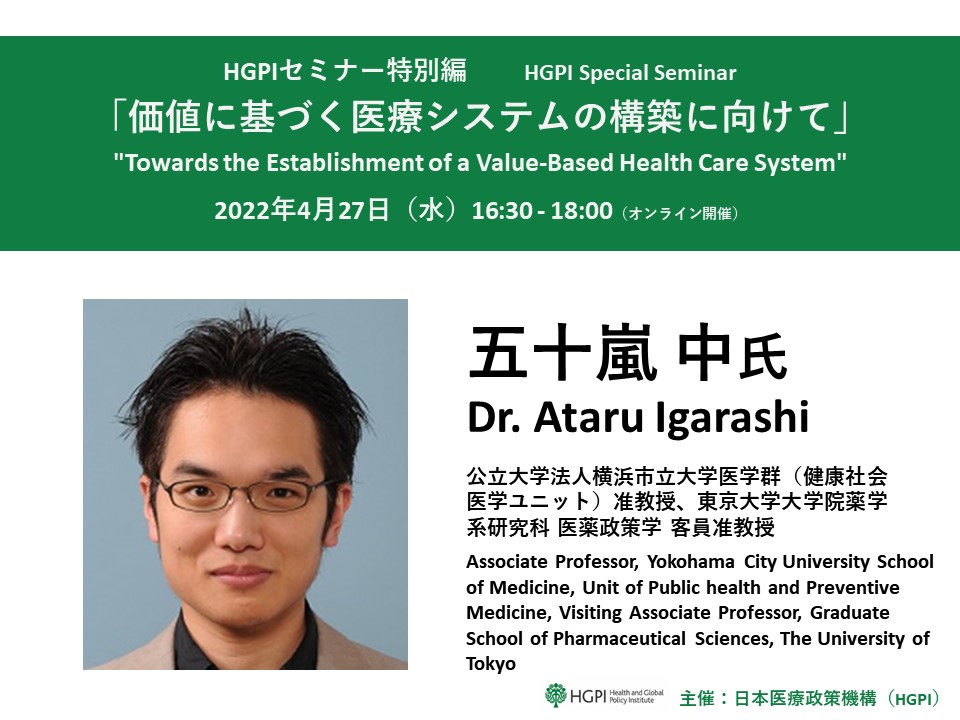
[Event Report & Recommendations] HGPI Special Seminar - HGPI Expert Policy Advocacy Platform “Towards the Establishment of a Value-Based Health Care System” (April 27, 2022)
-
2025-01-31
[Recommendations] HGPI Expert Policy Advocacy Platform “Japan’s Global Health Policy and Domestic Processes” Report (January 31, 2025)
-
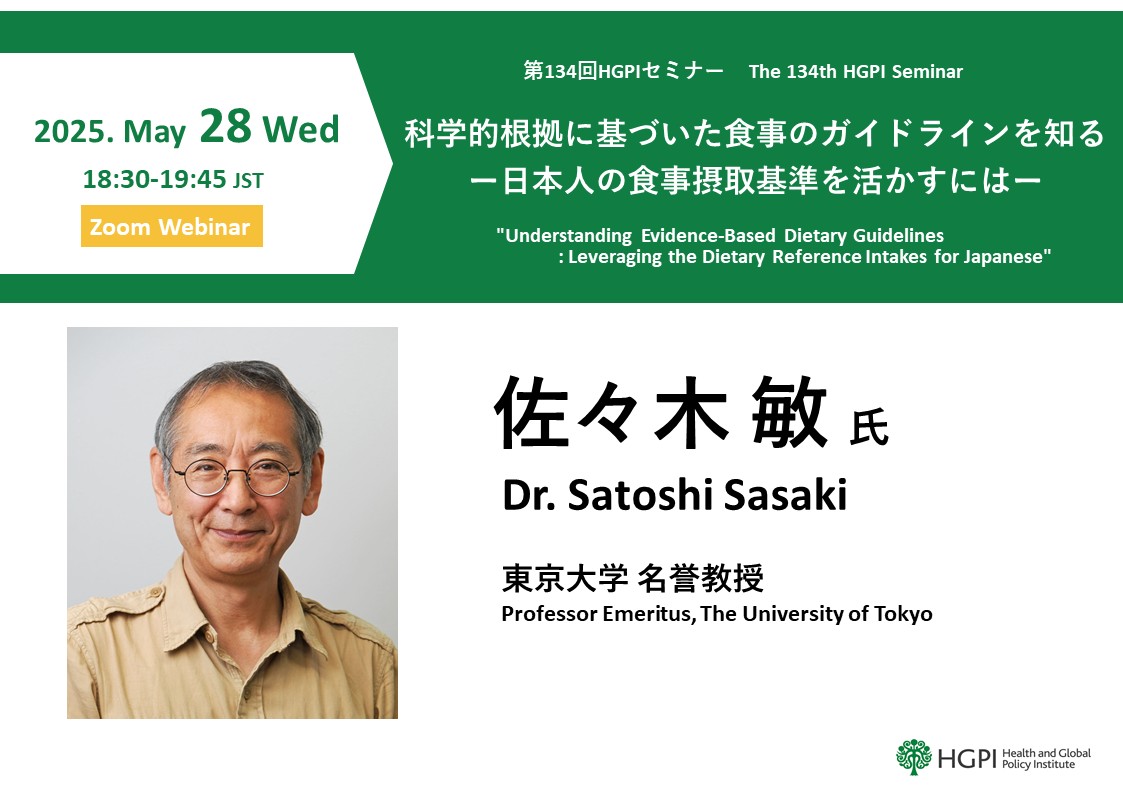
2025-07-30
[Event Report] The 134th HGPI Seminar "Understanding Evidence-Based Dietary Guidelines: Leveraging the Dietary Reference Intakes for Japanese" (May 28, 2025)
-
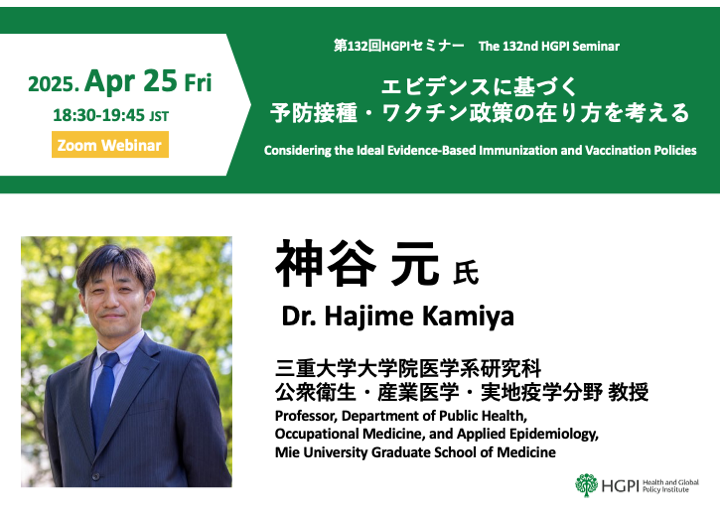
2025-08-27
[Event Report] The 132nd HGPI Seminar “Considering the Ideal Evidence-Based Immunization and Vaccination Policies” (April 25, 2025)
Top Research & Recommendations Posts
Featured Posts
-
2026-05-18
[Registration Closed] Kick-off Panel Discussion “From Africa and Japan, Drawing from Perspectives Around the World:A Platform for Cultivating a Philosophical Health Dialogue Together” (June 15, 2026)
![[Registration Closed] Kick-off Panel Discussion “From Africa and Japan, Drawing from Perspectives Around the World:A Platform for Cultivating a Philosophical Health Dialogue Together” (June 15, 2026)](https://hgpi.org/en/wp-content/uploads/sites/2/HGPI_20260615_Eyecathch_panel-discussion-From-Japan-and-Africa-in-Discussion-with-the-World_2.png)
-
2026-08-28
[Announcement] The 3rd Kiyoshi Kurokawa Award: Call for Nominations (Deadline: November 30, 2026)
![[Announcement] The 3rd Kiyoshi Kurokawa Award: Call for Nominations (Deadline: November 30, 2026)](https://hgpi.org/en/wp-content/uploads/sites/2/Kiyoshi-Kurokawa-Award_3rd_nominations_eyecatch_caseB_ENG_web_20260929_v0.5.jpg)
-
2026-09-01
[Registration Closed] HGPI Salon 2025-2026 Looking Ahead to the Future of Japan’s Social Security System “Session 6: Japan’s Health Policy through the Lens of Global Security” (October 13, 2026)
![[Registration Closed] HGPI Salon 2025-2026 Looking Ahead to the Future of Japan’s Social Security System “Session 6: Japan’s Health Policy through the Lens of Global Security” (October 13, 2026)](https://hgpi.org/en/wp-content/uploads/sites/2/HGPISalon2025-20266.png)
-
2026-09-17
[Registration Open] (Webinar) The 145th HGPI Seminar “Toward Better AMR Measures at Elderly Care Facilities—Considering Infectious Disease Control in a Super-Aged Society From a Policy Perspective” (October 27, 2026)
![[Registration Open] (Webinar) The 145th HGPI Seminar “Toward Better AMR Measures at Elderly Care Facilities—Considering Infectious Disease Control in a Super-Aged Society From a Policy Perspective” (October 27, 2026)](https://hgpi.org/en/wp-content/uploads/sites/2/HGPIseminar145.png)
-
2026-10-06
[Registration Open] (Webinar) The 146th HGPI Seminar “How We Can Build a Society That Supports Choices Around Organ Donation: Exploring Decision-Making by Citizens and a Multi-Layered Approach Through Strategic Social Marketing” (November 9, 2026)
![[Registration Open] (Webinar) The 146th HGPI Seminar “How We Can Build a Society That Supports Choices Around Organ Donation: Exploring Decision-Making by Citizens and a Multi-Layered Approach Through Strategic Social Marketing” (November 9, 2026)](https://hgpi.org/en/wp-content/uploads/sites/2/HGPI_20261001_Eyecatch_HGPIseminer-146th-1.png)
