


[Event Report] The 134th HGPI Seminar “Understanding Evidence-Based Dietary Guidelines: Leveraging the Dietary Reference Intakes for Japanese” (May 28, 2025)
date : 7/30/2025
Tags: HGPI Seminar, NCDs, Other Activities

![[Event Report] The 134th HGPI Seminar “Understanding Evidence-Based Dietary Guidelines: Leveraging the Dietary Reference Intakes for Japanese” (May 28, 2025)](https://hgpi.org/en/wp-content/uploads/sites/2/HGPI_DRIs_20250416_eyecatch-1.jpg)
In this HGPI Seminar, we were honored to welcome Dr. Satoshi Sasaki, who serves as Chair of the Committee for the Revision of the Dietary Reference Intakes for Japanese (2025 Edition), to provide a comprehensive overview. His presentation covered the basic concepts underpinning the Dietary Reference Intakes for Japanese (hereinafter referred to as the “DRIs”), their historical development, current status, and future directions, delivering them in a way that was easy to understand, even for those without a background in nutrition.
<POINTS>
- The DRIs are dietary guidelines established by the Ministry of Health, Labour and Welfare every five years, with the 2025 edition being the latest. They provide specific “quantitative guidelines” for energy and 34 types of nutrients by gender and age group, targeting almost all individuals.
- The DRIs scientifically demonstrate the relationship between nutrition and five lifestyle-related diseases (hypertension, dyslipidemia, diabetes, chronic kidney disease, and osteoporosis). For example, in the hypertension section, high sodium consumption is identified as an important factor contributing to the pathology of both obesity and hypertension.
- In contrast to other countries , only a few major domestic universities have independent departments of nutrition. To extend healthy life expectancy and reduce medical costs, it is desirable to establish an academic and research framework that comprehensively covers nutrition science from basic to applied research, and to promote evidence-based policy development.
■ What Are the Dietary Reference Intakes for Japanese?
The DRIs are comprehensive guidelines for nutrition and diet established by the Ministry of Health, Labour and Welfare every five years. As an important foundation supporting health, they aim to maintain and promote health and prevent lifestyle-related diseases and their progression among all people living in Japan. The latest edition was released in 2025 and will serve as fundamental dietary guidelines not only in hospitals and schools but throughout Japan for the next five years.
Standards related to nutrition have existed since the Meiji era, and after World War II, standards later called “Nutritional Requirements” were created, which became the foundation of the current DRIs. The Nutritional Requirements indicated “the necessary amount of nutrition” and can be said to have been guidelines for an era when Japanese people suffered from hunger and malnutrition. Subsequently, to address issues of nutritional excess, the name was changed to “Dietary Reference Intakes” in 2005, enabling response to both excess and deficiency. With this change, the scope of people targeted by the DRIs expanded to include those suffering from malnutrition, healthy individuals, and even those with blood pressure or other issues identified in health check-ups , making almost all Japanese people the target regardless of their health status.
The most notable characteristic of the DRIs is that they provide specific “quantitative guidelines” for energy and 34 types of nutrients by gender and age group. However, these are merely guidelines, and nutritionists and other professionals who use the DRIs must read the general principles thoroughly and interpret them according to specific situations. Additionally, since the DRIs target the broad Japanese population and affect many people, they are formulated based on highly reliable scientific evidence, with emphasis placed on providing accurate information to the public.
■ The Relationship Between Lifestyle-Related Diseases and the Dietary Reference Intakes
The DRIs explain the relationship between nutrition and five lifestyle-related diseases, namely hypertension, dyslipidemia, diabetes, chronic kidney disease, and osteoporosis, based on reliable scientific evidence.
For example, the DRIs illustrate the relationship between energy and nutrient intake and hypertension in a diagram. The relationship with hypertension is particularly strong for sodium (salt) intake and obesity, and this relationship is considered scientifically and highly reliable. This indicates that when preventing hypertension, it is advisable to focus first on sodium (salt) intake and take measure to counter obesity rather than trying to reduce alcohol or increasing potassium intake, and to improve diet and lifestyle habits accordingly.
Additionally, the osteoporosis section, newly added in the 2025 edition, shows that low body weight is associated with low bone density, osteoporosis, and fragility fractures. However, based on reliable scientific evidence, the relationship between calcium and osteoporosis and fragility fractures is not sufficient and needs to be elucidated , so the guidelines state that calcium is only associated with low bone density. In this way, the DRIs are guidelines created by collecting real-world data objectively, scientifically, and comprehensively.
■ Prospects for Building Sustainable Nutrition Policy and Research Infrastructure
Nevertheless, major domestic universities such as the University of Tokyo and Kyoto University have almost no independent departments or faculties specializing in nutrition science, unlike medical or law schools. In contrast, major overseas universities such as Harvard University, Cambridge University, Peking University, and Seoul National University have independent departments and graduate schools related to nutrition science, representing a notable difference from Japan.
To address urgent challenges such as extending healthy life expectancy and reducing medical costs, it is imperative to establish an academic and research framework that can comprehensively handle nutrition science from basic to applied research. Going forward, there is a need for an environment that can promote evidence-based nutrition policies, including the DRIs, and sustainably generate new knowledge in this field.
[Event Overview]
- Speaker:
Dr. Satoshi Sasaki (Professor Emeritus, The University of Tokyo) - Date & Time: Wednesday, May 28, 2025; 18:30-19:45 JST
- Format: Online (Zoom webinar)
- Language: Japanese
- Participation Fee: Free
- Capacity: 500 participants
■Profile:
Satoshi Sasaki (Professor Emeritus, The University of Tokyo)
Professor Emeritus, The University of Tokyo, Visiting Professor, Kagawa Nutrition University.
Dr. Sasaki holds degrees from the Faculty of Engineering at Kyoto University and the Faculty of Medicine at Osaka University, and earned doctorates from both Osaka University Graduate School and the University of Leuven. A physician and Doctor of Medical Science, he has held key leadership roles, including Chief of the Department of Clinical Epidemiology at the Research Institute of the National Cancer Center Japan, and Program Leader of Nutritional Epidemiology at the National Institute of Health and Nutrition. As one of the earliest advocates of Evidence-Based Nutrition (EBN) in Japan, he developed widely used dietary assessment tools tailored to the Japanese population, such as the brief self-administered diet history questionnaire. Dr. Sasaki has played a central role in formulating the Dietary Reference Intakes for Japanese, published by the Ministry of Health, Labour and Welfare. In parallel, he has been deeply involved in nurturing the next generation of researchers, including through the Tokyo Nutrition Epidemiology Study Group, contributing significantly to the advancement of nutrition science in Japan. His hobbies include visiting local markets and enjoying food culture around the world—he has traveled to dozens of countries and possesses extensive knowledge of global culinary traditions. His publications include: “Evidence-Based Nutrition & Nutritional Epidemiology,” “Understanding the Dietary Reference Intakes,” (Domon Shoin), “How to Read Nutrition Data,” and “The Data-Driven Nutrition Guide by Satoshi Sasaki” (Kagawa Nutrition University Press), among others.

![[Event Report] The 134th HGPI Seminar](/assets/img/katsudo/icon_pdf_l.png)
Related Posts
-
2025-07-22
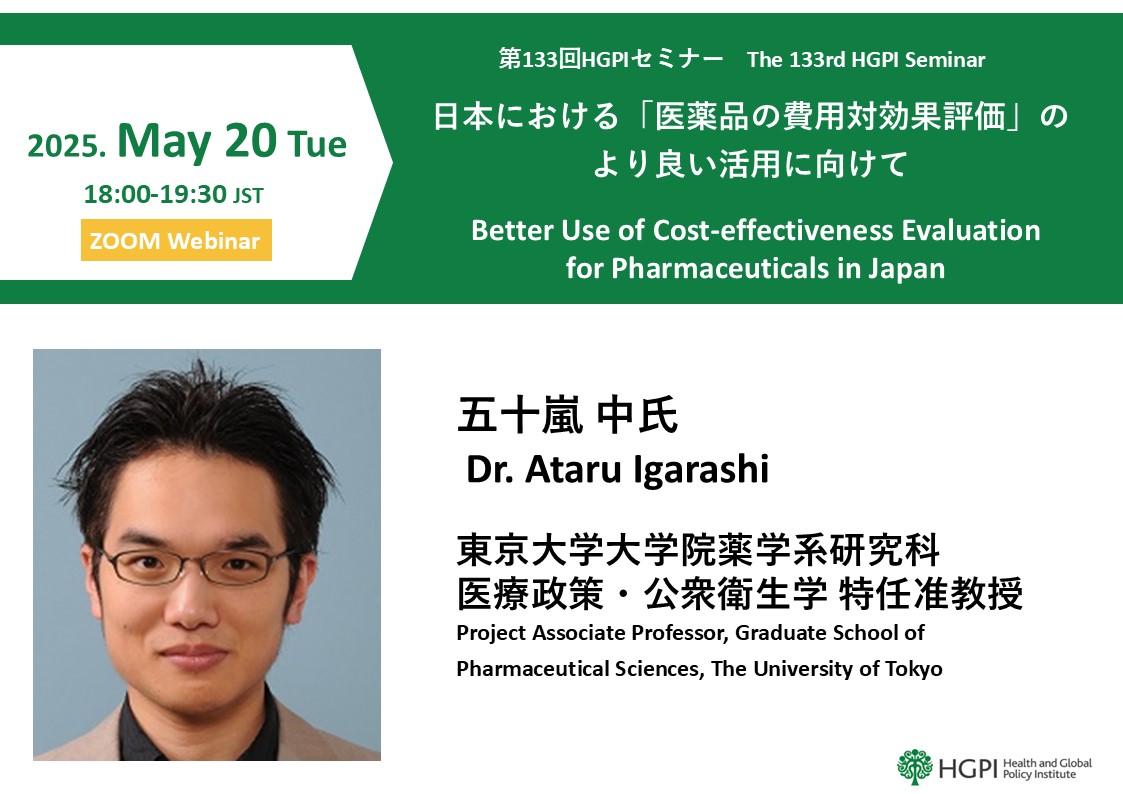
[Event Report] The 133rd HGPI Seminar -HGPI Expert Policy Advocacy Platform- “Better Use of Cost-effectiveness Evaluation for Pharmaceuticals in Japan” (May 20, 2025)
-
2025-08-12
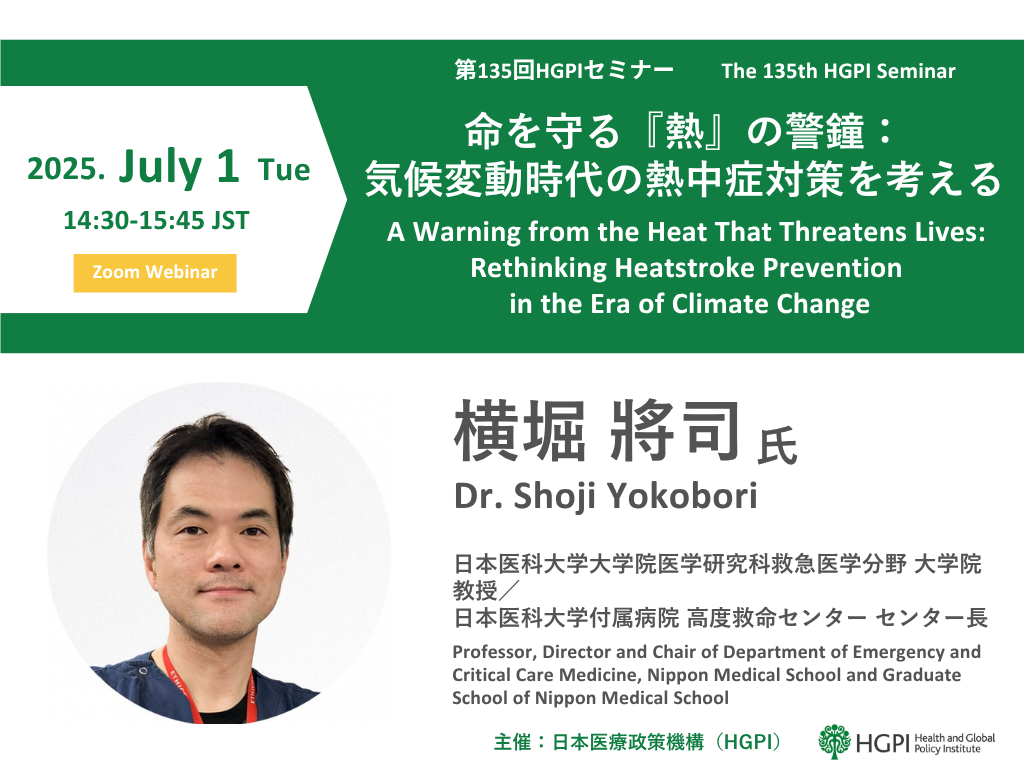
[Event Report] The 135th HGPI Seminar “A Warning from the Heat That Threatens Lives-Rethinking Heatstroke Prevention in the Era of Climate Change” (July 1, 2025)
-
2025-03-13
[HGPI Policy Column] (No.55) From the Kidney Disease Control Promotion Project “What Is Required from a Patient Perspective for Continuity of Treatment for Chronic Kidney Disease (CKD): Dietary Therapy Edition”
Top Research & Recommendations Posts
Featured Posts
-
2026-05-18
[Registration Closed] Kick-off Panel Discussion “From Africa and Japan, Drawing from Perspectives Around the World:A Platform for Cultivating a Philosophical Health Dialogue Together” (June 15, 2026)
![[Registration Closed] Kick-off Panel Discussion “From Africa and Japan, Drawing from Perspectives Around the World:A Platform for Cultivating a Philosophical Health Dialogue Together” (June 15, 2026)](https://hgpi.org/en/wp-content/uploads/sites/2/HGPI_20260615_Eyecathch_panel-discussion-From-Japan-and-Africa-in-Discussion-with-the-World_2.png)
-
2026-08-28
[Announcement] The 3rd Kiyoshi Kurokawa Award: Call for Nominations (Deadline: November 30, 2026)
![[Announcement] The 3rd Kiyoshi Kurokawa Award: Call for Nominations (Deadline: November 30, 2026)](https://hgpi.org/en/wp-content/uploads/sites/2/Kiyoshi-Kurokawa-Award_3rd_nominations_eyecatch_caseB_ENG_web_20260929_v0.5.jpg)
-
2026-09-01
[Registration Closed] HGPI Salon 2025-2026 Looking Ahead to the Future of Japan’s Social Security System “Session 6: Japan’s Health Policy through the Lens of Global Security” (October 13, 2026)
![[Registration Closed] HGPI Salon 2025-2026 Looking Ahead to the Future of Japan’s Social Security System “Session 6: Japan’s Health Policy through the Lens of Global Security” (October 13, 2026)](https://hgpi.org/en/wp-content/uploads/sites/2/HGPISalon2025-20266.png)
-
2026-09-17
[Registration Open] (Webinar) The 145th HGPI Seminar “Toward Better AMR Measures at Elderly Care Facilities—Considering Infectious Disease Control in a Super-Aged Society From a Policy Perspective” (October 27, 2026)
![[Registration Open] (Webinar) The 145th HGPI Seminar “Toward Better AMR Measures at Elderly Care Facilities—Considering Infectious Disease Control in a Super-Aged Society From a Policy Perspective” (October 27, 2026)](https://hgpi.org/en/wp-content/uploads/sites/2/HGPIseminar145.png)
-
2026-10-06
[Registration Open] (Webinar) The 146th HGPI Seminar “How We Can Build a Society That Supports Choices Around Organ Donation: Exploring Decision-Making by Citizens and a Multi-Layered Approach Through Strategic Social Marketing” (November 9, 2026)
![[Registration Open] (Webinar) The 146th HGPI Seminar “How We Can Build a Society That Supports Choices Around Organ Donation: Exploring Decision-Making by Citizens and a Multi-Layered Approach Through Strategic Social Marketing” (November 9, 2026)](https://hgpi.org/en/wp-content/uploads/sites/2/HGPI_20261001_Eyecatch_HGPIseminer-146th-1.png)
