


[Event Report] The 135th HGPI Seminar “A Warning from the Heat That Threatens Lives-Rethinking Heatstroke Prevention in the Era of Climate Change” (July 1, 2025)
date : 8/12/2025
Tags: HGPI Seminar, Planetary Health

![[Event Report] The 135th HGPI Seminar “A Warning from the Heat That Threatens Lives-Rethinking Heatstroke Prevention in the Era of Climate Change” (July 1, 2025)](https://hgpi.org/en/wp-content/uploads/sites/2/The135th-HGPI-Seminar-1.png)
At the 135th HGPI Seminar entitled “A Warning from the Heat That Threatens Lives- Rethinking Heatstroke Prevention in the Era of Climate Change,” we invited Dr. Shoji Yokobori, who is a Professor of the Department of Emergency Medicine, Graduate School of Medicine, Nippon Medical School and a Director of the Advanced Life Support Center at Nippon Medical School Hospital, to speak about the growing threat of heatstroke due to climate change. He presented current countermeasures and also discussed the latest developments on the use of data and tools that support both experts and the general public.
<POINTS>
- Climate change is driving a surge in heat-related mortality worldwide. In Japan, heatstroke-related deaths reached a record high of 2,033 deaths in 2024.
- Heatstroke is caused by a breakdown in thermoregulation, resulting in elevated core body temperature. Rapid cooling is the key to treatment.
- Most cases of heatstroke occur indoors among elderly individuals and single-person households. The risk of fatal outcomes increases significantly when air conditioning is not used.
- The Heatstroke Clinical Practice Guideline 2024 introduce improved methods for assessing severity and emphasize early intervention, supported by new diagnostic tools such as mobile applications.
■ Heatstroke Risk Due to Climate Change Amidst an Aging Society
Climate change has significantly heightened the risk of heatstroke, posing a critical challenge for Japan’s rapidly aging population. In 2024, heatstroke-related deaths in Japan reached a record high of 2,033, approximately six to seven times greater than fatalities from other natural disasters such as earthquakes and floods, effectively constituting a “super-catastrophe.” By 2040, people aged 65 and older are projected to comprise 35.3% of Japan’s population. The rising number of high-risk elderly individuals and single-person households is expected to further exacerbate heatstroke risks.
Approximately 40% of heatstroke cases occur predominantly indoors among the elderly. A survey conducted by Tokyo Metropolis found that 94% of heatstroke deaths involved individuals who did not use air conditioning. Of these, 18% had no air conditioner installed, and 76% had one but had not used it. Proper use of air conditioning is vital for survival, reducing the risk of death by as much as half. However, challenges such as the urban heat island effect and increased electricity consumption highlight the need for long-term solutions, such as urban greening and climate-resilient infrastructure.
■ Mechanisms of Heatstroke Onset and Treatment
Heatstroke results from failure of the body’s thermoregulatory system, leading to an abnormal rise in core body temperature. The hypothalamus regulates body temperature by balancing heat production (e.g., from exercise or fever) and heat dissipation (e.g. through heat exchange with the environment), maintaining a normal range of approximately 36°C ± 0.5°C. Heatstroke develops when heat production increases (such as through exercise or strenuous physical activity), or when heat dissipation is impaired, especially in hot and humid conditions where sweating and skin heat loss are less effective. This leads to heat accumulation, reduced blood flow to internal organs, dehydration, circulatory collapse, and systemic inflammation. Severe cases can cause central nervous system impairment, liver and kidney dysfunction, and coagulopathy (DIC), which can be life-threatening.
Unlike fever, heatstroke does not involve a change in the hypothalamic temperature set point, rendering antipyretics ineffective. The primary treatment is rapid and consistent cooling, as well as immediate removal from the heat source.
■ Redefining the Heatstroke Severity Classification
In the Heatstroke Clinical Practice Guideline 2024 published by the Japanese Association for Acute Medicine, the severity classification system has been revised, allowing for comparisons with international standards. Previously, the relationship between symptoms such as heat syncope, heat cramps, heat exhaustion, and heatstroke and their severity levels was not clearly organized, making on-site decision-making difficult in some cases.
To address this, the 2015 edition of the guidelines introduced a three-stage classification: mild, moderate, and severe, based on symptoms. In the 2024 edition, the previous “severe (Grade III)” category was further subdivided, with the addition of a new “Grade IV”. Grade IV is defined as a condition involving a core body temperature of 40°C or higher accompanied by impaired consciousness. The in-hospital mortality rate for Grade IV is reported to be approximately 4.5 times higher than that of Grade III, making emergency intervention essential.
■ Latest Developments in Heatstroke Countermeasures and Diagnostic Support Tools
In the “Heat Illness Prevention Action Plan” approved by the Cabinet in 2023, a clear goal was set to reduce the number of deaths caused by heatstroke by half by 2030. The plan outlines various measures, public awareness campaigns, support for vulnerable groups such as the elderly and children, collaboration with industry, and promotion of related research. To address the risks associated with extreme heat, the “Heat Stroke Alert” system was introduced in 2021. Starting in 2024, a “Special Heat Stroke Alert” is now being issued when the Wet Bulb Globe Temperature (WBGT) reaches 35 or higher. These alerts allow for quicker and more effective responses, such as the opening of cooling shelters by local governments and the temporary restriction of social activities at schools and workplaces.
Diagnostic support applications are also being developed to assess the severity of heatstroke. By entering information such as age, location of occurrence, and medical history, users can receive real-time assessments of which severity level (Grade I to IV) applies. The app is widely distributed through the official LINE account of the Ministry of the Environment.
The data collected through the app helps authorities monitor the current situation and adjust alert levels as needed. Looking ahead, there are high expectations for predictive technologies that estimate the emergency transport numbers based on the heat index reported by the Japan Meteorological Agency. In addition, establishing support systems for the elderly—through governments, communities, and family members—is crucial for preventing severe cases.
[Event Overview]
- Speaker:
Dr. Shoji Yokobori (Professor, Director and Chair of Department of Emergency and Critical Care Medicine, Nippon Medical School and Graduate School of Nippon Medical School) - Date & Time: Tuesday, July 1, 14:30-15:45 JST
- Format: Online (Zoom webinar)
- Language: Japanese
- Participation Fee: Free
- Capacity: 500 participants
■Profile:
Shoji Yokobori (Professor, Director and Chair of Department of Emergency and Critical Care Medicine, Nippon Medical School and Graduate School of Nippon Medical School)
Prof. Yokobori graduated from Gunma University of Medicine in 1999 and obtained his Ph.D from Graduate School of Nippon Medical School in 2005. From 2010 to 2013, he had carried out research on neurotrauma as a visiting researcher at University of Miami Miller School of Medicine in the United States. His specialty is neruosurgical emergency. He is currently engaged in clinical work and research on basic experiment of nerve regeneration, transplantation of stem cells, brain hypothermia and heatstroke.

![[Event Report] The 135th HGPI Seminar “A Warning from the Heat That Threatens Lives-Rethinking Heatstroke Prevention in the Era of Climate Change”](/assets/img/katsudo/icon_pdf_l.png)
Related Posts
-
2025-07-30
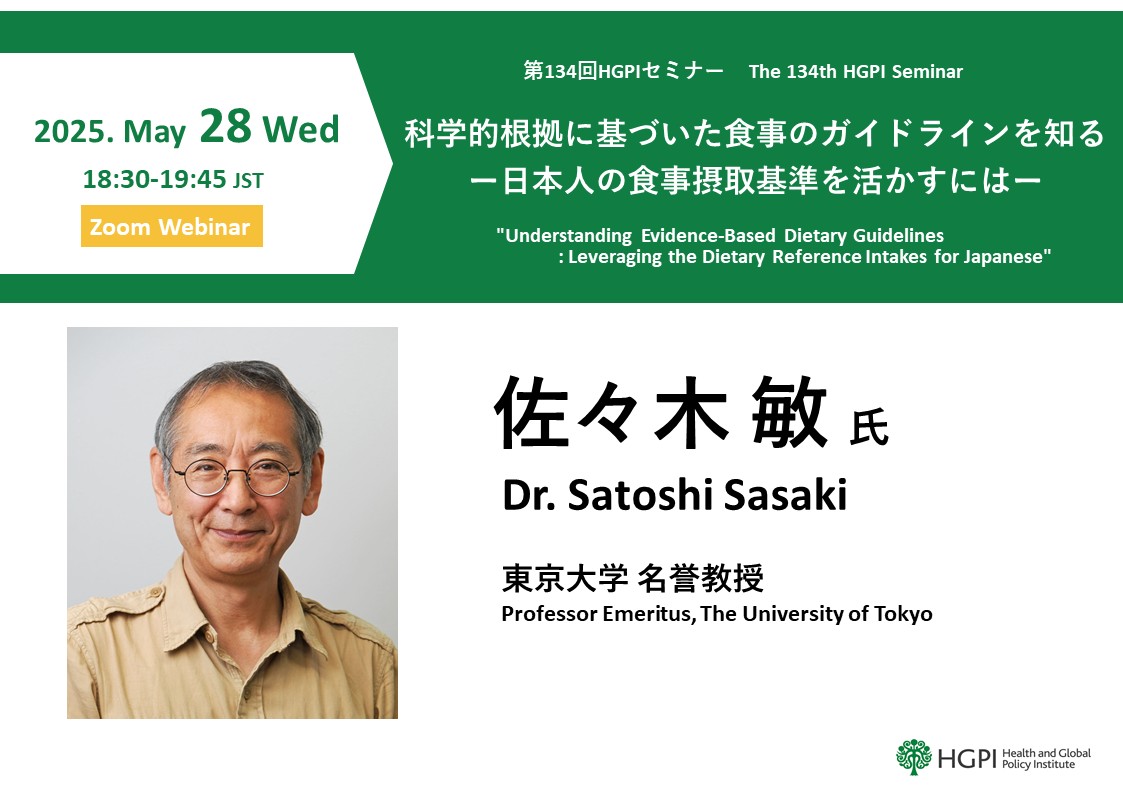
[Event Report] The 134th HGPI Seminar "Understanding Evidence-Based Dietary Guidelines: Leveraging the Dietary Reference Intakes for Japanese" (May 28, 2025)
-
2025-06-09
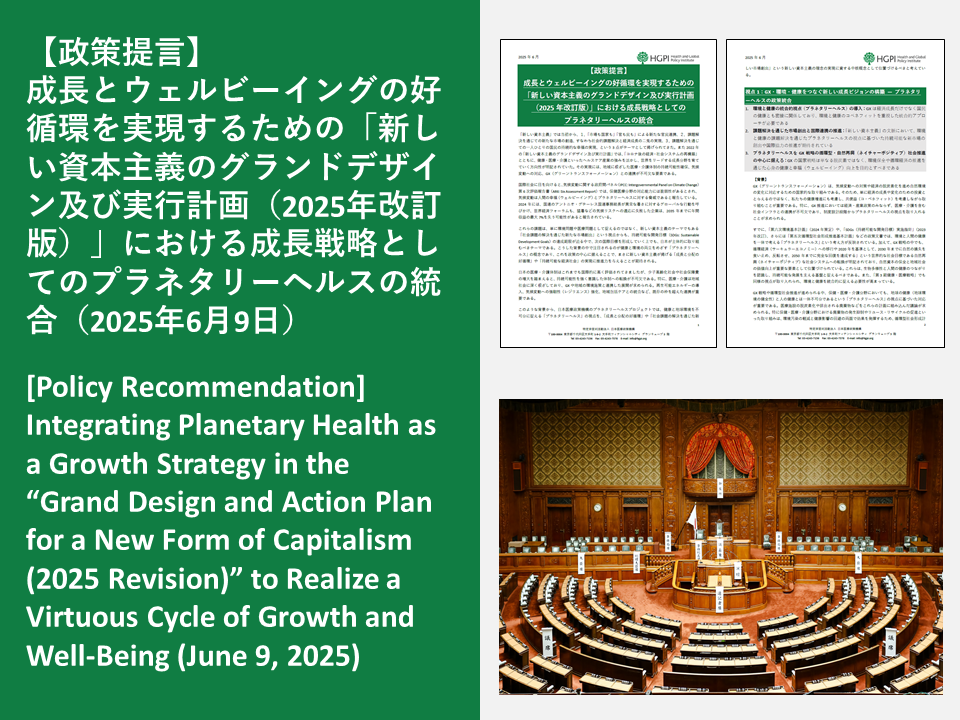
[Policy Recommendation] Integrating “Planetary Health” as a Growth Strategy — Proposal for the Grand Design and Action Plan for a New Form of Capitalism (2025 Revised Edition) (June 9, 2025)
-
2025-06-09
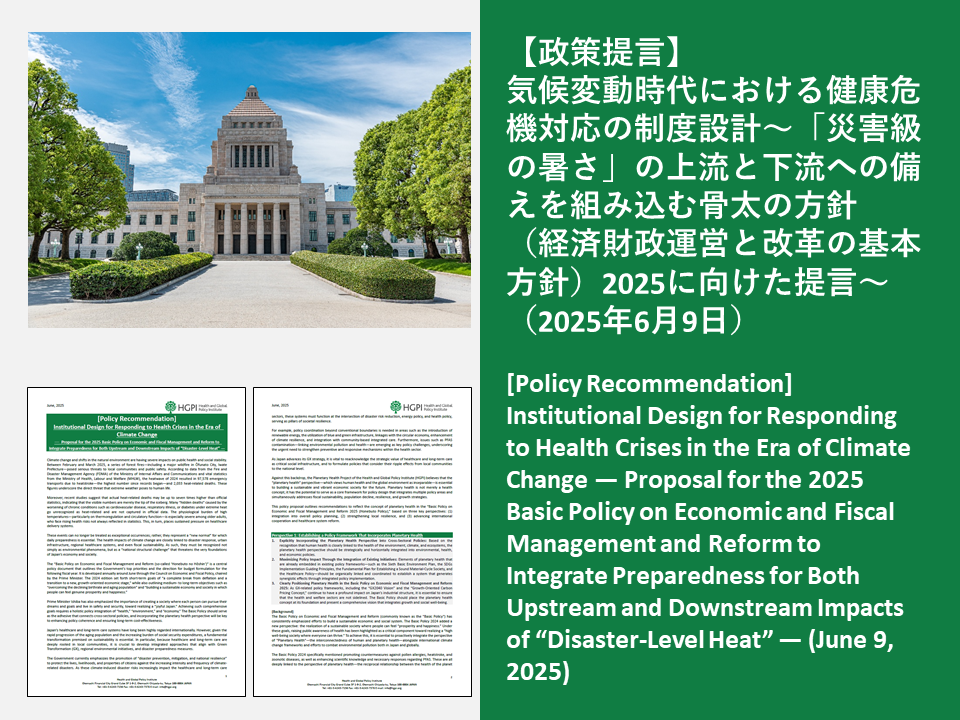
[Policy Recommendation] Preparing for “Disaster-Level Heat” in the 2025 Basic Policy on Economic and Fiscal Management and Reform (June 9, 2025)
-
2025-07-02
[HGPI Policy Column] (No.61) — From the Planetary Health Project “Part 15: WHO's Response to the Climate and Health Crisis: The Global Action Plan on Climate Change and Health”
Top Research & Recommendations Posts
Featured Posts
-
2026-05-18
[Registration Closed] Kick-off Panel Discussion “From Africa and Japan, Drawing from Perspectives Around the World:A Platform for Cultivating a Philosophical Health Dialogue Together” (June 15, 2026)
![[Registration Closed] Kick-off Panel Discussion “From Africa and Japan, Drawing from Perspectives Around the World:A Platform for Cultivating a Philosophical Health Dialogue Together” (June 15, 2026)](https://hgpi.org/en/wp-content/uploads/sites/2/HGPI_20260615_Eyecathch_panel-discussion-From-Japan-and-Africa-in-Discussion-with-the-World_2.png)
-
2026-08-28
[Announcement] The 3rd Kiyoshi Kurokawa Award: Call for Nominations (Deadline: November 30, 2026)
![[Announcement] The 3rd Kiyoshi Kurokawa Award: Call for Nominations (Deadline: November 30, 2026)](https://hgpi.org/en/wp-content/uploads/sites/2/Kiyoshi-Kurokawa-Award_3rd_nominations_eyecatch_caseB_ENG_web_20260929_v0.5.jpg)
-
2026-09-01
[Registration Closed] HGPI Salon 2025-2026 Looking Ahead to the Future of Japan’s Social Security System “Session 6: Japan’s Health Policy through the Lens of Global Security” (October 13, 2026)
![[Registration Closed] HGPI Salon 2025-2026 Looking Ahead to the Future of Japan’s Social Security System “Session 6: Japan’s Health Policy through the Lens of Global Security” (October 13, 2026)](https://hgpi.org/en/wp-content/uploads/sites/2/HGPISalon2025-20266.png)
-
2026-09-17
[Registration Open] (Webinar) The 145th HGPI Seminar “Toward Better AMR Measures at Elderly Care Facilities—Considering Infectious Disease Control in a Super-Aged Society From a Policy Perspective” (October 27, 2026)
![[Registration Open] (Webinar) The 145th HGPI Seminar “Toward Better AMR Measures at Elderly Care Facilities—Considering Infectious Disease Control in a Super-Aged Society From a Policy Perspective” (October 27, 2026)](https://hgpi.org/en/wp-content/uploads/sites/2/HGPIseminar145.png)
-
2026-10-06
[Registration Open] (Webinar) The 146th HGPI Seminar “How We Can Build a Society That Supports Choices Around Organ Donation: Exploring Decision-Making by Citizens and a Multi-Layered Approach Through Strategic Social Marketing” (November 9, 2026)
![[Registration Open] (Webinar) The 146th HGPI Seminar “How We Can Build a Society That Supports Choices Around Organ Donation: Exploring Decision-Making by Citizens and a Multi-Layered Approach Through Strategic Social Marketing” (November 9, 2026)](https://hgpi.org/en/wp-content/uploads/sites/2/HGPI_20261001_Eyecatch_HGPIseminer-146th-1.png)
