


[Public Comment Submission] Cancer Project “Basic Plan for Genomic Medicine Policies (Draft)” (August 1, 2025)
date : 8/20/2025
Tags: Cancer, NCDs, Precision Cancer Medicine

![[Public Comment Submission] Cancer Project “Basic Plan for Genomic Medicine Policies (Draft)” (August 1, 2025)](https://hgpi.org/en/wp-content/uploads/sites/2/ncd-pcm-20250801-top.png)
Health and Global Policy Institute (HGPI) Cancer Project has submitted public comments on the “Basic Plan for Genomic Medicine Policies (Draft)” by Research and Development Policy Division, Medical Affairs Bureau, Ministry of Health, Labour and Welfare. Please note that the call for public comments has already ended.
This plan (draft) is based on the “Genome Medicine Promotion Act (Act on the Comprehensive and Systematic Promotion of Policies to Ensure that the Public Can Receive High-Quality and Appropriate Genome Medicine with Peace of Mind)”, enacted in 2023, and outlines the basic policy direction for genome medicine that the government should pursue over the next five years starting in fiscal year 2025.
With the advancement of human genome sequencing, “genome medicine,” which utilizes individual genetic information for the diagnosis and treatment of diseases such as cancer, intractable diseases, and rare diseases, is rapidly expanding. In particular, the reimbursement coverage of cancer gene panel testing (2019) marked the beginning of the full-scale clinical implementation of genome medicine.
On the other hand, the following issues have been pointed out regarding the spread and sustainable development of genomic medicine:
- Due to the high level of specialization required, the number of medical institutions that can provide genomic medicine is limited.
- The results of genomic medicine research should be further returned to patients to inform them.
- It is necessary to deepen the public’s understanding of the characteristics of genomic information and to ensure that ethical considerations are fully understood.
In order to overcome these challenges and realize a patient-centered, reliable genomic medicine system, it is essential to establish a “virtuous cycle of medical care and research.” This plan comprehensively presents a wide range of measures centered on “improving the provision system,” “promoting research and development,” “developing human resources,” and “addressing ethical issues.”
Based on insights gained from ongoing discussions and surveys with experts and stakeholders through previous projects, our organization submitted public comments with the aim of further enhancing this plan. The comments focused on the following points.
Key Points of the Public Comment
- The significance and benefits of genomic medicine (improved quality of prevention, diagnosis, and treatment; personalized medicine; overcoming cancer and intractable diseases) should be properly communicated to the public in comprehensible and accessible manner.
- In order to appropriately use genomic information as part of standard treatment, it is necessary to promote the development of education systems, collaboration, and consultation support not only at core hospitals for cancer genomic medicine but also at cancer treatment collaboration hospitals.
- The system that limits cancer gene panel testing to ‘after standard treatment has ended (or is expected to end)’ should be reviewed, and a system should be considered and established that allows testing to be conducted flexibly at a timing that is relevant to treatment. Additionally, simplification of the expert panel should also be considered.
- Flexibility should be introduced to allow expanded clinical trials to be conducted on a case-by-case basis, and an environment should be established that facilitates the implementation of patient assistance programs, with the aim of improving access to unapproved drugs and off-label drugs.
- A framework for PPI (Patient and Public Involvement) should be established to enable citizens and patients to participate from the planning and design stages of genomic research, and collaborative and dialogue-based platforms should be established.
- To improve the quality of counselling support and secure human resources, institutional reforms including the national certification of genetic counsellors should be considered.
For more detailed information on this public comment, please check here.
Related Posts
-

2025-07-29
[Event Report] Invitation-Only Policy Dialogue Event “Considering Comprehensive Genomic Profiling from the Perspective of Patient Access: Utilizing the Medical Service Fee Reimbursement System and the Mixed Medical Services Program to Meet the Needs of Today” (July 14, 2025)
-
2025-07-14
[Policy Recommendation] Ensuring Equitable Access to Cancer Gene Panel Testing and Key Considerations for Applying the Mixed Medical Services Program (April 28, 2025)
-
2025-03-28
[Policy Recommendations] Cancer Control Project "Policy Recommendations on Addressing Regional Disparities in Breast Cancer Care" (January 31, 2025)
-
2024-11-27
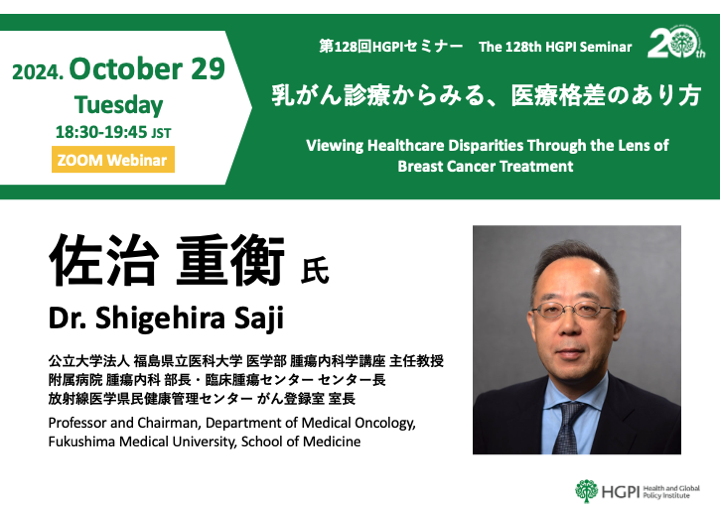
[Event Report] The 128th HGPI Seminar “Viewing Healthcare Disparities Through the Lens of Breast Cancer Treatment” (October 29, 2024)
Top Research & Recommendations Posts
Featured Posts
-
2026-05-18
[Registration Closed] Kick-off Panel Discussion “From Africa and Japan, Drawing from Perspectives Around the World:A Platform for Cultivating a Philosophical Health Dialogue Together” (June 15, 2026)
![[Registration Closed] Kick-off Panel Discussion “From Africa and Japan, Drawing from Perspectives Around the World:A Platform for Cultivating a Philosophical Health Dialogue Together” (June 15, 2026)](https://hgpi.org/en/wp-content/uploads/sites/2/HGPI_20260615_Eyecathch_panel-discussion-From-Japan-and-Africa-in-Discussion-with-the-World_2.png)
-
2026-08-28
[Announcement] The 3rd Kiyoshi Kurokawa Award: Call for Nominations (Deadline: November 30, 2026)
![[Announcement] The 3rd Kiyoshi Kurokawa Award: Call for Nominations (Deadline: November 30, 2026)](https://hgpi.org/en/wp-content/uploads/sites/2/Kiyoshi-Kurokawa-Award_3rd_nominations_eyecatch_caseB_ENG_web_20260929_v0.5.jpg)
-
2026-09-01
[Registration Closed] HGPI Salon 2025-2026 Looking Ahead to the Future of Japan’s Social Security System “Session 6: Japan’s Health Policy through the Lens of Global Security” (October 13, 2026)
![[Registration Closed] HGPI Salon 2025-2026 Looking Ahead to the Future of Japan’s Social Security System “Session 6: Japan’s Health Policy through the Lens of Global Security” (October 13, 2026)](https://hgpi.org/en/wp-content/uploads/sites/2/HGPISalon2025-20266.png)
-
2026-09-17
[Registration Open] (Webinar) The 145th HGPI Seminar “Toward Better AMR Measures at Elderly Care Facilities—Considering Infectious Disease Control in a Super-Aged Society From a Policy Perspective” (October 27, 2026)
![[Registration Open] (Webinar) The 145th HGPI Seminar “Toward Better AMR Measures at Elderly Care Facilities—Considering Infectious Disease Control in a Super-Aged Society From a Policy Perspective” (October 27, 2026)](https://hgpi.org/en/wp-content/uploads/sites/2/HGPIseminar145.png)
-
2026-10-06
[Registration Open] (Webinar) The 146th HGPI Seminar “How We Can Build a Society That Supports Choices Around Organ Donation: Exploring Decision-Making by Citizens and a Multi-Layered Approach Through Strategic Social Marketing” (November 9, 2026)
![[Registration Open] (Webinar) The 146th HGPI Seminar “How We Can Build a Society That Supports Choices Around Organ Donation: Exploring Decision-Making by Citizens and a Multi-Layered Approach Through Strategic Social Marketing” (November 9, 2026)](https://hgpi.org/en/wp-content/uploads/sites/2/HGPI_20261001_Eyecatch_HGPIseminer-146th-1.png)
