


[Public Comment Submission] The UN Special Rapporteur’s Call for Input on Protecting Clean Air (October 16, 2025)
date : 11/27/2025
Tags: Planetary Health

![[Public Comment Submission] The UN Special Rapporteur’s Call for Input on Protecting Clean Air (October 16, 2025)](https://hgpi.org/en/wp-content/uploads/sites/2/HGPI_20251128_UN-Clean-Air.png)
Health and Global Policy Institute (HGPI) submitted its input to the United Nations Special Rapporteur on the human right to a healthy environment in response to the Call for Inputs on Protecting Clean Air. The submission draws on Japan’s decades-long experience addressing the health risks posed by air pollution and the evolution of environmental policies and social measures.
The Special Rapporteur’s Call for Inputs aims to:
- Validate the obligation for all people to enjoy the human right to a safe, clean, healthy, and sustainable environment.
- Promote best practices in air quality management.
- Identify gaps, challenges, and emerging issues that require international attention.
HGPI’s submission emphasizes Japan’s experience in addressing the health and social impacts of environmental pollution stemming from rapid economic development, providing lessons for international policy and practice. The key points are summarized below:
Japan’s Experience
- During the rapid economic growth period from the 1950s to early 1970s, large-scale industrial emissions caused serious air pollution across Japan.
- “Four major pollution diseases,” such as Yokkaichi asthma, highlighted the urgent need to protect public health and shaped policy and public opinion.
- While Japan’s measures were not explicitly framed as “human rights,” policies prioritized protecting health, supporting affected communities, and holding polluters accountable through litigation, reflecting social justice considerations.
Evolution of Policies and Institutions
- The Basic Law on Pollution Control (1967) introduced environmental standards.
- Following the 1970 “Pollution Diet,” 14 pollution-related laws were enacted, and the Environment Agency (predecessor to the Ministry of the Environment) was established, marking a shift toward independent environmental governance.
- The Pollution and Health Damage Compensation Act (1973) established compensation mechanisms and codified the principle that polluters bear responsibility.
- The Automobile NOx and PM Act (1992, revised 2001) addressed traffic-related air pollution, reducing asthma and other health hazards along major roads.
Policy-Driven Initiatives and Future Challenges
- Nationwide real-time monitoring through AEROS (“Soramame-kun”) provides essential air quality data.
- Large-scale epidemiological studies such as the SORA Project and the National Survey on Children’s Health and Environment (JECS) strengthen the evidence base for policy.
- Integration of Health Impact Assessment (HIA) into Environmental Impact Assessment (EIA) is crucial for equitable health outcomes.
- Initiatives such as Yokkaichi City’s Pollution and Environment Miraikan and regional apps by Osaka and Tokyo governments (e.g., TOKYO Air Information App) demonstrate effective community-level engagement.
- Promoting emissions reduction across domestic and international supply chains via the Green Value Chain Platform underscores the importance of addressing cross-border environmental justice.
At the 61st session of the UN Human Rights Council (Geneva, February 23 – April 2, 2026), the Special Rapporteur’s thematic report on Protecting Clean Air will be officially submitted and presented. The session will include an interactive dialogue between member states, NGOs, and the Special Rapporteur, providing opportunities to exchange views, highlight concerns, and deepen understanding of the human right to clean air. Necessary measures and a draft resolution based on the report’s findings are expected to be adopted at the end of the session.
HGPI will continue to support and engage with such initiatives, contributing insights and encouraging dialogue to advance the realization of the human right to clean air domestically and globally.

Related Posts
-
2025-04-04
[Announcement] HGPI Joins Call to Action from Health Community “Stop Polluting the Air We Breathe: Prevent Diseases and Save Lives” (March 17, 2025)
-
2025-11-26
[Announcement] HGPI Endorses the “Let’s adapt” Campaign by the National Institute for Environmental Studies (August 19, 2025)
-
2025-11-17
[Announcement] HGPI Endorses the “Belém Health Action Plan” (November 14, 2025)
-
2025-11-17
[Announcement] HGPI Endorsed “Negotiating to Protect Health and Lives: Recommendations for COP30” (October 29, 2025)
-
2025-10-15
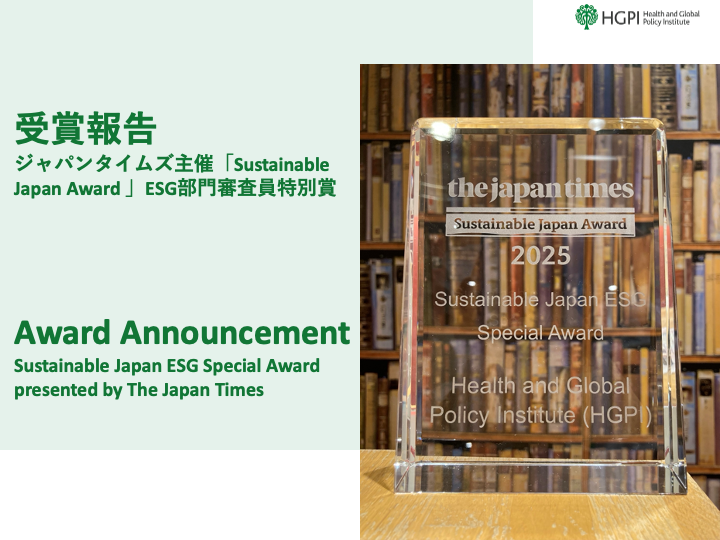
[Award Report] Sustainable Japan Award 2025 (ESG Category) (The Japan Times, September 18, 2025)
-
2025-10-10
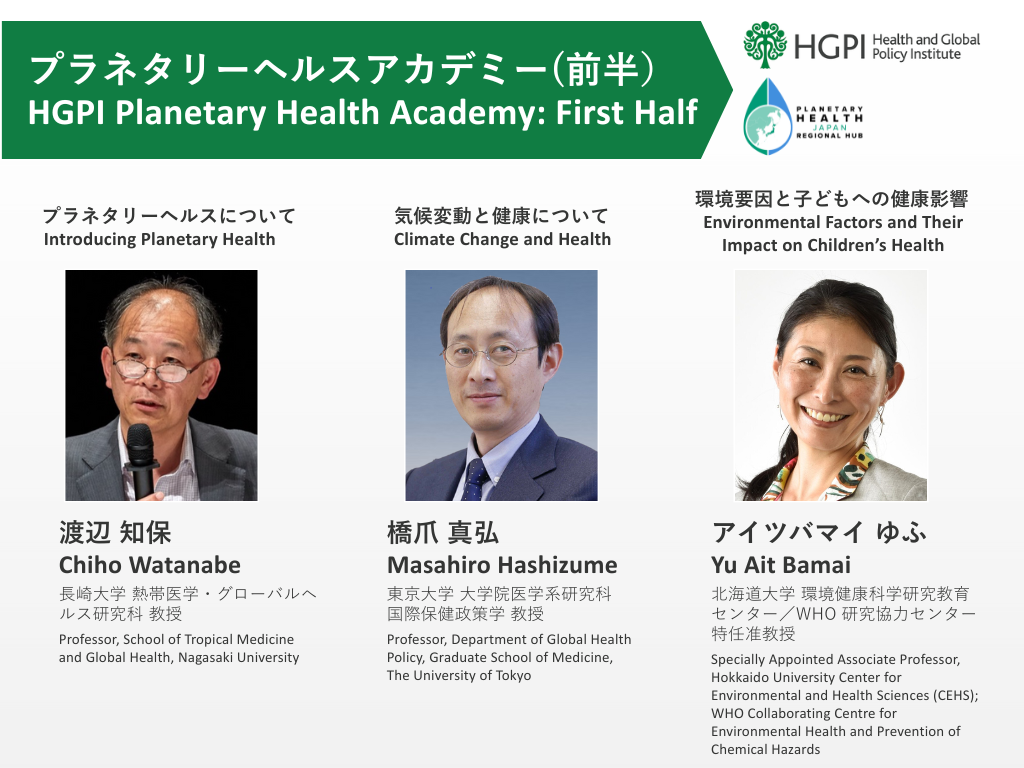
[Event Report] Planetary Health Academy: First Half (August 27-September 24, 2025)
-
2025-07-02
[HGPI Policy Column] (No.61) — From the Planetary Health Project “Part 15: WHO's Response to the Climate and Health Crisis: The Global Action Plan on Climate Change and Health”
-
2025-06-09
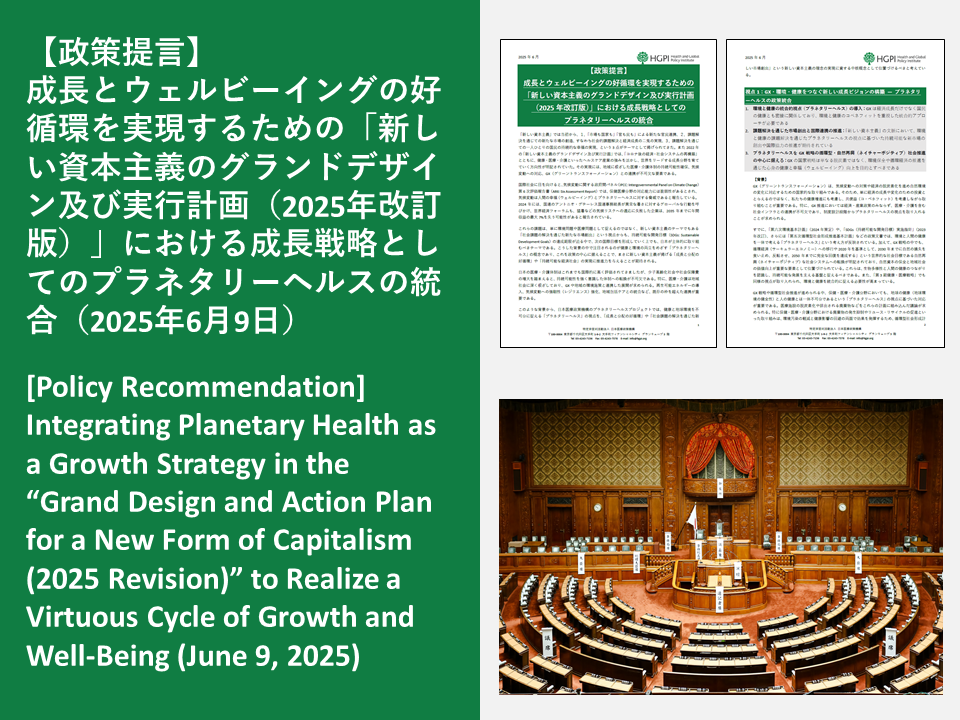
[Policy Recommendation] Integrating “Planetary Health” as a Growth Strategy — Proposal for the Grand Design and Action Plan for a New Form of Capitalism (2025 Revised Edition) (June 9, 2025)
Top Research & Recommendations Posts
Featured Posts
-
2026-05-18
[Registration Closed] Kick-off Panel Discussion “From Africa and Japan, Drawing from Perspectives Around the World:A Platform for Cultivating a Philosophical Health Dialogue Together” (June 15, 2026)
![[Registration Closed] Kick-off Panel Discussion “From Africa and Japan, Drawing from Perspectives Around the World:A Platform for Cultivating a Philosophical Health Dialogue Together” (June 15, 2026)](https://hgpi.org/en/wp-content/uploads/sites/2/HGPI_20260615_Eyecathch_panel-discussion-From-Japan-and-Africa-in-Discussion-with-the-World_2.png)
-
2026-08-28
[Announcement] The 3rd Kiyoshi Kurokawa Award: Call for Nominations (Deadline: November 30, 2026)
![[Announcement] The 3rd Kiyoshi Kurokawa Award: Call for Nominations (Deadline: November 30, 2026)](https://hgpi.org/en/wp-content/uploads/sites/2/Kiyoshi-Kurokawa-Award_3rd_nominations_eyecatch_caseB_ENG_web_20260929_v0.5.jpg)
-
2026-09-01
[Registration Closed] HGPI Salon 2025-2026 Looking Ahead to the Future of Japan’s Social Security System “Session 6: Japan’s Health Policy through the Lens of Global Security” (October 13, 2026)
![[Registration Closed] HGPI Salon 2025-2026 Looking Ahead to the Future of Japan’s Social Security System “Session 6: Japan’s Health Policy through the Lens of Global Security” (October 13, 2026)](https://hgpi.org/en/wp-content/uploads/sites/2/HGPISalon2025-20266.png)
-
2026-09-17
[Registration Open] (Webinar) The 145th HGPI Seminar “Toward Better AMR Measures at Elderly Care Facilities—Considering Infectious Disease Control in a Super-Aged Society From a Policy Perspective” (October 27, 2026)
![[Registration Open] (Webinar) The 145th HGPI Seminar “Toward Better AMR Measures at Elderly Care Facilities—Considering Infectious Disease Control in a Super-Aged Society From a Policy Perspective” (October 27, 2026)](https://hgpi.org/en/wp-content/uploads/sites/2/HGPIseminar145.png)
-
2026-10-06
[Registration Open] (Webinar) The 146th HGPI Seminar “How We Can Build a Society That Supports Choices Around Organ Donation: Exploring Decision-Making by Citizens and a Multi-Layered Approach Through Strategic Social Marketing” (November 9, 2026)
![[Registration Open] (Webinar) The 146th HGPI Seminar “How We Can Build a Society That Supports Choices Around Organ Donation: Exploring Decision-Making by Citizens and a Multi-Layered Approach Through Strategic Social Marketing” (November 9, 2026)](https://hgpi.org/en/wp-content/uploads/sites/2/HGPI_20261001_Eyecatch_HGPIseminer-146th-1.png)
