


[Policy Recommendations] Strengthening Lifelong Mental Health Support for Children with Intellectual Disabilities (April 30, 2025)
date : 4/30/2025
Tags: Child Health

![[Policy Recommendations] Strengthening Lifelong Mental Health Support for Children with Intellectual Disabilities (April 30, 2025)](https://hgpi.org/en/wp-content/uploads/sites/2/ch-20250430-top.jpg)

Health and Global Policy Institute (HGPI) has presented policy recommendations titled, “Strengthening Lifelong Mental Health Support for Children with Intellectual Disabilities.” For details, please see the PDF linked below. Please note that the full document is available in Japanese only.
In addition to sound physical health, good mental health is an essential part of a happy and fulfilling life. For children in the developmental stages, support for mental health can be a foundation for growth, social participation, and independent living, and the right support at the right time can foster autonomy and wellbeing. In light of this, Health and Global Policy Institute (HGPI) recognizes children’s health as a key item on the health policy agenda and launched its Child Health Project in FY2020. In that project, we held a series of advisory board meetings, interviews, and expert meetings with opinion leaders and various related organizations from industry, government, academia, and civil society during which we used quantitative data to crystallize discussion points and consider policy solutions for mental health-related issues that lie at the intersection of physical, mental, and socioeconomic development. To gather that data, we conducted intervention surveys with elementary and middle school students in FY2021 and with kindergarten teachers, nursery school teachers, and others who support preschoolers in FY2022. In August 2023, together with the Japan Society for Stress Management, we presented policy recommendations titled, “Steps for Implementing Children’s Stress Management in Society.”
Based on this knowledge, with support from the Nippon Foundation, our FY2024 activities aimed to establish a mental health support system for children with intellectual disabilities and to further expand opportunities for the early detection and intervention of mental disorders. As part of these efforts, we developed and carried out a skill development program for promoting mental health for high school students with intellectual disabilities. After implementing the program, we also conducted an effectiveness assessment to gauge its impact. We then compiled policy recommendations that reflect our findings and interviews with specialists and supporters. We aim to broadly disseminate these recommendations to policy makers and other key parties in hopes of creating a future in which children with intellectual disabilities can grow up with peace of mind and live true to themselves as full members of society.
Overview of policy recommendations
Perspective 1: Strengthening mental health support in special support schools
- Increase or cultivate school counselors who can provide tailored responses to children with disabilities that match their characteristics and needs
- Strengthen support for school personnel by placing specialists in psychiatry who can be deeply involved in daily education at schools, such as by assigning them as teachers
- Introduce mental health programs that match the needs and circumstances of each school and are comprehensive from the perspective of prevention
Perspective 2: Establishing systems providing seamless mental health support before and after graduation
- Develop a support system that provides continuous support regardless of affiliation and makes full use of regional centers for developmental support
- Expand mental health support measures that can be implemented by small and medium enterprises
Related Posts
-
2025-02-07
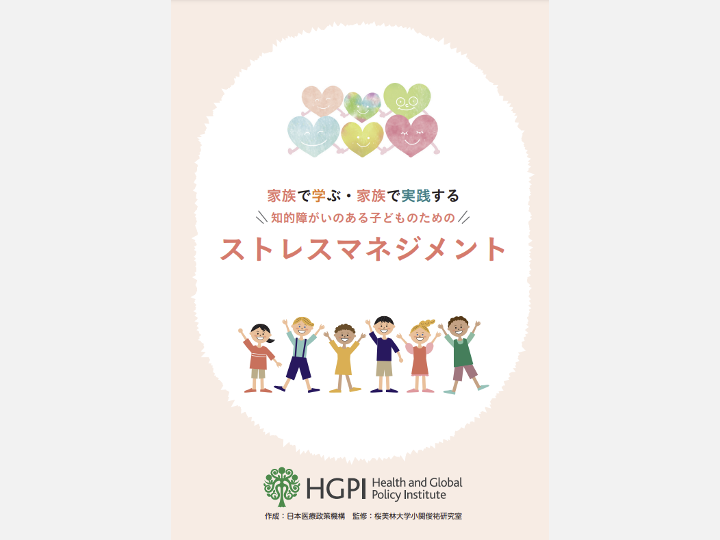
[Publication Report] The Child Health Project Publishes Family Mental Health Booklet “Learning and Practicing at Home – Stress Management for Children with Intellectual Disabilities” (February 3, 2025)
-
2025-01-31
[In the Media] Introduction of HGPI Child Health Project’s e-learning program on stress management for children with intellectual disabilities and their guardians published on Child Lab (Child Lab, January 29, 2025)
-
2024-04-16
[Activity Report] HGPI Child Health Project Selected to Implement FY2024 Nippon Foundation Grant Program, “Establishing a Skill Development Program and Collaborative Network for Improving Mental Health for Students with Intellectual Disabilities” (April 15, 2024)
-
2023-08-31
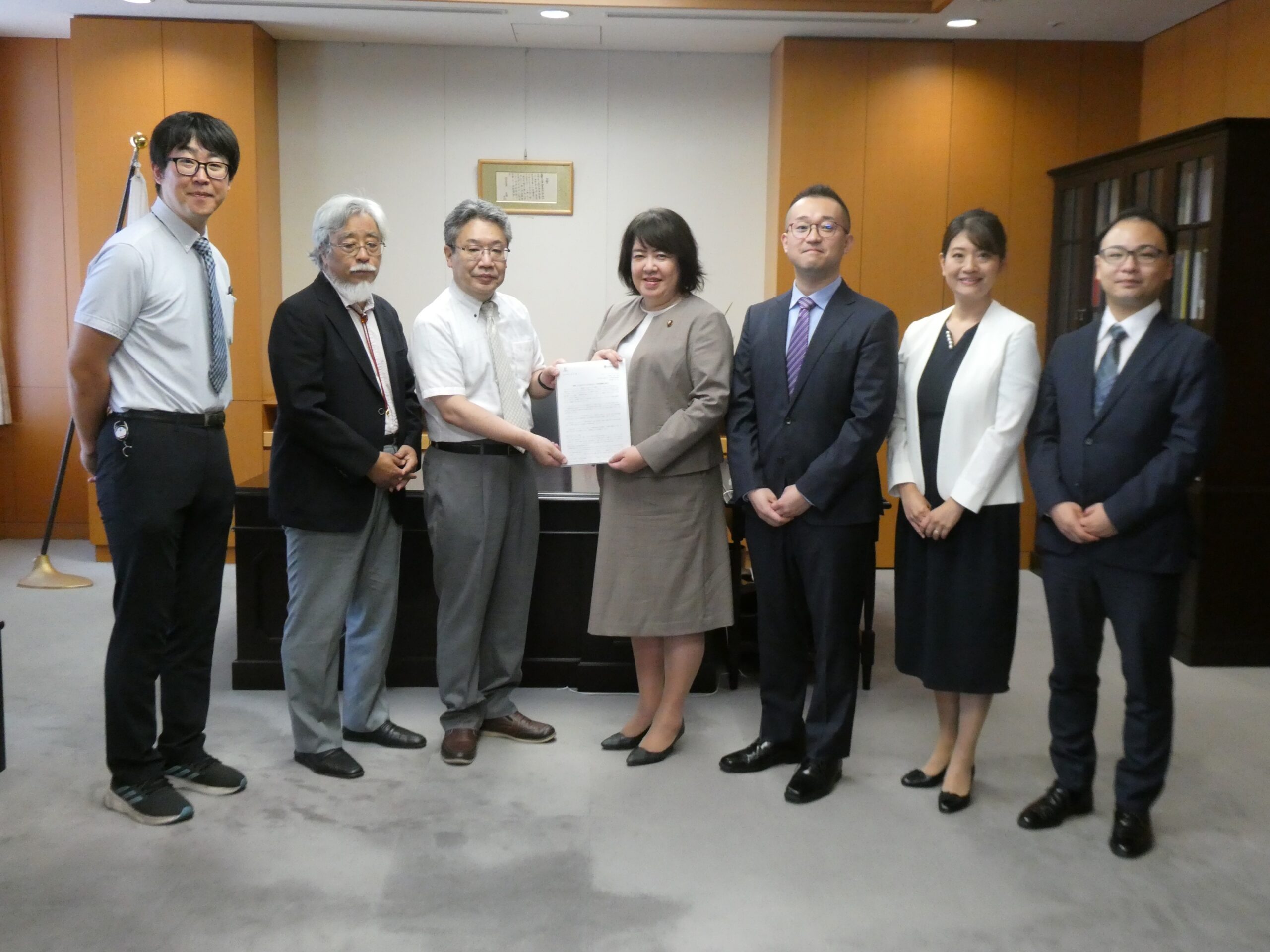
[Activity Report] HGPI and Japan Society of Stress Management Submit Recommendations on Stress Management Education (August 10, 2023)
-
2023-03-22
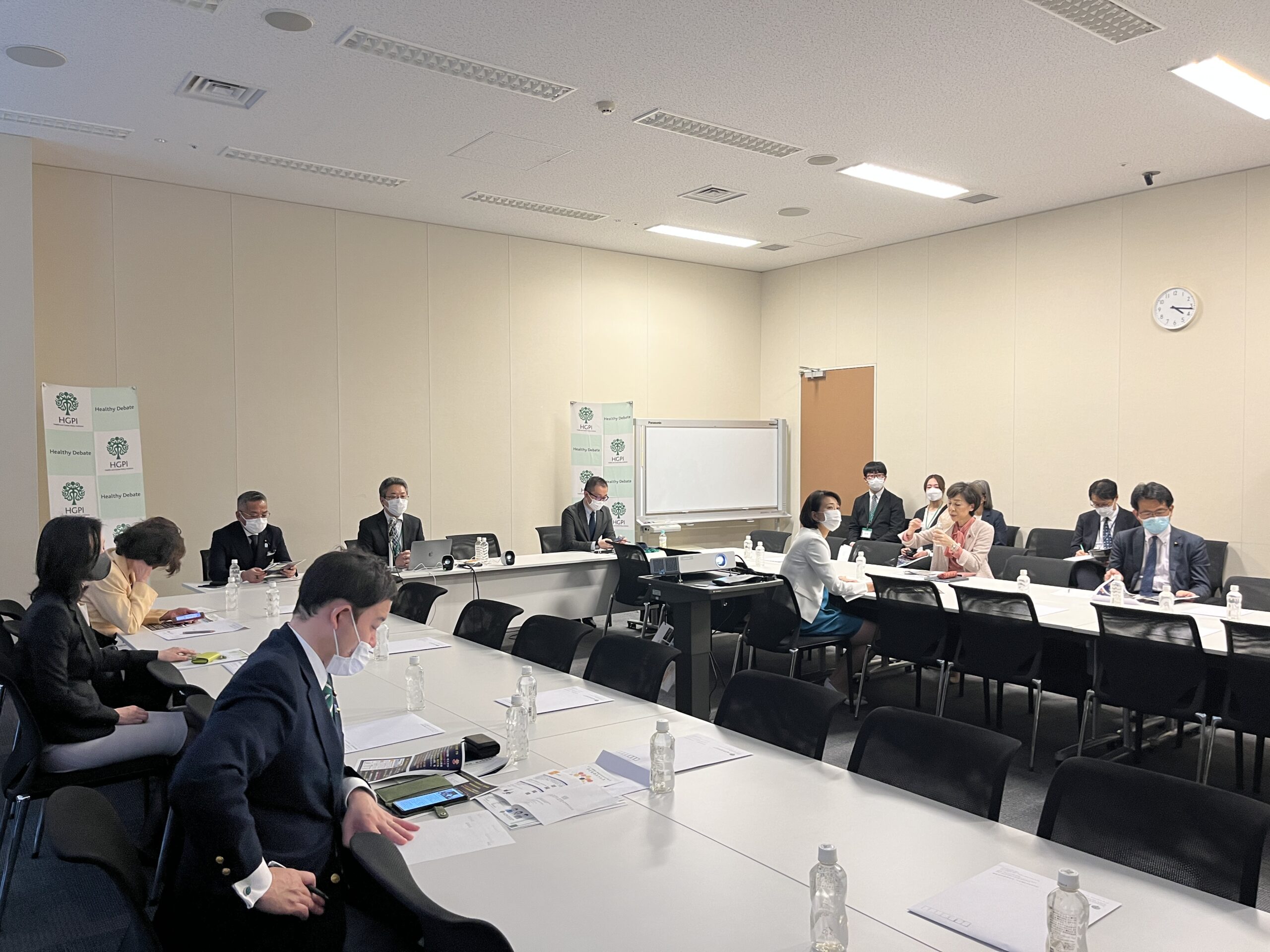
[Event Report] Non-partisan Diet Member Briefing – 30-minute Health Policy Update: “Considering Children’s Mental Health – Issues in Classrooms and Stress Management” (March 9, 2023)
-
2023-03-10
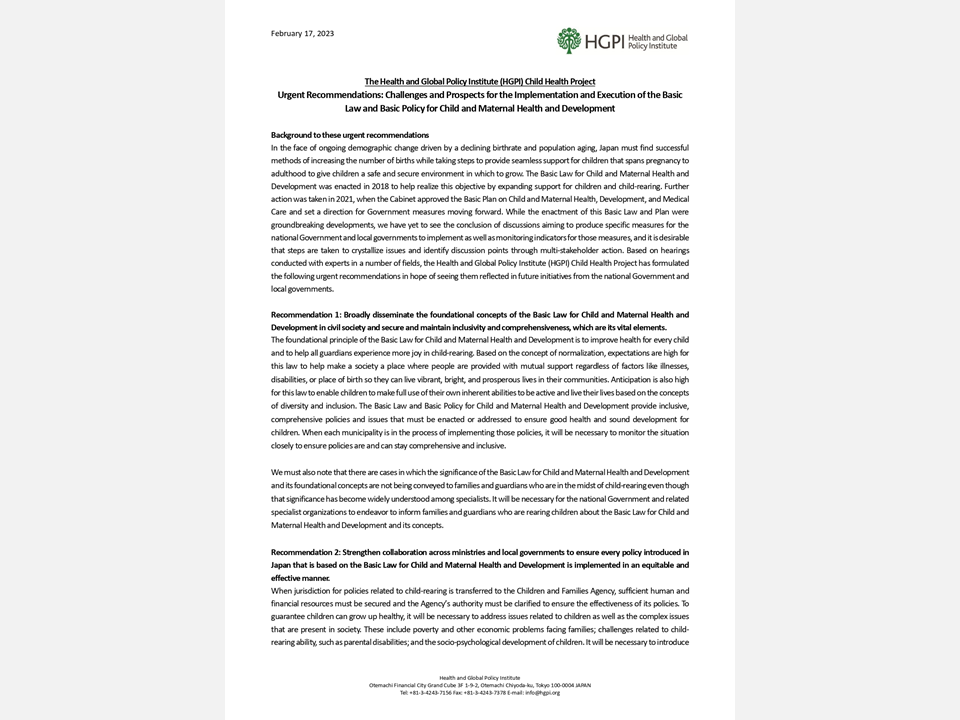
[Urgent Recommendations] Challenges and Prospects for the Implementation and Execution of the Basic Law and Basic Policy for Child and Maternal Health and Development (February 17, 2023)
-
2023-02-07
[Recommendations] Strengthening Mental Health Care for Kindergarten Teachers, Nursery School Teachers, Other Child Care Providers and Parents and Guardians of Preschoolers (February 7, 2023)
-
2023-02-06
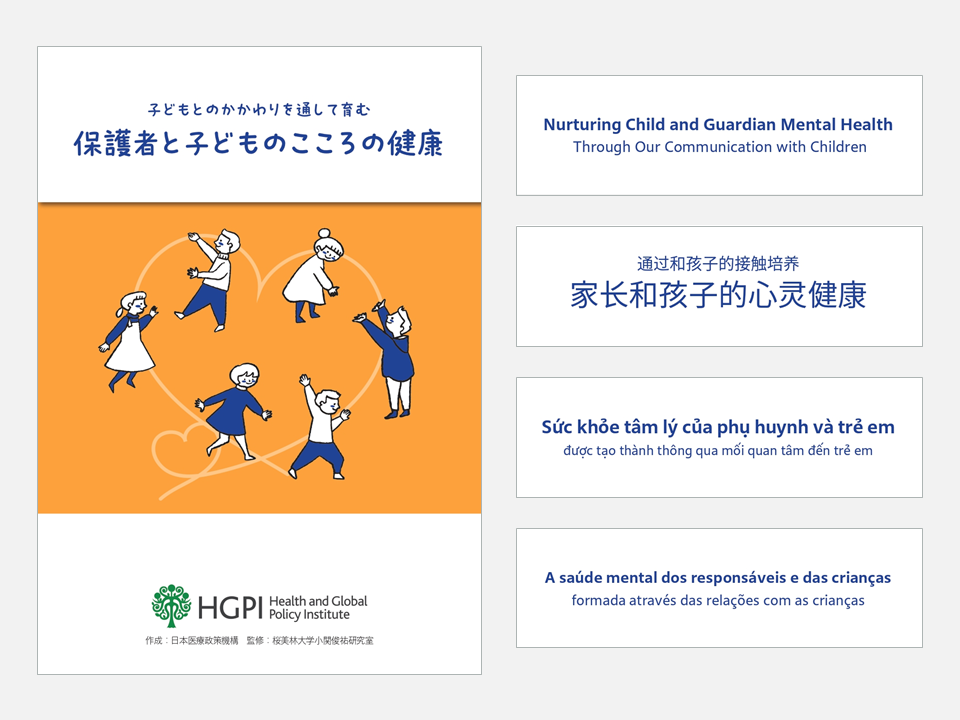
[Publication Report] The Children’s Health Project Publishes Family Mental Health Booklet “Nurturing Child and Guardian Mental Health through Our Communication with Children” in Five Languages (February 6, 2023)
Top Research & Recommendations Posts
Featured Posts
-
2026-05-18
[Registration Closed] Kick-off Panel Discussion “From Africa and Japan, Drawing from Perspectives Around the World:A Platform for Cultivating a Philosophical Health Dialogue Together” (June 15, 2026)
![[Registration Closed] Kick-off Panel Discussion “From Africa and Japan, Drawing from Perspectives Around the World:A Platform for Cultivating a Philosophical Health Dialogue Together” (June 15, 2026)](https://hgpi.org/en/wp-content/uploads/sites/2/HGPI_20260615_Eyecathch_panel-discussion-From-Japan-and-Africa-in-Discussion-with-the-World_2.png)
-
2026-08-28
[Announcement] The 3rd Kiyoshi Kurokawa Award: Call for Nominations (Deadline: November 30, 2026)
![[Announcement] The 3rd Kiyoshi Kurokawa Award: Call for Nominations (Deadline: November 30, 2026)](https://hgpi.org/en/wp-content/uploads/sites/2/Kiyoshi-Kurokawa-Award_3rd_nominations_eyecatch_caseB_ENG_web_20260929_v0.5.jpg)
-
2026-09-01
[Registration Closed] HGPI Salon 2025-2026 Looking Ahead to the Future of Japan’s Social Security System “Session 6: Japan’s Health Policy through the Lens of Global Security” (October 13, 2026)
![[Registration Closed] HGPI Salon 2025-2026 Looking Ahead to the Future of Japan’s Social Security System “Session 6: Japan’s Health Policy through the Lens of Global Security” (October 13, 2026)](https://hgpi.org/en/wp-content/uploads/sites/2/HGPISalon2025-20266.png)
-
2026-09-17
[Registration Open] (Webinar) The 145th HGPI Seminar “Toward Better AMR Measures at Elderly Care Facilities—Considering Infectious Disease Control in a Super-Aged Society From a Policy Perspective” (October 27, 2026)
![[Registration Open] (Webinar) The 145th HGPI Seminar “Toward Better AMR Measures at Elderly Care Facilities—Considering Infectious Disease Control in a Super-Aged Society From a Policy Perspective” (October 27, 2026)](https://hgpi.org/en/wp-content/uploads/sites/2/HGPIseminar145.png)
-
2026-10-06
[Registration Open] (Webinar) The 146th HGPI Seminar “How We Can Build a Society That Supports Choices Around Organ Donation: Exploring Decision-Making by Citizens and a Multi-Layered Approach Through Strategic Social Marketing” (November 9, 2026)
![[Registration Open] (Webinar) The 146th HGPI Seminar “How We Can Build a Society That Supports Choices Around Organ Donation: Exploring Decision-Making by Citizens and a Multi-Layered Approach Through Strategic Social Marketing” (November 9, 2026)](https://hgpi.org/en/wp-content/uploads/sites/2/HGPI_20261001_Eyecatch_HGPIseminer-146th-1.png)
