


[Event Report] The 131st HGPI Seminar “The Policy Process of the Kyoto City Caregiver Support Ordinance” (March 19, 2025)
date : 5/12/2025
Tags: Dementia, HGPI Seminar

![[Event Report] The 131st HGPI Seminar “The Policy Process of the Kyoto City Caregiver Support Ordinance” (March 19, 2025)](https://hgpi.org/en/wp-content/uploads/sites/2/131stHGPISeminar-eyecatch-2.png)
For the 131st HGPI Seminar, we hosted Professor Masatoshi Tsudome, Professor Emeritus of Ritsumeikan University. Using the enactment of the Kyoto City Caregiver Support Ordinance as a case study, Professor Tsudome talked about circumstances and issues surrounding support for Japan’s caregivers and examined future prospects in this area.
<POINTS>
- The “Kyoto City Ordinance for the Promotion of Caregiver Support” (hereinafter, the “Kyoto City Caregiver Support Ordinance”) aims to transform caregiving from a “responsibility of the family” to a “framework for all-of-society support.” It provides a noteworthy example of an ordinance established under the leadership of citizens, particularly those living with health concerns and supporters.
- The process of enacting the ordinance included paying close attention to the voices of related parties and reflecting the history and culture of Kyoto caregiving in the ordinance’s preamble. The preamble also includes a comprehensive definition of young caregivers, inclusion for linguistic minorities, clear mention of involving affected parties in advancing measures, and the government’s responsibility to implement financial measures for caregiver support. In doing so, it aims to create a highly effective support system that matches real-world circumstances for caregivers.
- Future challenges for full-scale operations under the ordinance include how to make certain aspects directly related to support measures a reality, such as the formulation of promotion plans or the establishment of opportunities for deliberation. Continuous and proactive involvement from citizens and affected parties will be essential in achieving caregiver support that will allow people to truly feel the significance of the ordinance.
What are caregiver support ordinances?
“Caregiver support ordinances” are enacted by local governments to support people providing uncompensated care to people in need of care over the course of everyday life. Such people are called, “caregivers,” and here that term broadly refers to anyone who provides care without pay for a senior citizen, a person living with a disability, or someone living with an illness. It is not limited to parents or spouses; caregivers may be close relatives, friends, and children or other young people. The latter group is referred to as, “young caregivers.”
The national Government has also advocated for supporting family caregivers through efforts like its 2015 “Zero People Leaving Their Jobs to Care for Family Members ” campaign and the “Family Caregiver Support Manual: Supporting the Lives of Caregivers Themselves” presented by the Ministry of Health, Labour and Welfare (MHLW) in 2018, but full-fledged support programs, measures, or systems have yet to be established. Within that context, local governments have started introducing independent initiatives for caregiver support. In 2020, Saitama Prefecture became the first prefecture in Japan to enact a caregiver support ordinance. Since then, caregiver support ordinances have gradually spread and a total of 33 local governments (8 prefectures, 2 ordinance-designated cities, and 23 cities and towns) have formulated caregiver support ordinances as of March 2025.
Characteristics of the Kyoto Caregiver Support Ordinance
The significance of the Kyoto City Caregiver Support Ordinance
The Kyoto City Caregiver Support Ordinance aims to shift caregiving from a “responsibility of the family” to a “framework for all-of-society support.” There are three highly significant aspects of the ordinance. The first one is that it clearly positions caregiving as a responsibility of the government and not only a responsibility of the family. The second is that it clearly states the need for social support for caregivers in addition to the people who require care. This provides a legal basis to the voices of caregivers and obligates the government to answer those voices. Third is that it provides clear mention of establishing a support system, formulating plans, and providing financial measures, and that it obligates the government to take responsibility for the budgetary measures needed to support caregivers.
The enactment processes
Efforts to enact the Kyoto City Caregiver Support Ordinance began with an initiative from the Kyoto Carer Network for a Carer Support Ordinance, which was launched in April 2022. From its establishment, it was decided that the Kyoto Carer Network would be active for three years and that its objective was for an ordinance to be formulated with citizen involvement. Its activities advanced with moderate collaboration among leaders from 19 patient advocacy and support groups in areas like dementia, childhood disability, social withdrawal, and language support. It held regular meetings for caregivers and public study sessions for citizens on an ongoing basis to highlight the need for caregiver support as a social issue and to communicate the significance of enacting a caregiver support ordinance to the city assembly.
Later, a number of assembly members took an interest in the theme and submitted questions regarding caregiver support and enacting an ordinance for it at plenary sessions and to expert committees, thus promoting collaboration in the assembly. In April 2024, the Kyoto City Council announced it would propose an ordinance as a joint proposal by all council members. The City Council established a project team to perform the specific duties for enacting the ordinance in May 2024. After hearing opinion statements from the Kyoto Carer Network and executive agencies and gathering public comments in two rounds that received over 600 submissions, the project team finalized a draft of the ordinance on October 21, 2024. The Kyoto City Caregiver Support Ordinance was approved with unanimous support at a city assembly plenary session on November 6 and went into effect on November 11, which is Caregiver’s Day.
It was vital that affected parties from various backgrounds (such as young caregivers, people living with dementia, people living with mental disabilities, and caregivers for children requiring continuous medical care) were provided with opportunities to express their opinions at each step in this policy process with full recognition of the concept, “Nothing about us without us.”
Characteristics of the ordinance
The Kyoto City Caregiver Support Ordinance has several characteristics that stand out from caregiver support ordinances from other municipalities around the country. One is the number of items and content in its preamble. It is 1,349 characters long, making it the longest among the 33 municipal caregiver support ordinances in Japan. It goes beyond simply describing the concept of the ordinance to provide a thorough description of the historical background of caregiving in Kyoto, its local culture, and the diversity of caregiving and caregiver-supporting entities. This content helps it capture the essence of Kyoto.
The content of its articles is also highly unique. In addition to including a definition of “young caregivers” that is more flexible and accurate to reality than that provided by the national Government, by including “people who require assistance due to the language they use” among those eligible for support, it also provides accommodations for linguistic minorities. As for advancing measures, it also mentions that affected parties must be involved in deliberation forums or duties related to formulating plans to promote support. Furthermore, while many other ordinances state “The local government shall endeavor to take necessary financial measures,” the Kyoto Caregiver Support Ordinance stipulates that “The city of Kyoto shall take the necessary financial measures,” indicating its strong intent regarding financial measures.
Future challenges and prospects
While the enactment of the Kyoto City Caregiver Support Ordinance was an important step forward, if it is to be meaningful, then it will be vital for there to be continuous efforts in the future. Ahead of its full-scale application in FY2025, Kyoto City plans to create a support promotion plan that is concrete and that reflects the voices of people serving as caregivers. The ordinance requires that meetings on items related to the formulation and operation of measures are held in a manner that provides those most affected with substantive opportunities for participation and to see their opinions reflected. Another issue will be establishing a system for continuous operations of the network that led to and has supported initiatives that developed the ordinance. To make society a place where people can feel the significance of these ordinances, rather than saying “I leave the rest up to the government,” it will be essential for citizens and affected parties to be engaged in continuous and proactive involvement.
[Event Overview]
- Speaker: Prof. Masatoshi Tsudome (Professor Emeritus, Ritsumeikan University)
- Date & Time: Wednesday, March 19, 2025; 17:30-19:00 JST
- Format: Online (Zoom webinar)
- Language: Japanese
- Participation Fee: Free
- Capacity: 500 participants
■Profile:
Masatoshi Tsudome (Professor Emeritus, Ritsumeikan University)
Professor Masatoshi Tsudome was born in Kagoshima Prefecture in 1953. He holds a master’s degree from the Ritsumeikan University Graduate School of Sociology. After serving on the Kyoto City Social Welfare Council (where his roles included Director of the Community Welfare Department and the Volunteer Information Center), he was appointed Professor at Ritsumeikan University in April 2001. He was named professor emeritus by Ritsumeikan University in April 2019. He established the “Man Nursing and Support Person’s Nationwide Networks” in March 2009, where he serves as Director-General. His published works include Men Who Serve as Long-term Caregivers: The State of Family Care and Support Initiatives, Living the Male Caregiver Life: Calling Out to One Million Male Caregivers, The Male Caregiver White Paper: Recommendations for Supporting Family Caregivers, The Clinical Sociology of Volunteerism: A Future Clouded in Ambiguity, and A Social Movement for Happiness: When People Support One Another.

![[Event Report] The 131st HGPI Seminar “The Policy Process of the Kyoto City Caregiver Support Ordinance”](/assets/img/katsudo/icon_pdf_l.png)
Related Posts
-

2025-05-02
[Registration Closed] (Webinar) The 133rd HGPI Seminar -HGPI Expert Policy Advocacy Platform- “Better Use of Cost-effectiveness Evaluation for Pharmaceuticals in Japan” (May 20, 2025)
-
2025-05-07
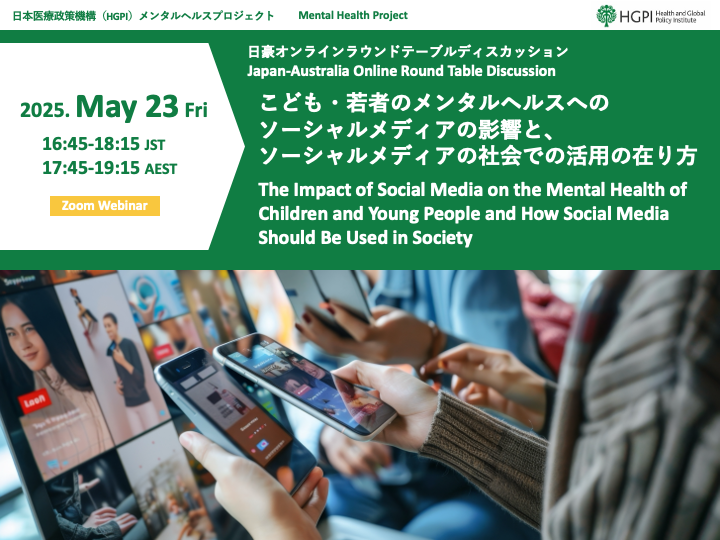
[Registration Closed] Japan-Australia Online Round Table Discussion “The Impact of Social Media on the Mental Health of Children and Young People and How Social Media Should Be Used in Society“ (May 23, 2025)
-
2025-04-17
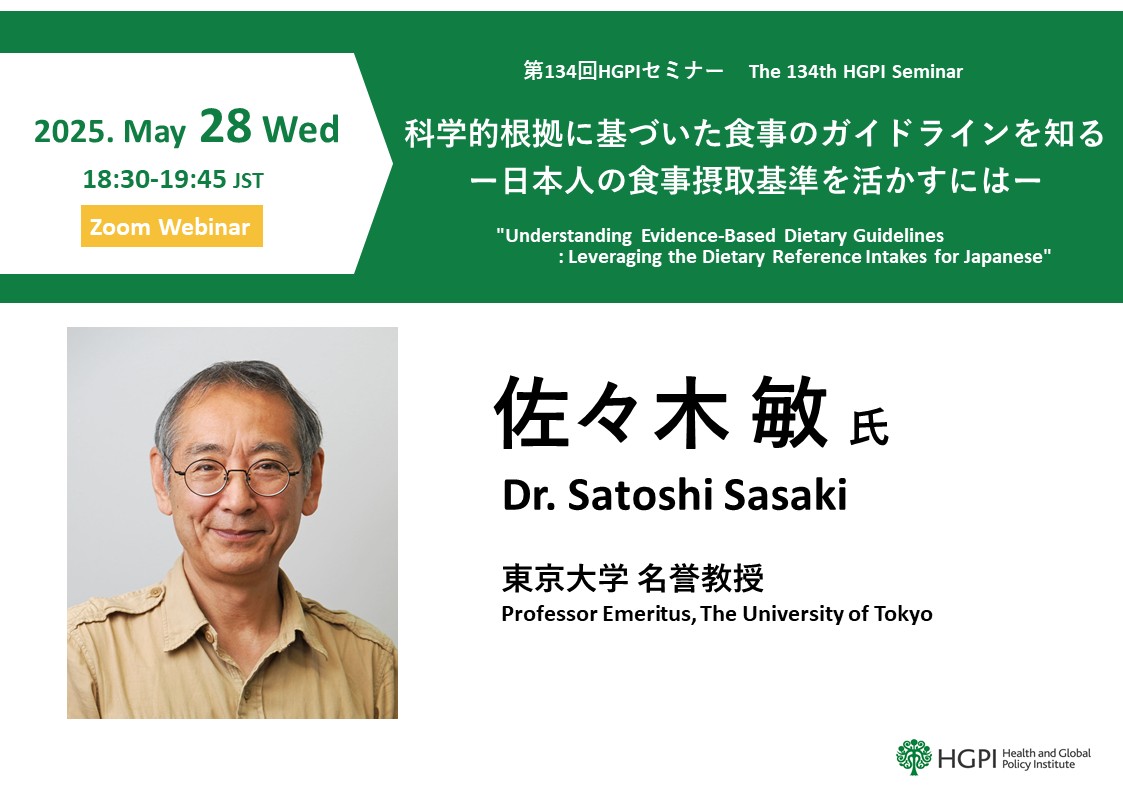
[Registration Closed] (Webinar) The 134th HGPI Seminar "Understanding Evidence-Based Dietary Guidelines: Leveraging the Dietary Reference Intakes for Japanese" (May 28, 2025)
-
2025-04-23
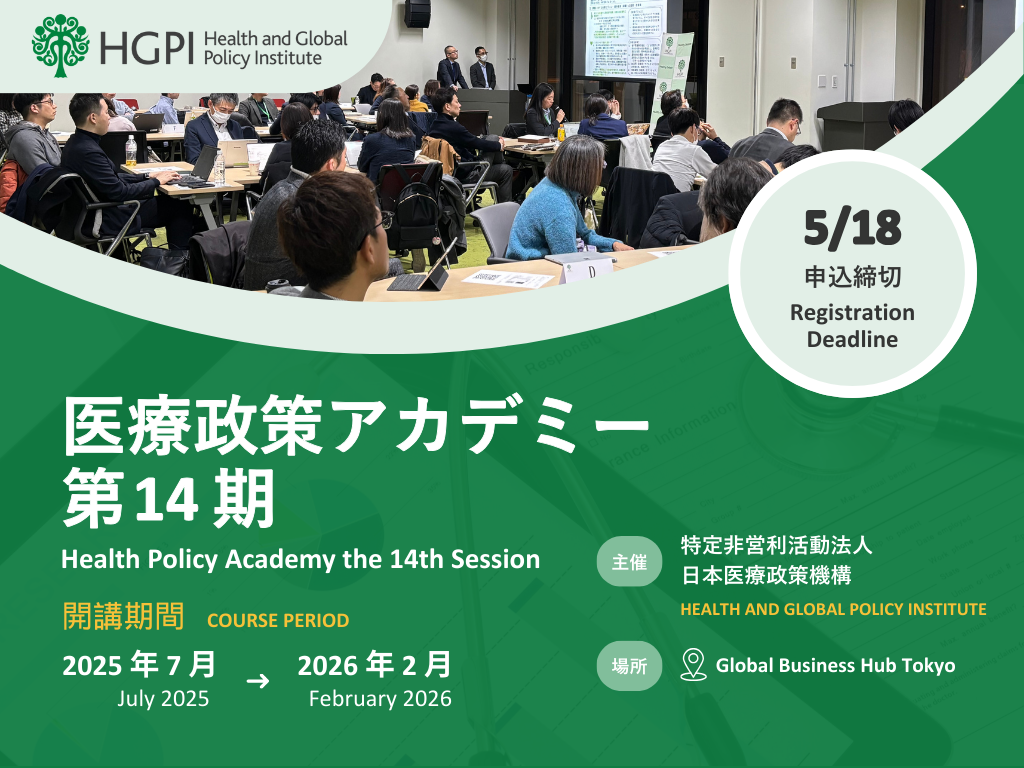
[Registration Closed] Recruitment of the Health Policy Academy the 14th Session (Starts July 2025)
-
2025-04-30
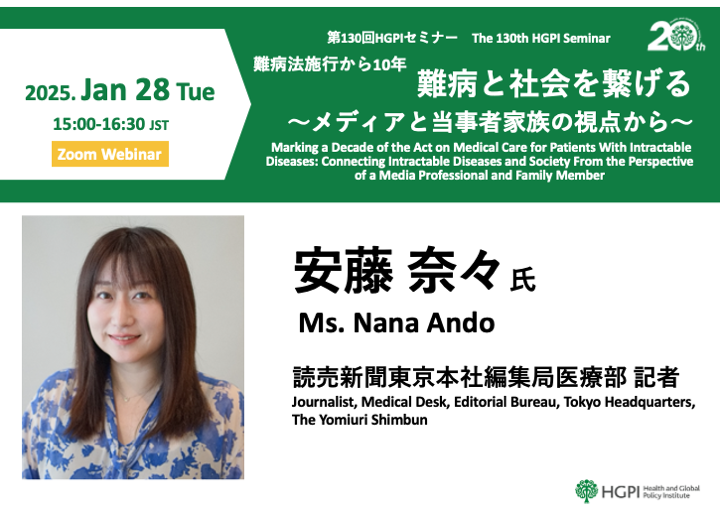
[Event Report] The 130th HGPI Seminar “Marking a Decade of the Act on Medical Care for Patients With Intractable Diseases: Connecting Intractable Diseases and Society From the Perspective of a Media Professional and Family Member” (January 28, 2025)
-

2025-03-05
[HGPI Policy Column] (No.53) From the Dementia Project "The Future of Dementia Research Co-created with Affected Parties, Vol. 1: Three Key Points for Achieving Meaningful Involvement"
Top Research & Recommendations Posts
Featured Posts
-
2026-05-18
[Registration Closed] Kick-off Panel Discussion “From Africa and Japan, Drawing from Perspectives Around the World:A Platform for Cultivating a Philosophical Health Dialogue Together” (June 15, 2026)
![[Registration Closed] Kick-off Panel Discussion “From Africa and Japan, Drawing from Perspectives Around the World:A Platform for Cultivating a Philosophical Health Dialogue Together” (June 15, 2026)](https://hgpi.org/en/wp-content/uploads/sites/2/HGPI_20260615_Eyecathch_panel-discussion-From-Japan-and-Africa-in-Discussion-with-the-World_2.png)
-
2026-08-28
[Announcement] The 3rd Kiyoshi Kurokawa Award: Call for Nominations (Deadline: November 30, 2026)
![[Announcement] The 3rd Kiyoshi Kurokawa Award: Call for Nominations (Deadline: November 30, 2026)](https://hgpi.org/en/wp-content/uploads/sites/2/Kiyoshi-Kurokawa-Award_3rd_nominations_eyecatch_caseB_ENG_web_20260929_v0.5.jpg)
-
2026-09-01
[Registration Closed] HGPI Salon 2025-2026 Looking Ahead to the Future of Japan’s Social Security System “Session 6: Japan’s Health Policy through the Lens of Global Security” (October 13, 2026)
![[Registration Closed] HGPI Salon 2025-2026 Looking Ahead to the Future of Japan’s Social Security System “Session 6: Japan’s Health Policy through the Lens of Global Security” (October 13, 2026)](https://hgpi.org/en/wp-content/uploads/sites/2/HGPISalon2025-20266.png)
-
2026-09-17
[Registration Open] (Webinar) The 145th HGPI Seminar “Toward Better AMR Measures at Elderly Care Facilities—Considering Infectious Disease Control in a Super-Aged Society From a Policy Perspective” (October 27, 2026)
![[Registration Open] (Webinar) The 145th HGPI Seminar “Toward Better AMR Measures at Elderly Care Facilities—Considering Infectious Disease Control in a Super-Aged Society From a Policy Perspective” (October 27, 2026)](https://hgpi.org/en/wp-content/uploads/sites/2/HGPIseminar145.png)
-
2026-10-06
[Registration Open] (Webinar) The 146th HGPI Seminar “How We Can Build a Society That Supports Choices Around Organ Donation: Exploring Decision-Making by Citizens and a Multi-Layered Approach Through Strategic Social Marketing” (November 9, 2026)
![[Registration Open] (Webinar) The 146th HGPI Seminar “How We Can Build a Society That Supports Choices Around Organ Donation: Exploring Decision-Making by Citizens and a Multi-Layered Approach Through Strategic Social Marketing” (November 9, 2026)](https://hgpi.org/en/wp-content/uploads/sites/2/HGPI_20261001_Eyecatch_HGPIseminer-146th-1.png)
