

[Activity Report] Final Report for the Global Health Education Program (G-HEP) 2024 Released (May 29, 2025)
date : 5/29/2025
Tags: Global Health, Global Health Human Resources Development

![[Activity Report] Final Report for the Global Health Education Program (G-HEP) 2024 Released (May 29, 2025)](https://hgpi.org/en/wp-content/uploads/sites/2/ghep2024-final-top.png)
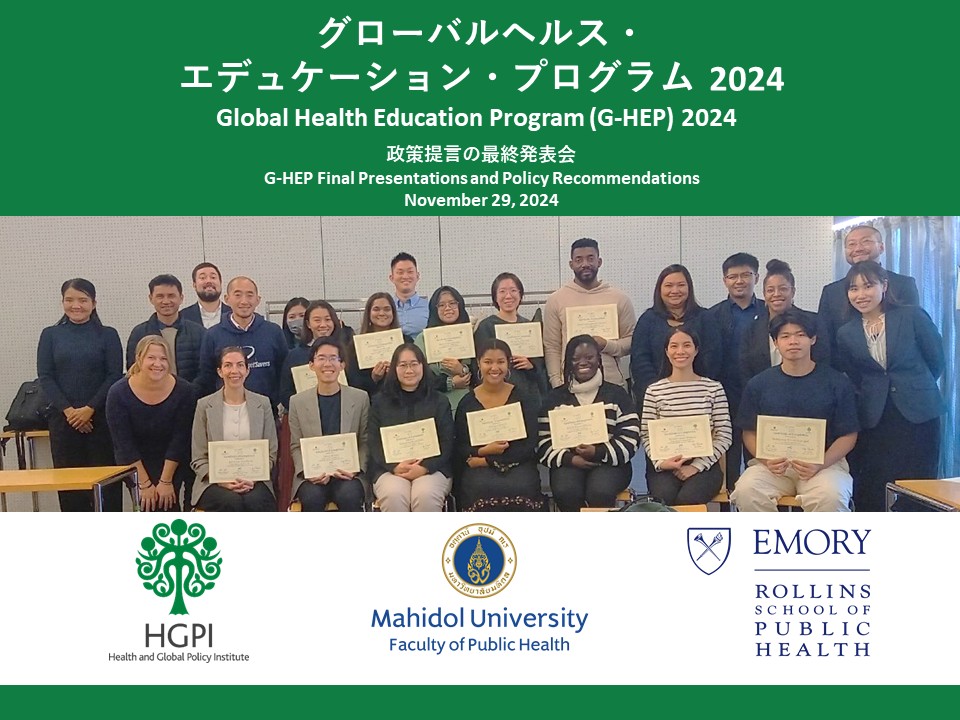
Health and Global Policy Institute (HGPI) has released the final report for the Global Health Education Program (G-HEP) 2024. This program was co-hosted by HGPI, the Faculty of Public Health at Mahidol University, and the Rollins School of Public Health at Emory University, with support from the Japan Foundation.
Held under the theme, “Fostering multilateral collaboration among young leaders to address planetary health challenges,” the program brought together 12 participants from Japan, Thailand, and the United States over a six-month period. They engaged in online lectures, group work centered on case study themes, and fieldwork in both Thailand and Japan.
The program consisted of the following four phases:
Phase 1: Lectures
Participants attended online lectures led by experts on planetary health, climate change, and environmental policy.
Phase 2: Case Study Formulation
Participants formed small groups to develop case studies on four core themes: food security, biodiversity conservation, waste management, and sustainable water resources.
Phase 3: Fieldwork in Thailand and development of policy recommendations
Participants conducted on-site research in Bang Krachao, Thailand, where they interacted with residents, government officials, and environmental organizations. Based on their research, the participants also worked in groups to formulate policy recommendations.
Phase 4: Fieldwork and Final Presentations in Japan
Participants visited Hiroshima to explore Japan’s environmental and super-aging society issues, followed by a policy proposal presentation in Tokyo to relevant stakeholders.
The program also included pre- and post-program assessments of participants’ knowledge, skills, attitudes, and behaviors across nine domains of global and intercultural competency. Significant improvements were observed particularly in the following areas of competency before and after the program.
- Critical thinking (46% increase): ability to analyze cause and effect, pros and cons, synthesize multiple perspectives, develop original opinions with evidence
- Global knowledge (40% increase): ability to find information about global issues and synthesize
- Academic engagement (34% increase): ability to engage in self-directed and collaborative work
A detail of the evaluation findings can be found in the final report.
Contents of the Report
- About the Global Health Education Program
- Phase 1: Lectures
- Phase 2: Case Study Formulation
- Phase 3: Fieldwork in Thailand
- Phase 4: Fieldwork in Japan
- Final Presentations and Policy Proposals
- Changes in Participants’ Awareness and Competency
- Dissemination of Survey Results
- Profiles of Participants and Organizers
Read the full report at the PDF attached.
■ About Global Health Education Program (G-HEP)
The “Global Health Education Program (G-HEP)” vision is to establish a global community of young leaders that can work together to push global health agendas forward and to conduct human resources training and development for the future. The partnership with the Mahidol University Faculty of Public Health which began in 2018 extended the program’s boundaries through interactions among young generations not only from Japan but from the ASEAN region as well. This year’s program welcomes Emory University Rollins School of Public Health bringing a U.S. perspective to the program along with participants of diverse professions and backgrounds. Participants in G-HEP can work together to deepen mutual understanding and cooperation for solving complex global public health issues.
■ About The Rollins School of Public Health at Emory University
 The Rollins School of Public Health at Emory University is ranked 3rd among all accredited schools and programs of public health in the United States. Located in Atlanta, known as the “Public Health Capital of the World,” the school draws strength from several unique local resources. The U.S. Centers for Disease Control and Prevention provides many of the school’s nearly 200 adjunct faculty. The Carter Center is involved in international health intervention programs that provide student practicum opportunities. Students can learn from both in the classroom and as interns in the field. Students join the Rollins community from all 50 states and from more than 40 foreign countries to contribute to the school and apply knowledge to promote health and prevent disease in human populations.
■ About The Faculty of Public Health at Mahidol University
 The Faculty of Public Health at Mahidol University, established in 1948 is the first public health academic institution in Thailand. At present, the Faculty of Public Health produces approximately 1,400 graduates in several majors from the Bachelor, Masters, and Doctoral levels. The faculty plays an integral role as an academic leader in the Asia-Pacific region, contributing to the development of the country on academic management, training, as well as academic service to Asia-Pacific countries. Since 1976, the faculty has been running the Master of Public Health – International Program, with over 1250 graduates from 42 different countries.
This project is supported by The Japan Foundation.
![[Final Report] Global Health Education Program (G-HEP) 2024](/assets/img/katsudo/icon_pdf_l.png)
Related Posts
-
2025-02-06
[Event Report] Global Health Education Program (G-HEP) 2024 – Final Presentations and Policy Recommendations (November 29, 2024)
-
2025-01-22
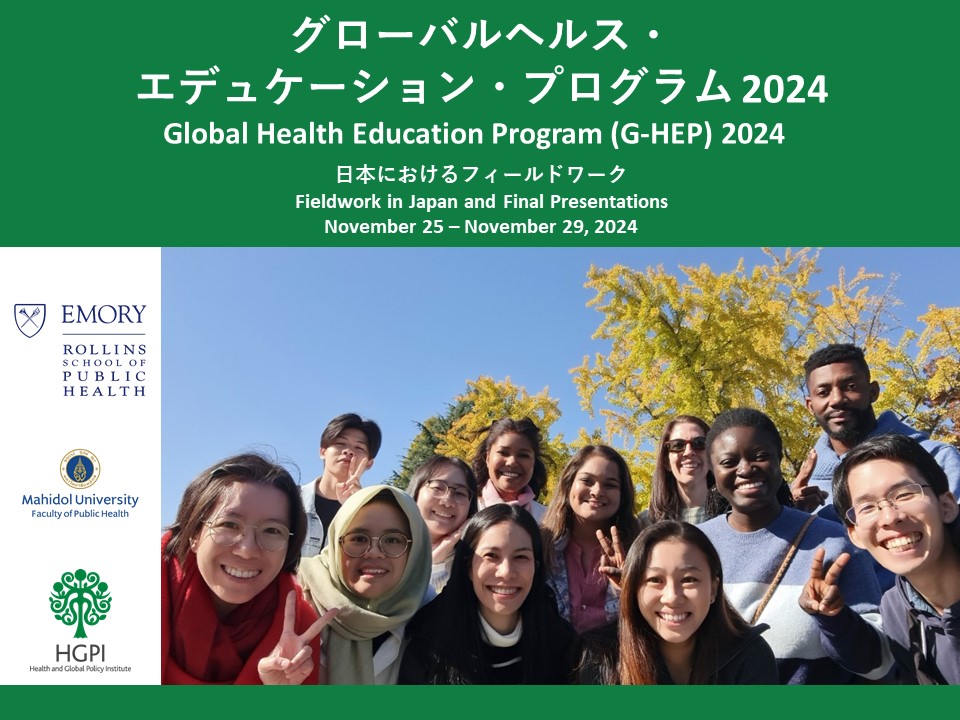
[Event Report] Global Health Education Program (G-HEP) 2024 Fieldwork in Japan (November 25 – November 29, 2024)
-
2025-01-21
[Event Report] Global Health Education Program (G-HEP) 2024 – Lecture 9: Solving Planetary Health Challenges in Japan and a Changing World (October 10, 2024)
-
2024-12-18
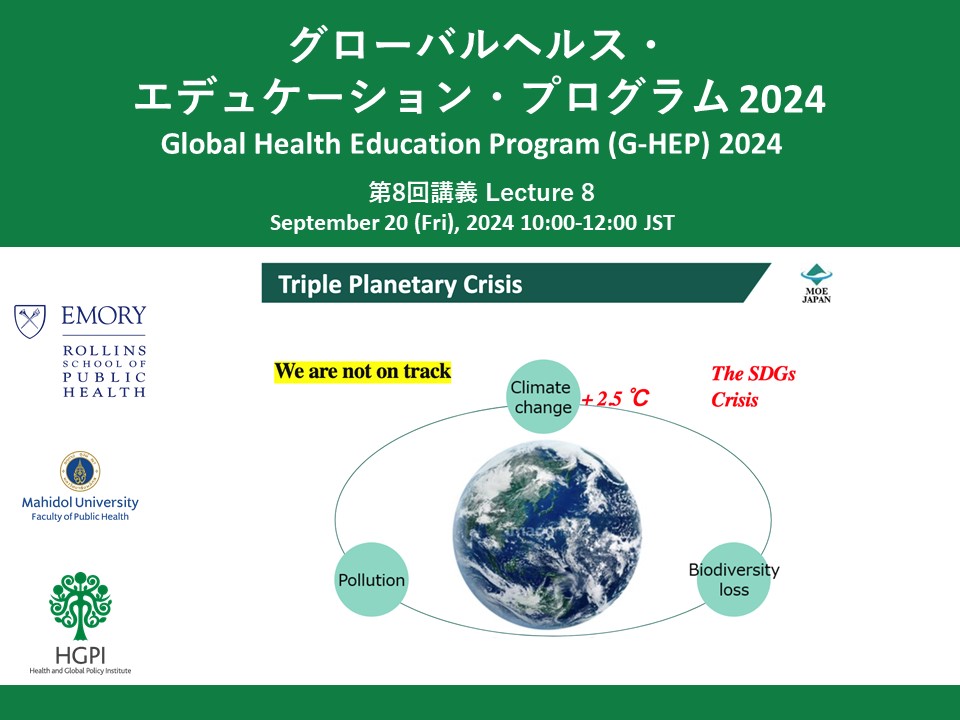
[Event Report] Global Health Education Program (G-HEP) 2024 – Lecture 8: Japan’s Environmental Administration against the Triple Planetary Crisis (September 20, 2024)
-
2024-09-24
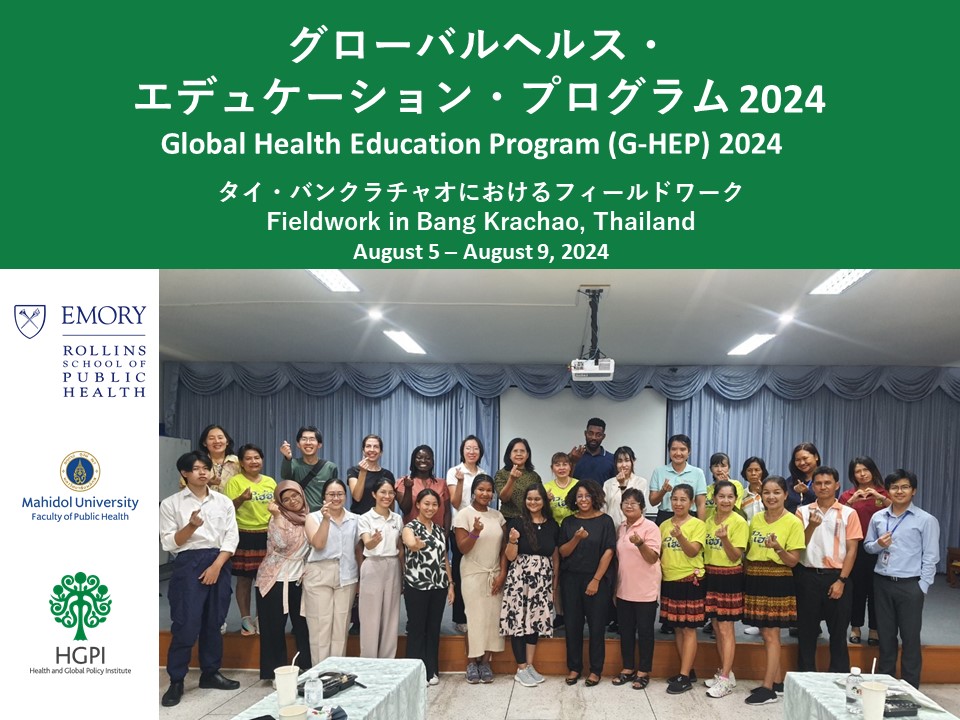
[Event Report] Global Health Education Program (G-HEP) 2024 - Fieldwork in Bang Krachao, Thailand (August 5 – August 9, 2024)
-
2024-08-09
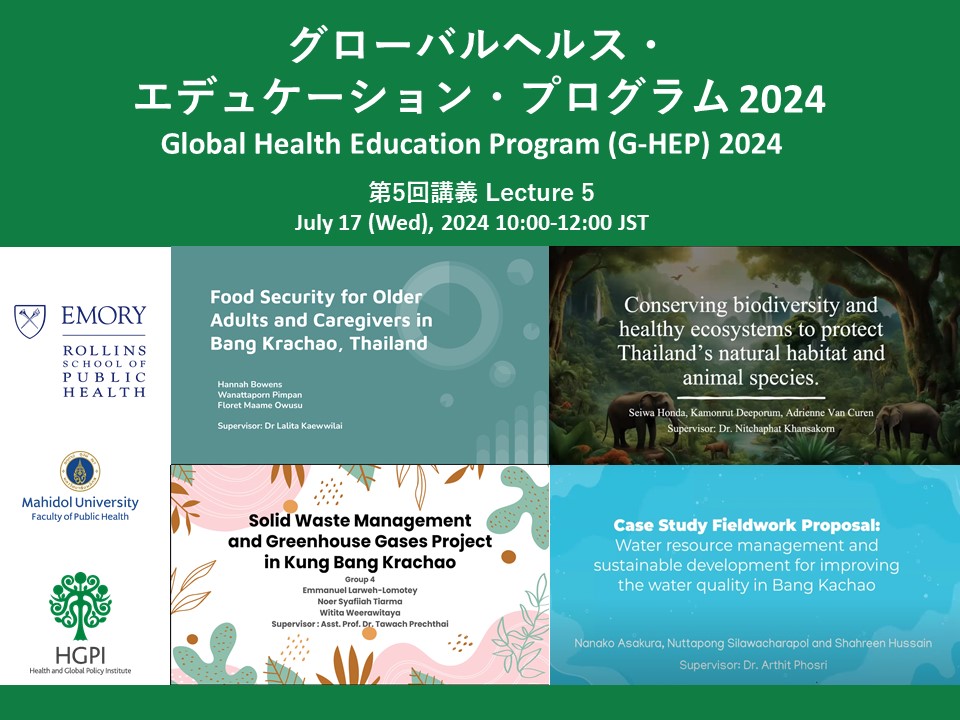
[Event Report] Global Health Education Program (G-HEP) 2024 — Lecture 5: Case Study Fieldwork Proposals (July 17, 2024)
-
2024-08-08
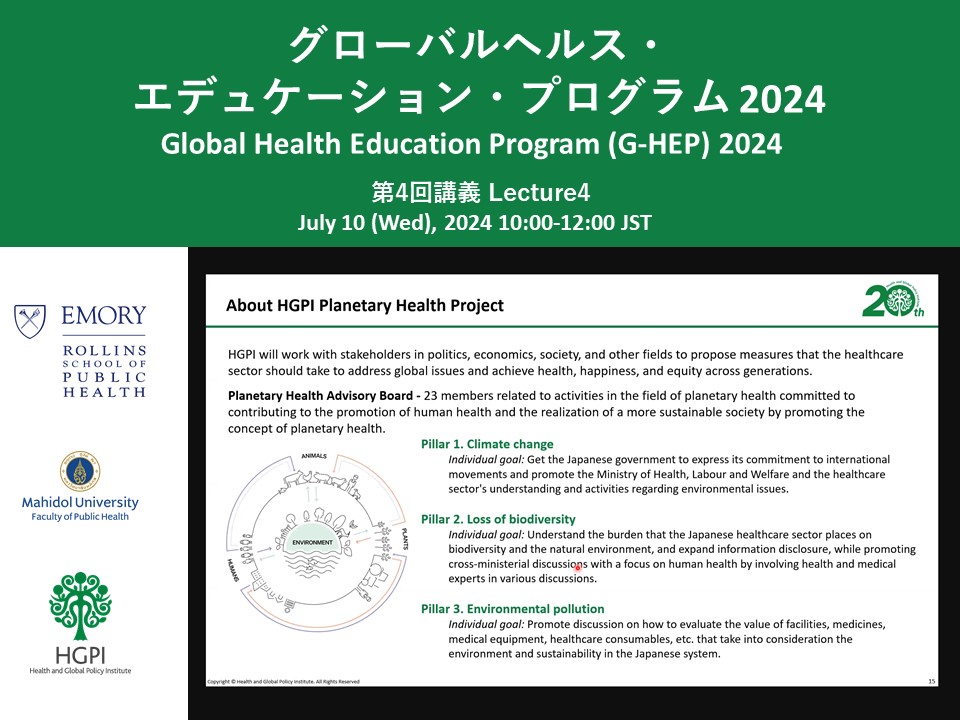
[Event Report] Global Health Education Program (G-HEP) 2024 – Lecture 4: Insights from Collaborative Efforts: Practical Steps for Advancing Planetary (July 10, 2024)
-
2024-07-17
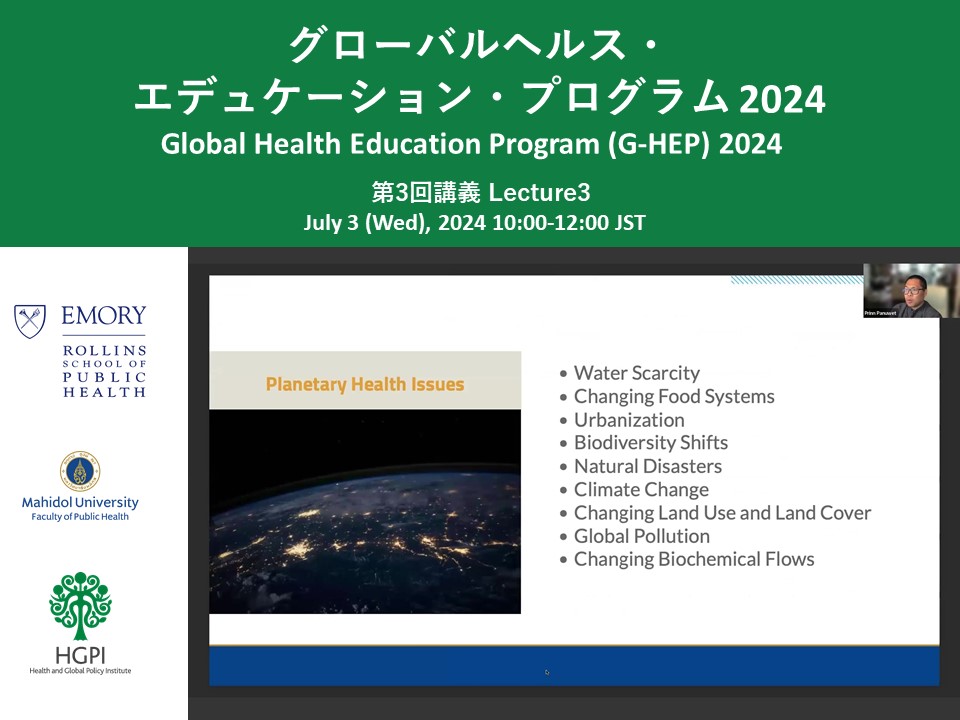
[Event Report] Global Health Education Program (G-HEP) 2024 – Lecture 3: Addressing Planetary Health Issues via Multidisciplinary Approach (July 3, 2024)
Top Research & Recommendations Posts
Featured Posts
-
2026-05-18
[Registration Closed] Kick-off Panel Discussion “From Africa and Japan, Drawing from Perspectives Around the World:A Platform for Cultivating a Philosophical Health Dialogue Together” (June 15, 2026)
![[Registration Closed] Kick-off Panel Discussion “From Africa and Japan, Drawing from Perspectives Around the World:A Platform for Cultivating a Philosophical Health Dialogue Together” (June 15, 2026)](https://hgpi.org/en/wp-content/uploads/sites/2/HGPI_20260615_Eyecathch_panel-discussion-From-Japan-and-Africa-in-Discussion-with-the-World_2.png)
-
2026-08-28
[Announcement] The 3rd Kiyoshi Kurokawa Award: Call for Nominations (Deadline: November 30, 2026)
![[Announcement] The 3rd Kiyoshi Kurokawa Award: Call for Nominations (Deadline: November 30, 2026)](https://hgpi.org/en/wp-content/uploads/sites/2/Kiyoshi-Kurokawa-Award_3rd_nominations_eyecatch_caseB_ENG_web_20260929_v0.5.jpg)
-
2026-09-01
[Registration Closed] HGPI Salon 2025-2026 Looking Ahead to the Future of Japan’s Social Security System “Session 6: Japan’s Health Policy through the Lens of Global Security” (October 13, 2026)
![[Registration Closed] HGPI Salon 2025-2026 Looking Ahead to the Future of Japan’s Social Security System “Session 6: Japan’s Health Policy through the Lens of Global Security” (October 13, 2026)](https://hgpi.org/en/wp-content/uploads/sites/2/HGPISalon2025-20266.png)
-
2026-09-17
[Registration Open] (Webinar) The 145th HGPI Seminar “Toward Better AMR Measures at Elderly Care Facilities—Considering Infectious Disease Control in a Super-Aged Society From a Policy Perspective” (October 27, 2026)
![[Registration Open] (Webinar) The 145th HGPI Seminar “Toward Better AMR Measures at Elderly Care Facilities—Considering Infectious Disease Control in a Super-Aged Society From a Policy Perspective” (October 27, 2026)](https://hgpi.org/en/wp-content/uploads/sites/2/HGPIseminar145.png)
-
2026-10-06
[Registration Open] (Webinar) The 146th HGPI Seminar “How We Can Build a Society That Supports Choices Around Organ Donation: Exploring Decision-Making by Citizens and a Multi-Layered Approach Through Strategic Social Marketing” (November 9, 2026)
![[Registration Open] (Webinar) The 146th HGPI Seminar “How We Can Build a Society That Supports Choices Around Organ Donation: Exploring Decision-Making by Citizens and a Multi-Layered Approach Through Strategic Social Marketing” (November 9, 2026)](https://hgpi.org/en/wp-content/uploads/sites/2/HGPI_20261001_Eyecatch_HGPIseminer-146th-1.png)
