


[Discussion Points] International Dialogue “Fostering Community and Citizen-led Approaches to AMR: Lessons from Antibiotic Smart Sweden” (August 29, 2025)
date : 9/1/2025
Tags: AMR

![[Discussion Points] International Dialogue “Fostering Community and Citizen-led Approaches to AMR: Lessons from Antibiotic Smart Sweden” (August 29, 2025)](https://hgpi.org/en/wp-content/uploads/sites/2/amr-20250829-top.png)
*The English version of the report was released on September 11, 2026.
Health and Global Policy Institute (HGPI) has published the report “Fostering Community and Citizen-led Approaches to AMR: Lessons from Antibiotic Smart Sweden.”
Antimicrobial Resistance (AMR) is a serious public health and global health challenge that has been positioned as a key agenda item in international fora such as the European Union (EU) and the G7. AMR is also a complex issue spanning human health, animal health, food production, and the environment. Addressing AMR requires collaboration across multiple fields under the One Health approach, involving medical institutions, elderly care facilities, educational institutions, water and sewage facilities, and the agricultural, livestock, and aquaculture industries.
However, these facilities and systems are closely connected to citizens’ daily lives, and actual activities strongly reflect the unique characteristics of each community, such as demographics, history, and local industries. Therefore, in order to advance effective and sustainable AMR countermeasures, it is essential to build community-based and citizen-led mechanisms in collaboration with a wide range of stakeholders.
A leading example is the “Antibiotic Smart Sweden” initiative, which was launched through inter-ministerial collaboration in Sweden. Through this initiative, multiple municipalities and regions are engaged in promoting cross-sectoral collaboration in AMR countermeasures in ways that are firmly rooted in each community.
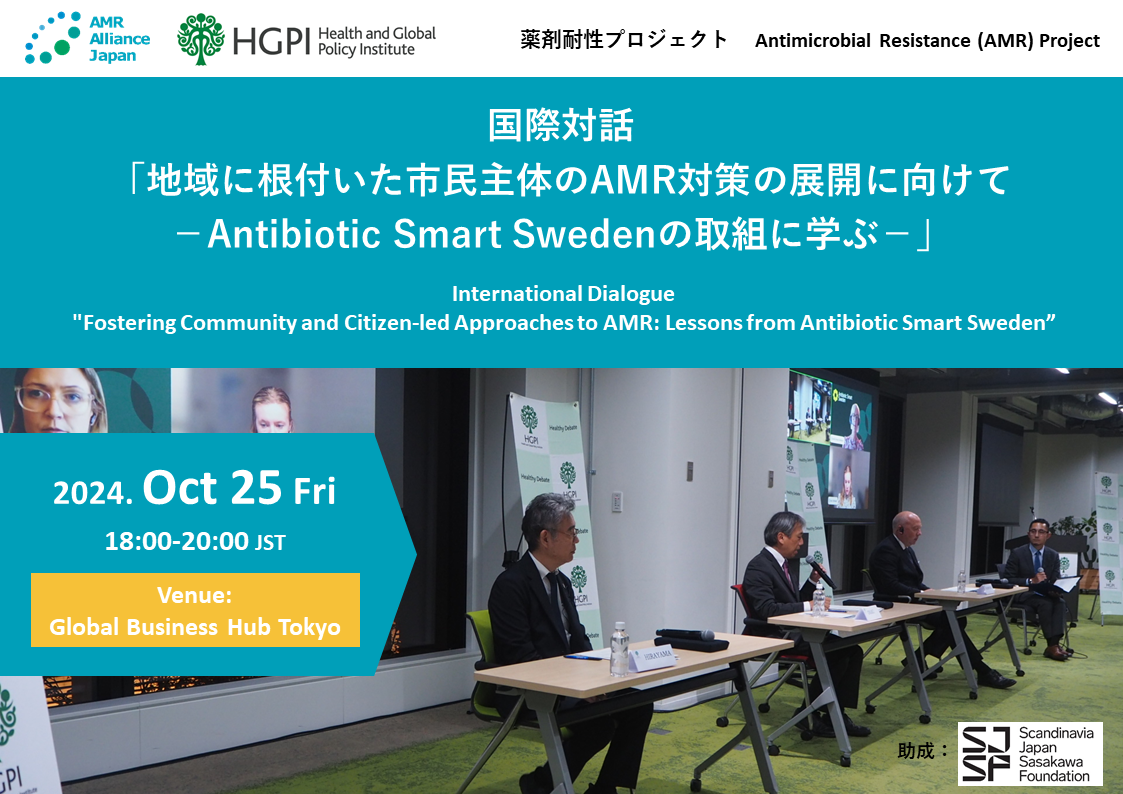
Against this backdrop, HGPI organized the international dialogue “Fostering Community and Citizen-led Approaches to AMR: Lessons from Antibiotic Smart Sweden” on October 25, 2024, with the participation of key stakeholders from Sweden.
Based on discussions held during this international dialogue, the newly published report organizes perspectives on how community-based and citizen-led AMR countermeasures should be implemented and outlines key directions for future action. It also introduces concrete examples from municipalities in both countries, featuring initiatives from Tanum Municipality in Sweden and from Fukuoka Prefecture and Himeji City in Japan.
For details, please view the PDF provided below.
Discussion Point 1
A broad range of expertise and cooperation among various organizations and groups will be essential in AMR control. Promoting collaboration that cuts across disciplines will require building systems for it that utilize the specialties and characteristics of existing networks and organizations.
Discussion Point 2
Local governments should advance measures for AMR control that leverage the characteristics of their administrative structures. Because one strength of basic municipalities is their proximity to community members, there are high expectations for them to foster initiatives that are rooted in communities and centered on awareness-raising and educational support. Meanwhile, regional governments (prefectures) should coordinate and support efforts among basic municipalities and establish foundations for multidisciplinary research and AMR control.
Discussion Point 3
There is a need for the national government to lead broad measures for AMR control on a nationwide scale. The national government should also mount responses to diversifying needs in society by encouraging collaboration among local governments while respecting local autonomy.
Discussion Point 4
AMR control requires efforts to raise awareness and provide educational support in the three stages of recognition, understanding, and behavioral change.
Discussion Point 5
An integrated surveillance system that surpasses administrative boundaries and disciplines must be built. Vital elements in successfully creating an effective surveillance system include clearly defining the roles of national, prefectural, and municipal governments and engaging in cross-cutting collaboration across disciplines based on the One Health perspective.

Related Posts
-
2024-11-11
[Event Report] International Dialogue "Fostering Community and Citizen-led Approaches to AMR: Lessons from Antibiotic Smart Sweden” (October 25, 2024)
-

2025-08-04
[Event Report] International Policy Dialogue “Advancing Action on AMR – Sustainable Policies, Financing, and Global Partnerships” (June 26, 2025)
-
2024-11-21
[Reserch Report] Antimicrobial Resistance (AMR) Measures in Sweden (November 21, 2024)
-
2024-10-24
[Event Report] HGPI Salon Special Edition “Overcoming Infectious Diseases through Partnership: Focusing on examples of promoting technology transfer of antimicrobial agents” (October 21, 2024)
Top Research & Recommendations Posts
Featured Posts
-
2026-05-18
[Registration Closed] Kick-off Panel Discussion “From Africa and Japan, Drawing from Perspectives Around the World:A Platform for Cultivating a Philosophical Health Dialogue Together” (June 15, 2026)
![[Registration Closed] Kick-off Panel Discussion “From Africa and Japan, Drawing from Perspectives Around the World:A Platform for Cultivating a Philosophical Health Dialogue Together” (June 15, 2026)](https://hgpi.org/en/wp-content/uploads/sites/2/HGPI_20260615_Eyecathch_panel-discussion-From-Japan-and-Africa-in-Discussion-with-the-World_2.png)
-
2026-08-28
[Announcement] The 3rd Kiyoshi Kurokawa Award: Call for Nominations (Deadline: November 30, 2026)
![[Announcement] The 3rd Kiyoshi Kurokawa Award: Call for Nominations (Deadline: November 30, 2026)](https://hgpi.org/en/wp-content/uploads/sites/2/Kiyoshi-Kurokawa-Award_3rd_nominations_eyecatch_caseB_ENG_web_20260929_v0.5.jpg)
-
2026-09-01
[Registration Closed] HGPI Salon 2025-2026 Looking Ahead to the Future of Japan’s Social Security System “Session 6: Japan’s Health Policy through the Lens of Global Security” (October 13, 2026)
![[Registration Closed] HGPI Salon 2025-2026 Looking Ahead to the Future of Japan’s Social Security System “Session 6: Japan’s Health Policy through the Lens of Global Security” (October 13, 2026)](https://hgpi.org/en/wp-content/uploads/sites/2/HGPISalon2025-20266.png)
-
2026-09-17
[Registration Open] (Webinar) The 145th HGPI Seminar “Toward Better AMR Measures at Elderly Care Facilities—Considering Infectious Disease Control in a Super-Aged Society From a Policy Perspective” (October 27, 2026)
![[Registration Open] (Webinar) The 145th HGPI Seminar “Toward Better AMR Measures at Elderly Care Facilities—Considering Infectious Disease Control in a Super-Aged Society From a Policy Perspective” (October 27, 2026)](https://hgpi.org/en/wp-content/uploads/sites/2/HGPIseminar145.png)
-
2026-10-06
[Registration Open] (Webinar) The 146th HGPI Seminar “How We Can Build a Society That Supports Choices Around Organ Donation: Exploring Decision-Making by Citizens and a Multi-Layered Approach Through Strategic Social Marketing” (November 9, 2026)
![[Registration Open] (Webinar) The 146th HGPI Seminar “How We Can Build a Society That Supports Choices Around Organ Donation: Exploring Decision-Making by Citizens and a Multi-Layered Approach Through Strategic Social Marketing” (November 9, 2026)](https://hgpi.org/en/wp-content/uploads/sites/2/HGPI_20261001_Eyecatch_HGPIseminer-146th-1.png)
