

[HGPI Policy Column] (No.71) From the Dementia Project “Beyond Dementia Measures: Transitioning to a Society That Fosters Brain Health Over the Life Course”
date : 5/15/2026
Tags: Dementia, HGPI Policy Column

![[HGPI Policy Column] (No.71) From the Dementia Project “Beyond Dementia Measures: Transitioning to a Society That Fosters Brain Health Over the Life Course”](https://hgpi.org/en/wp-content/uploads/sites/2/HGPI_202605_BrainHealth-1.png)
<POINTS>
- Instead of only indicating the presence or absence of a disease, the concept of “brain health” is being redefined as a state in which individuals can realize their full inherent potential and contribute to society throughout the life course. Brain health has been positioned as a foundation for the sustainability of society and the economy.
- “Brain capital” is a concept which encompasses the whole of brain health and brain skills and can be interpreted as strategic investments that support social prosperity and well-being by drawing out the creativity, problem-solving capacities, sympathy, and other gifts possessed by each individual.
- Incorporating the concept of brain health in the field of dementia may drive a transition from disease-centric or negative perceptions, encourage proactive involvement in health maintenance and promotion through daily habits and activities, and decrease stigma.
- Conversely, placing too much emphasis on a comprehensive concept like brain health may dilute discussions on or budgets for diagnosis, treatment, or research on individual conditions like Alzheimer’s disease. Care must be taken to ensure these items are promoted in a parallel and balanced manner.
- Key actions for achieving an inclusive society in the future include recognizing each person’s cerebral function, emotions, and skills as social capital regardless of the presence or absence of dementia or another brain-related disorder, and promoting inclusive and forward-looking investments in various areas including employment and social participation.
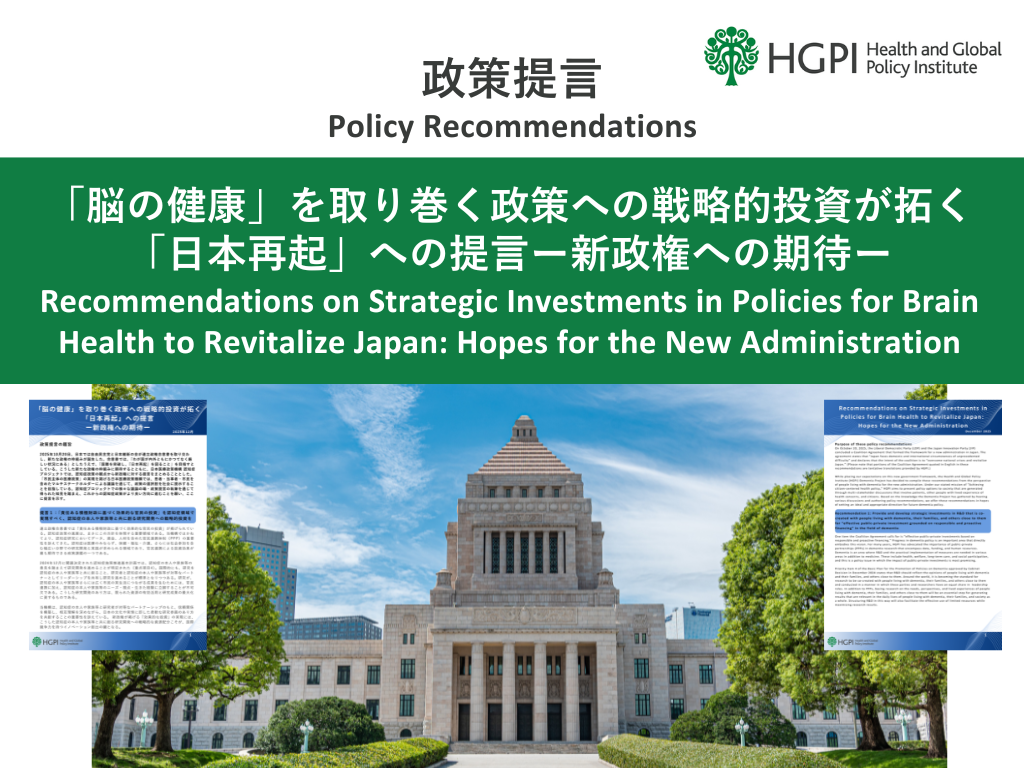
Advocating for the importance of placing brain health at the center of strategic investments, in December 2025, Health and Global Policy Institute (HGPI) presented “Recommendations on Strategic Investments in Policies for Brain Health to Revitalize Japan: Hopes for the New Administration.” This column will take an overhead view of global discussions on the topic of brain health and examine the significance of considering brain health from the perspective of the field of dementia.
Discussions Surrounding Brain Health
In recent years, the global community has come to recognize a new definition of brain health as an issue that extends beyond individual health and that serves as a foundation for sustainability for society and the economy. The World Health Organization (WHO) defines brain health as “the state of brain functioning across cognitive, sensory, social-emotional, behavioral and motor domains, allowing a person to realize their full potential over the life course, irrespective of the presence or absence of disorders.” This means that brain health does not simply refer to the absence of a disorder, but rather to a condition in which individuals can continue exercising their maximum potential, learning and adapting to a changing environment, and contributing to society throughout the life course.
This transition is being driven by a new concept called “brain capital.” This concept refers to the sum of “brain skills,” which are the full body of knowledge and creativity-based skills that people accumulate over the life course, and optimal brain health. With these factors as its foundation, the concept of brain capital can enable people to realize their potential and make full use of their inherent abilities in society.
The added value that AI and other technological innovations bring to activities utilizing the advanced cognitive and emotional capacities of humans exceeds the value that can be obtained through AI’s ability to perform routine tasks with accuracy. Within this context, cultivating brain health as a society through investments in brain capital will help people maintain a state of optimal cognitive function throughout the life course. Harnessing brain skills such as creativity, critical thinking, complex problem-solving, adaptability, resilience, and sympathy to the greatest extent possible while maintaining optimal cognitive function will contribute to an ecosystem that upholds social prosperity and well-being.
Interpreting the Brain Health Concept in the Field of Dementia
The concepts of brain capital and brain health, which redefine the brain functioning of each person as an asset for all of society and reimagine it as a driving force for economic growth, are highly significant in the promotion of dementia policies. In January 2026, with support from Alzheimer’s Society (a U.K. patient advocacy group for people living with dementia), the World Dementia Council (WDC) hosted a virtual dialogue titled, “Brain Health Advocacy.” In the following section, we summarize how the concept of brain health is perceived in the area of dementia based on that dialogue.
Changes in Attitudes toward Dementia
- The brain health framework reforms negative connotations such as “terrifying and unavoidable diseases” that have been associated with the terms “dementia” or “Alzheimer’s disease” in the past. It allows us to redefine these terms in a more positive manner as items people can control over the life course.
- Discussions can now examine diet, sleep, lifestyle, and other elements that people can engage with in concrete terms and on a daily basis from a perspective that goes beyond the context of disease prevention to include brain health cultivation.
- People can feel in control of their own health with a sense of empowerment and be encouraged to proactively engage in health management and promotion in ways accessible to anyone and as part of daily life.
- It will become easier to collaborate with communities where forming direct connections to dementia is difficult, such as school education or sports.
The Paradigm Shift from “driver of increased healthcare spending” to “a strategic national asset”
- The conventional view of dementia or mental health was as a cost to nations or to companies. However, adopting the perspective of brain capital makes it possible to define the brain as a strategic national asset, much like physical or financial capital.
- Employing the broad framework of brain health makes it possible to mobilize funding at a massive scale that exceeds the scope of conventional dementia research.
The Potential Risks of Centering Discussions or Policy Promotion on Brain Health
- Allowing discussions on investments or policy to become too centered on abstract slogans like “brain health” carries a number of risks. For example, it may lead to a dilution of budgets needed for detection, treatment, and research in certain diseases. Substantive improvements in treatment access may also end up being left behind if discussions are overwhelmed by politicians’ attempts to draw attention.
- To move forward, it will be important to strike a good balance between measures for individual diseases and the promotion of brain health.
As these perspectives suggest, implementing the concept of brain health in domestic dementia policy may lessen stigma toward the condition or term itself and elevate interest in the brain throughout the life course. On the other hand, allowing discussions to become too brain health-centric may detract attention from individual diseases such as Alzheimer’s disease or Dementia with Lewy Bodies. It will be important to split future discussions in Japan between those on the diagnosis, treatment, and intervention of individual diseases and those on comprehensive topics like brain health as necessary, and to advance said discussions in parallel.
Finally, to successfully create an inclusive society where people can live to fulfill their potential, we look forward to comprehensive, forward-looking investments in various areas including employment and social participation and that treat the cognitive functions, emotions, and skills possessed by all people as strategic investments, irrespective of whether or not they live with a brain-related disorder. Creating a society that optimizes brain health throughout the life course will require further discussions on brain capital and brain health in the future.
References
- World Health Organization. Brain health. World Health Organization. https://www.who.int/health-topics/brain-health#tab=tab_1
- World Health Organization. (2022). Optimizing brain health across the life course: WHO position paper. World Health Organization. https://iris.who.int/server/api/core/bitstreams/619fbcac-9fb4-4913-a56c-3be2b55084f2/content
- Ayadi, R., Eyre, H. A., Graham, C., Ronco, S., & Stotts-Lee, E. (2023). The Global Brain Capital Dashboard. Brookings Institution Working Paper. Euro-Mediterranean Economists Association. https://www.brookings.edu/wp-content/uploads/2023/09/20230926_BrainCapitalDashboard_WP.pdf
- World Dementia Council. (2026). Brain health advocacy: Transcript. World Dementia Council. https://www.worlddementiacouncil.org/sites/default/files/2026-03/Brain%20health%20advocacy%20%28transcript%29.pdf
Column author
Nana Moriguchi (Senior Associate, Health and Global Policy Institute)
Related Posts
-
2025-12-01
[Policy Recommendations] Recommendations on Strategic Investments in Policies for Brain Health to Revitalize Japan: Hopes for the New Administration (December 1, 2025)
-
2026-03-23
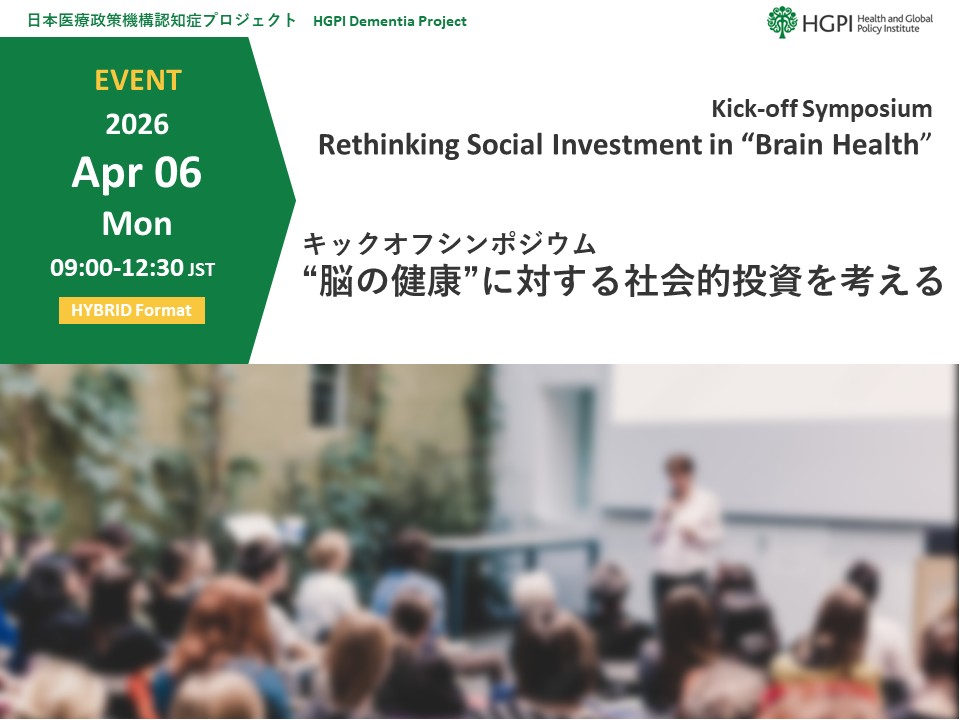
[Registration Closed] (Hybrid Format) Kick-off Symposium: Rethinking Social Investment in “Brain Health” (April 6, 2026)
-

2026-04-15
[HGPI Policy Column] (No.70) — From the Planetary Health Project “Part 17: The Lancet Countdown: A ‘Lifeline’ for Health and Economy Brought about by Climate Action”
-
2026-03-11
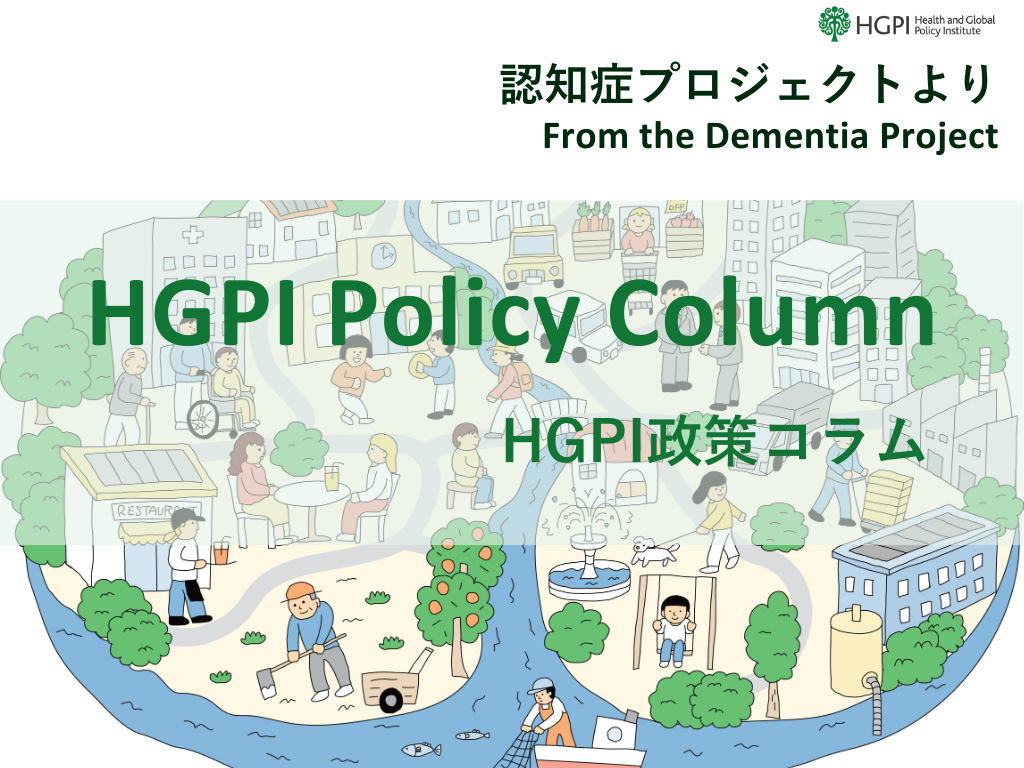
[HGPI Policy Column] (No. 69) From the Dementia Project “Urban Design Protects Our Health: The Potential of 'Healthy by Default' Cities to Harmonize Coexistence and Prevention”
Top Research & Recommendations Posts
Featured Posts
-
2026-05-18
[Registration Closed] Kick-off Panel Discussion “From Africa and Japan, Drawing from Perspectives Around the World:A Platform for Cultivating a Philosophical Health Dialogue Together” (June 15, 2026)
![[Registration Closed] Kick-off Panel Discussion “From Africa and Japan, Drawing from Perspectives Around the World:A Platform for Cultivating a Philosophical Health Dialogue Together” (June 15, 2026)](https://hgpi.org/en/wp-content/uploads/sites/2/HGPI_20260615_Eyecathch_panel-discussion-From-Japan-and-Africa-in-Discussion-with-the-World_2.png)
-
2026-08-28
[Announcement] The 3rd Kiyoshi Kurokawa Award: Call for Nominations (Deadline: November 30, 2026)
![[Announcement] The 3rd Kiyoshi Kurokawa Award: Call for Nominations (Deadline: November 30, 2026)](https://hgpi.org/en/wp-content/uploads/sites/2/Kiyoshi-Kurokawa-Award_3rd_nominations_eyecatch_caseB_ENG_web_20260929_v0.5.jpg)
-
2026-09-01
[Registration Closed] HGPI Salon 2025-2026 Looking Ahead to the Future of Japan’s Social Security System “Session 6: Japan’s Health Policy through the Lens of Global Security” (October 13, 2026)
![[Registration Closed] HGPI Salon 2025-2026 Looking Ahead to the Future of Japan’s Social Security System “Session 6: Japan’s Health Policy through the Lens of Global Security” (October 13, 2026)](https://hgpi.org/en/wp-content/uploads/sites/2/HGPISalon2025-20266.png)
-
2026-09-17
[Registration Open] (Webinar) The 145th HGPI Seminar “Toward Better AMR Measures at Elderly Care Facilities—Considering Infectious Disease Control in a Super-Aged Society From a Policy Perspective” (October 27, 2026)
![[Registration Open] (Webinar) The 145th HGPI Seminar “Toward Better AMR Measures at Elderly Care Facilities—Considering Infectious Disease Control in a Super-Aged Society From a Policy Perspective” (October 27, 2026)](https://hgpi.org/en/wp-content/uploads/sites/2/HGPIseminar145.png)
-
2026-10-06
[Registration Open] (Webinar) The 146th HGPI Seminar “How We Can Build a Society That Supports Choices Around Organ Donation: Exploring Decision-Making by Citizens and a Multi-Layered Approach Through Strategic Social Marketing” (November 9, 2026)
![[Registration Open] (Webinar) The 146th HGPI Seminar “How We Can Build a Society That Supports Choices Around Organ Donation: Exploring Decision-Making by Citizens and a Multi-Layered Approach Through Strategic Social Marketing” (November 9, 2026)](https://hgpi.org/en/wp-content/uploads/sites/2/HGPI_20261001_Eyecatch_HGPIseminer-146th-1.png)
