

[Event Report] Kick-off Symposium: Rethinking Social Investment in “Brain Health” (April 6, 2026)
date : 6/11/2026
Tags: Dementia

![[Event Report] Kick-off Symposium: Rethinking Social Investment in “Brain Health” (April 6, 2026)](https://hgpi.org/en/wp-content/uploads/sites/2/HGPI_20260406_BrainHealthKickOff-1.jpg)
On April 6, 2026, Health and Global Policy Institute (HGPI) held the Kick-off Symposium titled “Rethinking Social Investment in ‘Brain Health’.” Centered on the concept of “Brain Capital”, a concept that has recently begun to attract attention within the global community, the symposium sought to clearly position approaches to brain health not merely as a social cost, but as an investment in the future of Japanese society. Brain Capital refers to the combination of “brain health” and “brain skills” that can be cultivated and strengthened throughout the life course, and it constitutes a foundational asset underpinning productivity, innovation, and social sustainability. The brain is both an individual asset and a shared foundation that society as a whole should protect and nurture. From this perspective, investment in brain health is positioned not merely as the development of individual capabilities, but as an investment in creating a society in which no one is left behind.
At the same time, if social investment in brain health is concentrated on those deemed to offer the highest “investment efficiency,” it cannot be considered a genuine investment in society’s foundations. The symposium therefore examined how the building of an inclusive society, one in which everyone can maintain their dignity and continue to participate in society regardless of illness, can be integrated with strategic investment in Brain Capital. Building on this inclusive perspective, attendees further discussed the type of research infrastructure needed to drive future innovation in brain health, together with expectations for its social implementation and industrial development.
Through this symposium, HGPI, together with national and local governments, academia, industry, and others, looked ahead to the society of the future, connected Japan’s experience to global discussions on Brain Capital, and laid the groundwork for dialogue aimed at realizing an inclusive and sustainable society.
For details of the discussions, please see the report at the bottom of this page.
[Overview]
- Date & Time: Monday, April 6, 2026; 09:00-12:30 JST
- Venue: “Sakura” Room, 4F, Main Building, Imperial Hotel Tokyo (1-1-1 Uchisaiwaicho, Chiyoda-ku, Tokyo)
- Format: Hybrid (In-Person and Online)
- Language: Japanese and English (simultaneous interpretation provided)
- Participation fee: Free
- Capacity: 50 in person / 500 online
- Organized by: Health and Global Policy Institute (HGPI)
- Sponsors: Otsuka Pharmaceutical Co., Ltd.; Eli Lilly Japan K.K.; SOMPO Holdings, Inc.
![[Event Report] Kick-off Symposium: Rethinking Social Investment in “Brain Health”](/assets/img/katsudo/icon_pdf_l.png)
Related Posts
-
2025-12-01
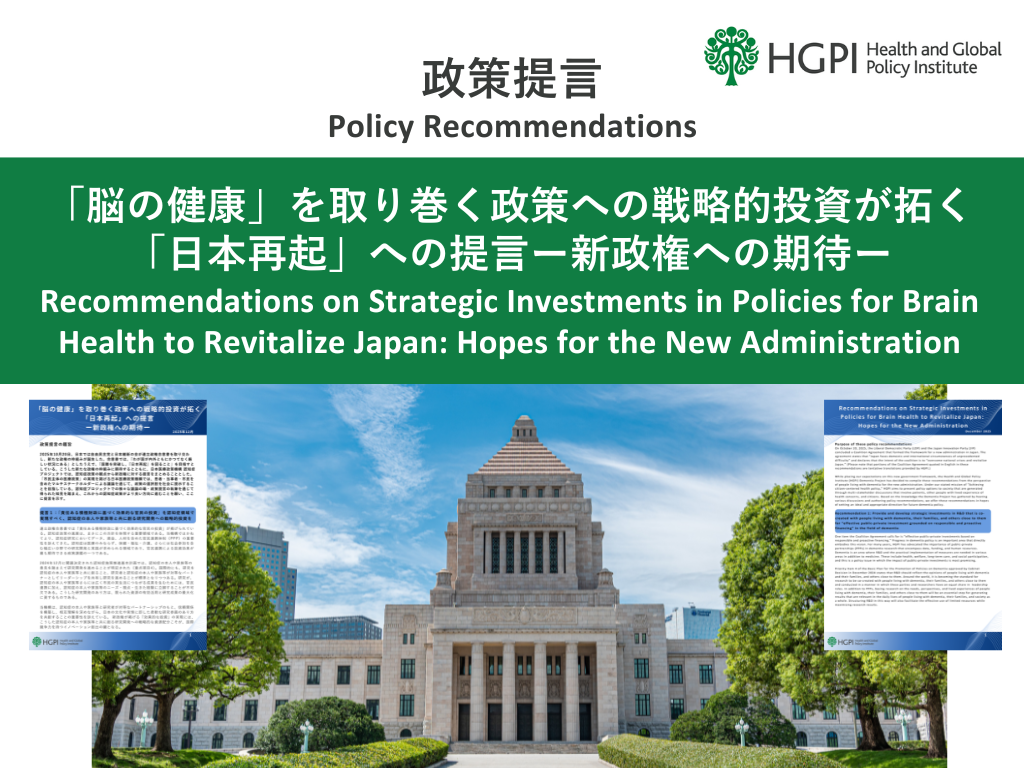
[Policy Recommendations] Recommendations on Strategic Investments in Policies for Brain Health to Revitalize Japan: Hopes for the New Administration (December 1, 2025)
-
2026-05-19
[HGPI Policy Column] (No.72) From the Dementia Project “Rethinking the Concept of Brain Health Through Arts and Culture”
-
2026-05-15
[HGPI Policy Column] (No.71) From the Dementia Project “Beyond Dementia Measures: Transitioning to a Society That Fosters Brain Health Over the Life Course”
Top Research & Recommendations Posts
Featured Posts
-
2026-05-18
[Registration Closed] Kick-off Panel Discussion “From Africa and Japan, Drawing from Perspectives Around the World:A Platform for Cultivating a Philosophical Health Dialogue Together” (June 15, 2026)
![[Registration Closed] Kick-off Panel Discussion “From Africa and Japan, Drawing from Perspectives Around the World:A Platform for Cultivating a Philosophical Health Dialogue Together” (June 15, 2026)](https://hgpi.org/en/wp-content/uploads/sites/2/HGPI_20260615_Eyecathch_panel-discussion-From-Japan-and-Africa-in-Discussion-with-the-World_2.png)
-
2026-08-28
[Announcement] The 3rd Kiyoshi Kurokawa Award: Call for Nominations (Deadline: November 30, 2026)
![[Announcement] The 3rd Kiyoshi Kurokawa Award: Call for Nominations (Deadline: November 30, 2026)](https://hgpi.org/en/wp-content/uploads/sites/2/Kiyoshi-Kurokawa-Award_3rd_nominations_eyecatch_caseB_ENG_web_20260929_v0.5.jpg)
-
2026-09-01
[Registration Closed] HGPI Salon 2025-2026 Looking Ahead to the Future of Japan’s Social Security System “Session 6: Japan’s Health Policy through the Lens of Global Security” (October 13, 2026)
![[Registration Closed] HGPI Salon 2025-2026 Looking Ahead to the Future of Japan’s Social Security System “Session 6: Japan’s Health Policy through the Lens of Global Security” (October 13, 2026)](https://hgpi.org/en/wp-content/uploads/sites/2/HGPISalon2025-20266.png)
-
2026-09-17
[Registration Open] (Webinar) The 145th HGPI Seminar “Toward Better AMR Measures at Elderly Care Facilities—Considering Infectious Disease Control in a Super-Aged Society From a Policy Perspective” (October 27, 2026)
![[Registration Open] (Webinar) The 145th HGPI Seminar “Toward Better AMR Measures at Elderly Care Facilities—Considering Infectious Disease Control in a Super-Aged Society From a Policy Perspective” (October 27, 2026)](https://hgpi.org/en/wp-content/uploads/sites/2/HGPIseminar145.png)
-
2026-10-06
[Registration Open] (Webinar) The 146th HGPI Seminar “How We Can Build a Society That Supports Choices Around Organ Donation: Exploring Decision-Making by Citizens and a Multi-Layered Approach Through Strategic Social Marketing” (November 9, 2026)
![[Registration Open] (Webinar) The 146th HGPI Seminar “How We Can Build a Society That Supports Choices Around Organ Donation: Exploring Decision-Making by Citizens and a Multi-Layered Approach Through Strategic Social Marketing” (November 9, 2026)](https://hgpi.org/en/wp-content/uploads/sites/2/HGPI_20261001_Eyecatch_HGPIseminer-146th-1.png)
