


[HGPI Policy Column] No. 37 – From the Dementia Policy Team – The Current State of Dementia Policy in the International Community in 2023
date : 8/8/2023
Tags: Dementia, HGPI Policy Column

![[HGPI Policy Column] No. 37 – From the Dementia Policy Team – The Current State of Dementia Policy in the International Community in 2023](https://hgpi.org/en/wp-content/uploads/sites/2/column-37-top.png)
<POINTS>
- On May 24, 2023, Alzheimer’s Disease International (ADI) presented a report evaluating national responses to dementia titled “From Plan to Impact VI – Making every step count.”
- The number of countries and regions that have enacted national policies for dementia remains at 46. Among these, 39 are Member States of the World Health Organization (WHO). Achieving the WHO’s goal of having 75% of its Member States formulate national dementia plans by 2025 will require 54 new plans to be developed annually for the next two years, making it a distant target.
- Like last year, Japan’s national policy for dementia was in “Stage 5B: Plan adopted, funded, and monitored.”
Introducing “From Plan to Impact VI”
In this column, we will introduce a report presented by Alzheimer’s Disease International (ADI) on May 24, 2023 titled, “From Plan to Impact VI – Making every step count” (hereinafter referred to as “the 2023 ADI report”).
This annual report from ADI summarizes progress on national strategies for dementia in each country and region and provides case studies of such plans, making it a valuable resource for understanding developments in dementia policy around the world. This column has covered previous ADI reports in 2020, 2021, and 2022, making this our fourth column in this series.
The Current State of Dementia Policy in the International Community (July 2020)
The Current State of Dementia Policy in the International Community in 2021 (June 2021)
The Current State of Dementia Policy in the International Community in 2022 (September 2022)
Current progress falls far short of 2025 targets
The latest ADI report found that as of May 2023, national strategies for dementia had been formulated in 46 countries and regions. These included 39 World Health Organization (WHO) Member States. By global region, these 39 Member States include 20 in Europe, 8 in the Americas, 2 in Southeast Asia, 6 in the Western Pacific (including Japan), 3 in the Eastern Mediterranean, and 0 in Africa.
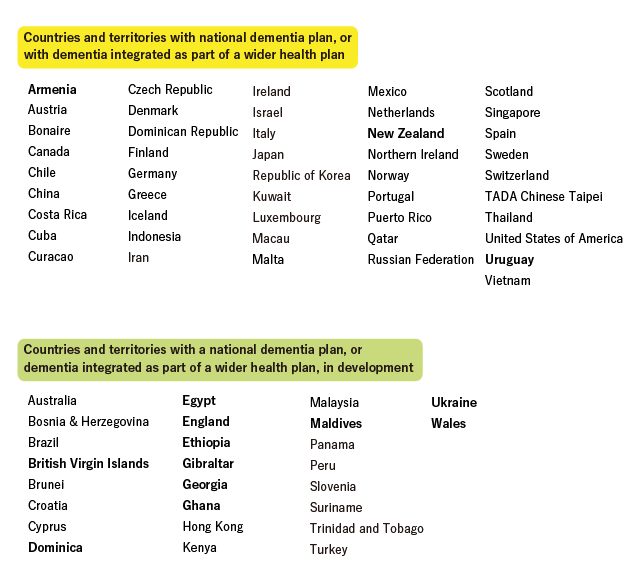
Figure 1
Regarding the formulation of national strategies, WHO Global action plan on the public response to dementia (hereinafter, “the WHO Action Plan”) stated, “75% of countries will have developed or updated national policies, strategies, plans or frameworks for dementia, either stand-alone or integrated into other policies/plans, by 2025.” This means 54 additional national strategies for dementia must be created annually for the next two years, so we must conclude that this target is a distant one.
In response to this situation, ADI plans to submit a formal request the WHO asking it to extend the WHO Action Plan to 2029. Rather than viewing this extension as a signal to lessen the pace of work on national strategies, it should be seen as an opportunity for each country and region to reaffirm the urgency of this issue and to re-energize efforts to elevate the priority of dementia so national strategies can be formulated.
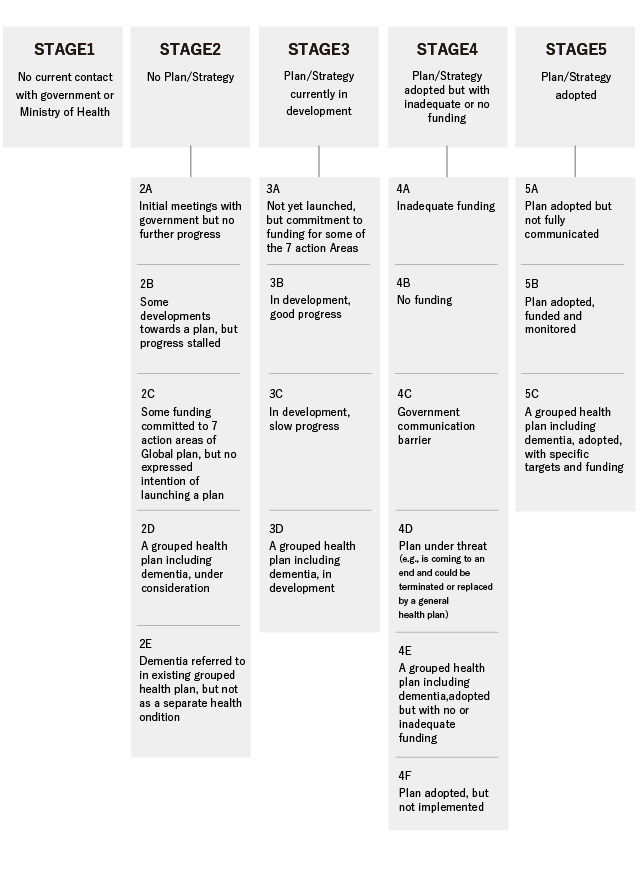
Figure 2
In 2023, Japan’s national strategy stayed at “Stage 5B: Plan adopted, funded, and monitored.” The 2023 ADI Report introduced a collaborative research project from Japan and the Nordic countries called NJ-FINGERS as an example of a good initiative for risk reduction. This international joint research initiative on multimodal preventive interventions aims to discover new scientific knowledge in the areas of healthy aging and dementia prevention.
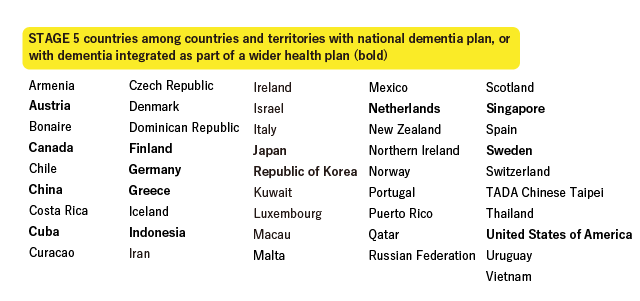
Figure 3
Figure 3 (above) shows the 46 countries and regions that have already completed work on formulating national plans for dementia. Countries and regions where plans met “Stage 5” criteria appear in bold. A number of countries and regions that were included in the 2022 ADI Report are no longer listed. These include Bonaire, Gibraltar, Macau, Russia, England, Wales, and Taiwan. In other words, some countries and regions were in “Stage 5” last year but have since regressed. Meanwhile, Sweden has been added to the list. Many countries have recovered from the COVID-19 pandemic, but it is clear that aftershocks continue to reverberate throughout healthcare systems.
Emphasizing the importance of continuing to respond to future pandemics, ADI also stated that “Governments must consider dementia and non-communicable disease (NCD) risk factors and build in resilience for future pandemics to ensure equity of access to treatment, care, and support and to avoid disruptions to the diagnostic pathway.”
In conclusion
This column gave an overview of the information presented in the 2023 ADI Report. While growth in the number of national dementia plans has come to a standstill at the global level, this year saw a number of steps forward for dementia policy in Japan. In May 2023, a dementia symposium was held to commemorate the G7 Health Ministers’ Meeting in Nagasaki, marking one decade since the G8 Dementia Summit was held in the U.K. in 2013. The themes of the symposium were “inclusion” and “risk reduction and innovation.” There, participants discussed the importance of reinforcing global collaboration under the leadership of Japan, the country with the most advanced population aging.
Then, in June 2023, Japan enacted the Dementia Basic Act for an Inclusive Society (hereinafter, the “Dementia Basic Act”). It makes clear mention of “an inclusive society” and “involvement of the parties most affected in the policy formulation process and in R&D.” Health and Global Policy Institute (HGPI) has been an active voice in support for the Dementia Basic Act, and has a long history of policy recommendation and advocacy activities for its formulation. We are proud to say that we helped contribute to the Dementia Basic Act’s emphasis on concepts like “building an inclusive society” and “ensuring opportunities for participation from people living with dementia.”
However, the enactment of the Dementia Basic Act means Japan has only come to the starting line for advancing measures for dementia. Given that efforts for the dementia agenda in the international community appear to be slowing down, we believe that Japan has a key role to play moving forward. In addition to efforts from governments, successfully building an inclusive society will require all relevant stakeholders from industry, Government, academia, and civil society to take up active roles to pursue this shared goal. As a representative of civil society, HGPI will continue working to encourage action for this purpose.
[About the author]
Orie Yamashita (Associate, HGPI)
Related Posts
-
2023-10-18
[HGPI Policy Column] No. 38 – From the Dementia Policy Team – Thoughts on the “Council for the Realization of a Happy Aging Society That Faces Dementia”
-
2023-06-14
[HGPI Policy Column] No. 36 – From the Dementia Policy Team – Commemorating the Approval of the Basic Act on Dementia: An Overview of the Act and a Look Back on HGPI’s Recommendations
-
2022-09-07
[HGPI Policy Column] No. 30 – From the Dementia Policy Team – The Position of Dementia Policy in International Society in 2022
-
2023-01-24
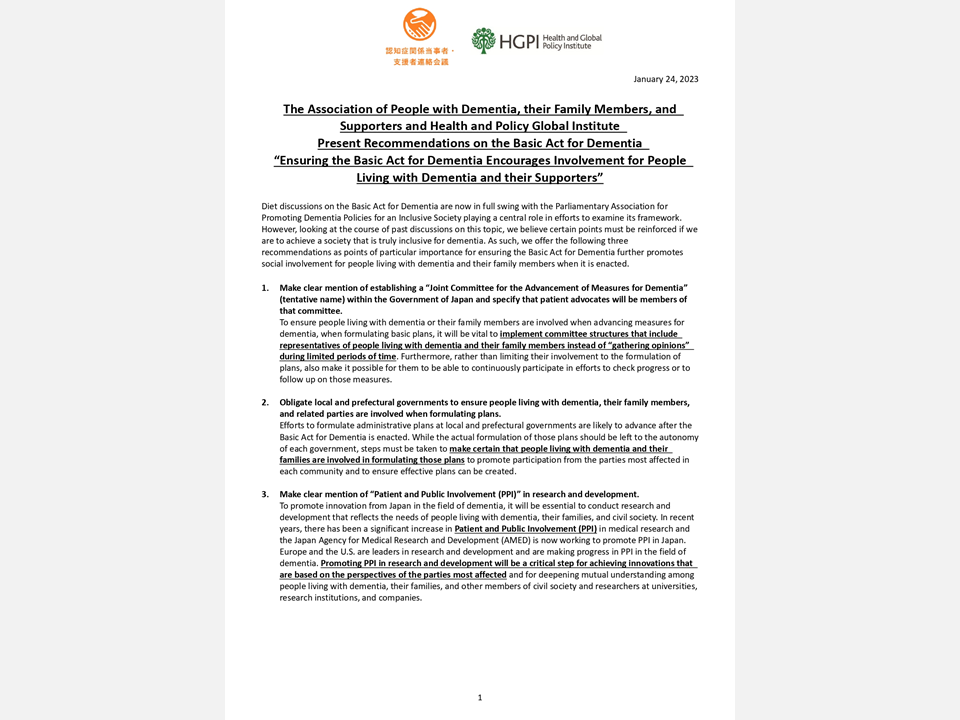
[Policy Recommendations] The Association of People with Dementia, their Family Members, and Supporters and Health and Policy Global Institute Present Recommendations on the Basic Act for Dementia – Ensuring the Basic Act for Dementia Encourages Involvement for People Living with Dementia and their Supporters (January 24, 2023)
Top Research & Recommendations Posts
Featured Posts
-
2026-05-18
[Registration Closed] Kick-off Panel Discussion “From Africa and Japan, Drawing from Perspectives Around the World:A Platform for Cultivating a Philosophical Health Dialogue Together” (June 15, 2026)
![[Registration Closed] Kick-off Panel Discussion “From Africa and Japan, Drawing from Perspectives Around the World:A Platform for Cultivating a Philosophical Health Dialogue Together” (June 15, 2026)](https://hgpi.org/en/wp-content/uploads/sites/2/HGPI_20260615_Eyecathch_panel-discussion-From-Japan-and-Africa-in-Discussion-with-the-World_2.png)
-
2026-08-28
[Announcement] The 3rd Kiyoshi Kurokawa Award: Call for Nominations (Deadline: November 30, 2026)
![[Announcement] The 3rd Kiyoshi Kurokawa Award: Call for Nominations (Deadline: November 30, 2026)](https://hgpi.org/en/wp-content/uploads/sites/2/Kiyoshi-Kurokawa-Award_3rd_nominations_eyecatch_caseB_ENG_web_20260929_v0.5.jpg)
-
2026-09-01
[Registration Closed] HGPI Salon 2025-2026 Looking Ahead to the Future of Japan’s Social Security System “Session 6: Japan’s Health Policy through the Lens of Global Security” (October 13, 2026)
![[Registration Closed] HGPI Salon 2025-2026 Looking Ahead to the Future of Japan’s Social Security System “Session 6: Japan’s Health Policy through the Lens of Global Security” (October 13, 2026)](https://hgpi.org/en/wp-content/uploads/sites/2/HGPISalon2025-20266.png)
-
2026-09-17
[Registration Open] (Webinar) The 145th HGPI Seminar “Toward Better AMR Measures at Elderly Care Facilities—Considering Infectious Disease Control in a Super-Aged Society From a Policy Perspective” (October 27, 2026)
![[Registration Open] (Webinar) The 145th HGPI Seminar “Toward Better AMR Measures at Elderly Care Facilities—Considering Infectious Disease Control in a Super-Aged Society From a Policy Perspective” (October 27, 2026)](https://hgpi.org/en/wp-content/uploads/sites/2/HGPIseminar145.png)
-
2026-10-06
[Registration Open] (Webinar) The 146th HGPI Seminar “How We Can Build a Society That Supports Choices Around Organ Donation: Exploring Decision-Making by Citizens and a Multi-Layered Approach Through Strategic Social Marketing” (November 9, 2026)
![[Registration Open] (Webinar) The 146th HGPI Seminar “How We Can Build a Society That Supports Choices Around Organ Donation: Exploring Decision-Making by Citizens and a Multi-Layered Approach Through Strategic Social Marketing” (November 9, 2026)](https://hgpi.org/en/wp-content/uploads/sites/2/HGPI_20261001_Eyecatch_HGPIseminer-146th-1.png)
