


[Public Comment Submission] Public Call for Proposals on the Basic Policy under the Green Contract Act: “Introducing Environmental Performance Evaluation into Procurement Contracts for Medical Devices (Targeting Remanufactured Single-Use Devices (R-SUDs) and Related Products)”(August 14, 2026)
date : 8/14/2026
Tags: Planetary Health

![[Public Comment Submission] Public Call for Proposals on the Basic Policy under the Green Contract Act: “Introducing Environmental Performance Evaluation into Procurement Contracts for Medical Devices (Targeting Remanufactured Single-Use Devices (R-SUDs) and Related Products)”(August 14, 2026)](https://hgpi.org/en/wp-content/uploads/sites/2/HGPI_PlanetaryHealthPJT_20260615_GreeenContractAct.jpg)
Health and Global Policy Institute (HGPI) submitted a proposal in response to the public call for proposals on the Basic Policy under the Green Contract Act, conducted by the Ministry of the Environment.
Under the Basic Policy established pursuant to the Act on Promotion of Contracts of the State and Other Entities, Which Show Consideration for Reduction of Emissions of Greenhouse Gases, etc. (hereinafter the “Green Contract Act”), the State and incorporated administrative agencies, etc. are required to give consideration to the reduction of greenhouse gas emissions, in addition to price, when entering into contracts. To inform its review of the Basic Policy in light of the status of its implementation, the Ministry of the Environment conducts an annual call for proposals on the addition or revision of contract categories. This year’s call was held from May 11 to June 11, 2026, with particular emphasis on proposals that contribute to creating initial demand for superior environmental products, technologies, and services that have not yet seen widespread use—owing to factors such as high production costs—or whose uptake is expected to grow going forward.
At present, the contract categories defined under the Basic Policy comprise eight types: the purchase of electricity; the purchase and leasing of automobiles; the procurement of vessels; the design and maintenance of buildings; energy-saving renovation (ESCO projects and other energy-saving renovation); and the treatment of industrial waste. Meanwhile, the greenhouse gases emitted by Japan’s health care system are estimated to account for 4.6 to 6.4 percent of the country’s total emissions, and its carbon dioxide emissions have been noted as the fourth largest in the world. As the development of a low-carbon, sustainable health care system grows increasingly important both internationally and domestically, there is significant value in re-examining the way procurement is conducted in the medical field from the perspective of reducing environmental load. In particular, the procurement contracts for medical devices (including medical materials) carried out by national medical institutions do not include environmental load at each stage from manufacturing to disposal among their evaluation criteria, making it difficult for incentives to favor products with a lower environmental load to take effect. Against this backdrop, remanufactured single-use devices (R-SUDs)—single-use devices (SUDs) that are made reusable through processes such as disassembly, cleaning, and sterilization—already benefit from a legal framework ensuring efficacy and safety equivalent to that of the original products, and offer both a lower environmental load and lower cost; yet at present their reduction effects are not evaluated in procurement.
Against this background, HGPI proposed the following perspectives.
Key Points of the Proposal
- Position procurement contracts for medical devices as a new contract category, and evaluate, as additional points (kasanten), the contribution made to reducing environmental load across the entire product life cycle.
- As evaluation indicators, assess—relative to conventional products—whether products that contribute to reductions (such as R-SUDs) are adopted, with respect to each of (i) reductions in CO2 emissions and (ii) reductions in medical waste.
- Design the scheme so that environmental performance is evaluated while securing basic functionality and quality (safety and efficacy), premised on marketing approval or certification under the Act on Securing Quality, Efficacy and Safety of Products Including Pharmaceuticals and Medical Devices (the “PMD Act”).
- Building on tailwinds such as the introduction of an add-on reimbursement in the FY2024 revision of medical service fees, support the creation of demand for R-SUDs—whose procurement by the State and other entities is expected to expand—and make this a leading example of decarbonization and the transition to a circular economy in the medical field.
As objective grounds for the proposal, HGPI noted that multiple life cycle assessment (LCA) studies have shown that adopting R-SUDs reduces CO2 emissions by 23 to 60 percent compared with conventional SUDs. It also cited reports that, in the United States, replacing SUDs with R-SUDs has reduced medical waste by approximately 9,000 tons.
The “Interim Summary on Public and Private Sector Efforts toward Creating GX (Green Transformation) Markets” expresses an expectation that products possessing GX value will be evaluated under the Green Contract Act. By positioning procurement contracts for medical devices as a new contract category, this proposal responds to that expectation while also serving as an effort to lead decarbonization and resource circulation in the medical field.
HGPI will continue to contribute to the advancement of planetary health through the provision of knowledge and the facilitation of dialogue, and will pursue policy recommendations and collaboration with relevant organizations.
For more details on the public call for proposals on the Basic Policy under the Green Contract Act, please see here.
Related Posts
-
2026-08-07
[HGPI Policy Column] (No.76) - From the Planetary Health Project “No. 19: Heat and Health - The Health Risks of Climate Change and Society's Preparedness”
-
2026-08-07
[Policy Recommendations] HGPI Supports the Release of a Youth Urgent Statement, “Emergency Youth Statement to Protect Lives and the Future from Extreme Heat: Calling for Climate Action that Leaves No One Behind” (August 7, 2026)
-
2026-08-07
[Announcement] Participation in the GX Future Consortium (August 3, 2026)
-
2026-07-22
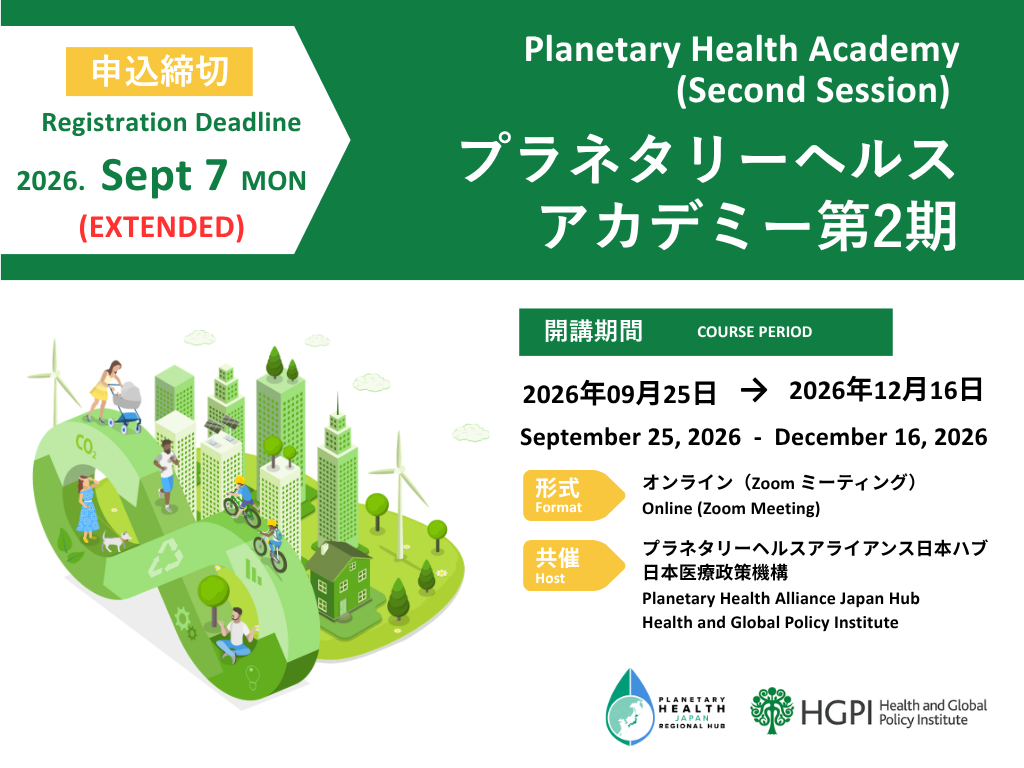
[Registration Closed] Second Session of the Planetary Health Academy (Starts September 2026)
-
2026-07-13
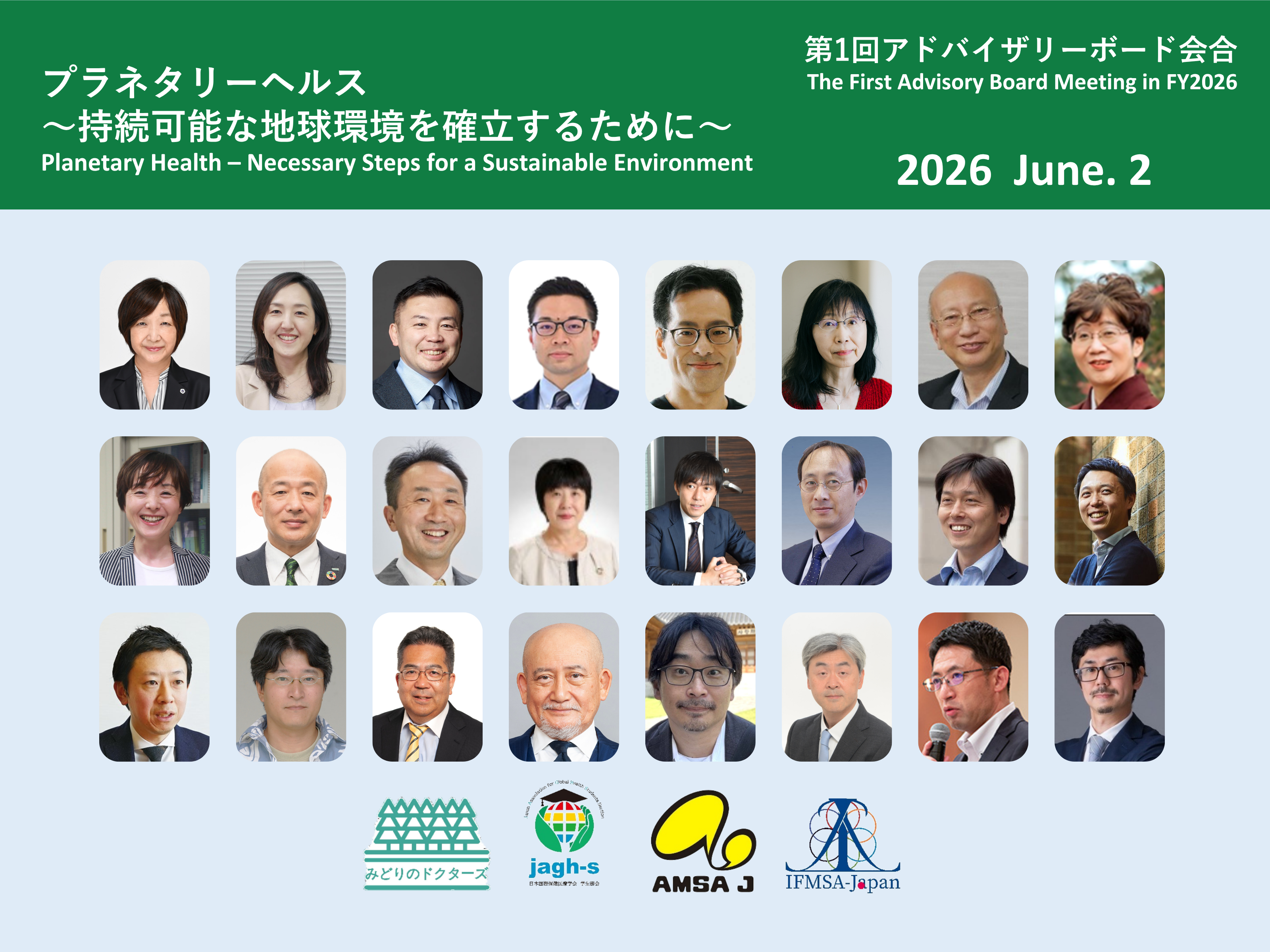
[Event Report] Planetary Health Project: First Advisory Board Meeting of FY2026 “Planetary Health—Establishing a Sustainable Earth’s Environment” (June 2, 2026)
-
2026-07-03
[In the Media] "Making Heat Health Countermeasures a Pillar of Health Security" (The Nikkei Personal Opinion and Insight, July 1, 2026)
-
2026-06-24
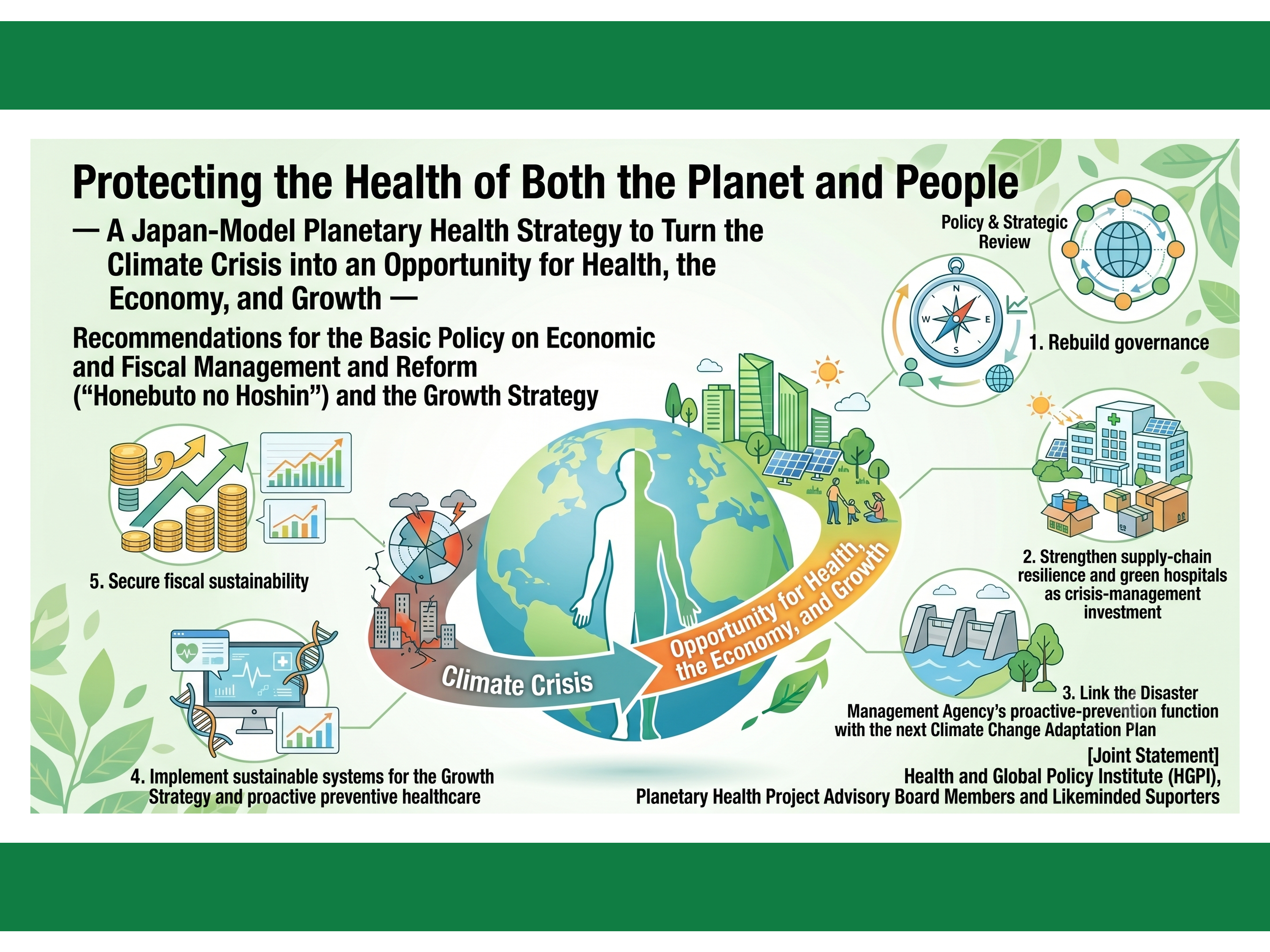
[Policy Recommendations] Joint Statement "Protecting the Health of Both the Planet and People — A Japan-Model Planetary Health Strategy to Turn the Climate Crisis into an Opportunity for Health, the Economy, and Growth" (June 24, 2026)
-
2025-06-24
[Public Comment Submission] Planetary Health Project “FY2025 Tokyo Metropolitan Citizens’ Project Proposal Initiative” Project Proposal (May 30, 2025)
Top Research & Recommendations Posts
Featured Posts
-
2026-05-18
[Registration Closed] Kick-off Panel Discussion “From Africa and Japan, Drawing from Perspectives Around the World:A Platform for Cultivating a Philosophical Health Dialogue Together” (June 15, 2026)
![[Registration Closed] Kick-off Panel Discussion “From Africa and Japan, Drawing from Perspectives Around the World:A Platform for Cultivating a Philosophical Health Dialogue Together” (June 15, 2026)](https://hgpi.org/en/wp-content/uploads/sites/2/HGPI_20260615_Eyecathch_panel-discussion-From-Japan-and-Africa-in-Discussion-with-the-World_2.png)
-
2026-08-28
[Announcement] The 3rd Kiyoshi Kurokawa Award: Call for Nominations (Deadline: November 30, 2026)
![[Announcement] The 3rd Kiyoshi Kurokawa Award: Call for Nominations (Deadline: November 30, 2026)](https://hgpi.org/en/wp-content/uploads/sites/2/Kiyoshi-Kurokawa-Award_3rd_nominations_eyecatch_caseB_ENG_web_20260929_v0.5.jpg)
-
2026-09-01
[Registration Closed] HGPI Salon 2025-2026 Looking Ahead to the Future of Japan’s Social Security System “Session 6: Japan’s Health Policy through the Lens of Global Security” (October 13, 2026)
![[Registration Closed] HGPI Salon 2025-2026 Looking Ahead to the Future of Japan’s Social Security System “Session 6: Japan’s Health Policy through the Lens of Global Security” (October 13, 2026)](https://hgpi.org/en/wp-content/uploads/sites/2/HGPISalon2025-20266.png)
-
2026-09-17
[Registration Open] (Webinar) The 145th HGPI Seminar “Toward Better AMR Measures at Elderly Care Facilities—Considering Infectious Disease Control in a Super-Aged Society From a Policy Perspective” (October 27, 2026)
![[Registration Open] (Webinar) The 145th HGPI Seminar “Toward Better AMR Measures at Elderly Care Facilities—Considering Infectious Disease Control in a Super-Aged Society From a Policy Perspective” (October 27, 2026)](https://hgpi.org/en/wp-content/uploads/sites/2/HGPIseminar145.png)
-
2026-10-06
[Registration Open] (Webinar) The 146th HGPI Seminar “How We Can Build a Society That Supports Choices Around Organ Donation: Exploring Decision-Making by Citizens and a Multi-Layered Approach Through Strategic Social Marketing” (November 9, 2026)
![[Registration Open] (Webinar) The 146th HGPI Seminar “How We Can Build a Society That Supports Choices Around Organ Donation: Exploring Decision-Making by Citizens and a Multi-Layered Approach Through Strategic Social Marketing” (November 9, 2026)](https://hgpi.org/en/wp-content/uploads/sites/2/HGPI_20261001_Eyecatch_HGPIseminer-146th-1.png)
