


[Registration Open] (Webinar) The 145th HGPI Seminar “Toward Better AMR Measures at Elderly Care Facilities—Considering Infectious Disease Control in a Super-Aged Society From a Policy Perspective” (October 27, 2026)
date : 9/17/2026
Tags: AMR, HGPI Seminar

![[Registration Open] (Webinar) The 145th HGPI Seminar “Toward Better AMR Measures at Elderly Care Facilities—Considering Infectious Disease Control in a Super-Aged Society From a Policy Perspective” (October 27, 2026)](https://hgpi.org/en/wp-content/uploads/sites/2/HGPIseminar145.png)
Every year on October 1 is the International Day of Older Persons. Designated by the United Nations, this day recognizes the contributions of older people to society, and for the entire world to come together to address the challenges confronting societies of healthy longevity. Japan became a super-aged society ahead of other countries; by 2040, older people are projected to comprise 35% of Japan’s population. Immunity declines with age while the number of older people living with multiple conditions at the same time is increasing, rendering society as a whole more susceptible to infectious diseases. The spread of antimicrobial resistance (AMR) has become one of the obstacles that must be overcome to build a society of healthy longevity. In Japan, approximately 70% of new patients with infections caused by drug-resistant bacteria are aged 70 or older, and internationally, AMR-related deaths among older adults are estimated to rise by approximately 146% by 2050. The International Day of Older Persons is a meaningful occasion to revisit AMR measures from the perspective of protecting the safety and security of living environments of older people.
Japan’s AMR measures have so far been built around medical institutions. The COVID-19 pandemic, however, showed that infection control in everyday settings such as elderly care facilities is directly tied to public safety and security. The current National Action Plan on AMR also indicates what is expected of elderly care facilities under “Strategy 3.1 Infection Prevention and Control in Healthcare and Nursing Care and Promotion of Regional Cooperation.” Supported by this, AMR measures at elderly care facilities have moved forward to some degree as part of the response to healthcare-associated infections (HAI); a Japanese translation of the Core Elements of Antibiotic Stewardship for Nursing Homes has been produced, and point prevalence surveys (PPS) of antimicrobial use are now being carried out regularly at long-term care health facilities.
Implementing organized and systematic AMR and infection control measures in elderly care facilities is not a simple matter however, because they vary widely in management structure and operating policies. They also possess features that set them apart from medical institutions: building designs that make isolation difficult, staff coming from diverse educational backgrounds, few full-time physicians and nursing personnel, and the need to care for residents whose cognitive functions have declined. Facilities are not obligated to establish an infection control team, and no staffing standards exist for specialized personnel. Furthermore, the spread of drug-resistant bacteria resulting from patient transfers between elderly care facilities and medical institutions, as well as the increasing complexity of infection control measures due to the growing number of home-care patients requiring medical procedures such as mechanical ventilation, pose serious challenges.
The 2024 revision of long-term care fees introduced a new infection control add-on payment for elderly care facilities intended to improve infection control, which has since drawn more attention from facility staff. At the same time, issues such as the refusal to admit individuals carrying antibiotic-resistant bacteria based on screening conducted upon admission, as well as unjust prejudice and discrimination, continue to persist. This is especially prominent in depopulated areas where residents and facility staff often come from the same local community, and where prejudice against carriers of drug-resistant bacteria could spread across the entire community. If an infection spreads, facility staff would become close contacts, which could significantly disrupt the operations of local healthcare and long-term care systems. There is a strong need to establish infection control measures, beginning with AMR countermeasures, at elderly care facilities. In doing so, facilities, local communities, and residents will need to work together while taking psychosocial factors into consideration.
For this seminar, we are pleased to welcome Dr. Hiroki Ohge, Professor in the Department of Infectious Diseases at Hiroshima University Hospital, who works at the forefront of infectious disease care and infection control. Through AMR measures as the foundation, he will lay out what infection control at elderly care facilities should look like within a society of health longevity, and speak more broadly about the policy interventions needed to overcome its present challenges.
The seminar is held in conjunction with the International Day of Older Persons. We hope to create a space for dialogue where citizens, long-term care and healthcare professionals, and policymakers can start from the same questions, and map out new options together for securing living environments in which older people can live safely and with peace of mind across the international community, starting with Asia-Pacific countries that are now entering a period of population aging.
[Event Overview]
- Speaker: Dr. Hiroki Ohge (Professor, Department of Infectious Diseases, Hiroshima University Hospital)
- Date & Time: Tuesday, October 27, 2026, 18:30-19:45 JST
- Format: Online (Zoom Webinar)
- Language: Japanese
- Participation Fee: Free
- Capacity: 500 participants
■ Speaker Profile
Dr. Hiroki Ohge (Professor, Department of Infectious Diseases, Hiroshima University Hospital)
Graduated from Hiroshima University School of Medicine in 1991 and later earned a PhD in Medical Science. He served as a physician in the First Department of Surgery at Hiroshima University and held posts in cardiovascular surgery at Kurashiki Central Hospital and in surgery at National Ohda Hospital, among others, before spending 2002 to 2004 as a research fellow in colorectal surgery at the University of Minnesota in the United States. After returning to Japan, he served as a lecturer at Hiroshima University Hospital and became a professor there in 2010. He specializes in infectious diseases and gastroenterological surgery. He is a certified instructor of both the Japanese Association for Infectious Diseases and the Japan Surgical Society, and serves on the boards of the Japanese Association for Infectious Diseases and the Japanese Society of Chemotherapy, among other roles.

Related Posts
-
2026-08-24
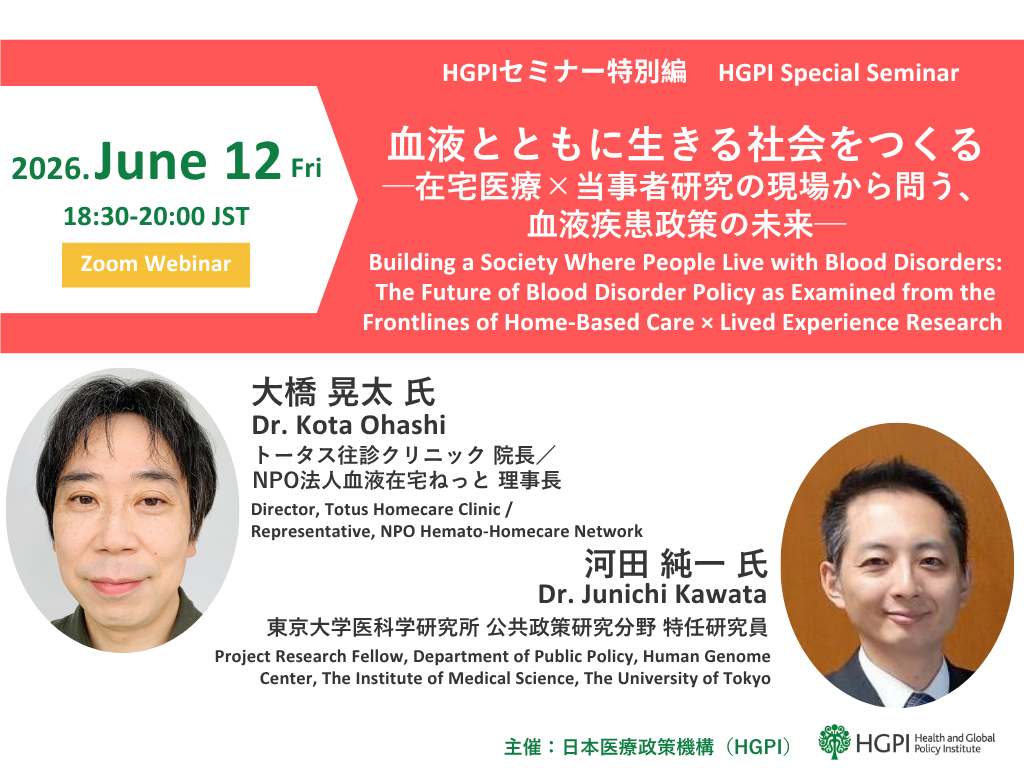
[Event Report] HGPI Special Seminar “Building a Society Where People Live with Blood Disorders: The Future of Blood Disorder Policy as Examined from the Frontlines of Home-Based Care × Lived Experience Research” (June 12, 2026)
-
2026-05-20
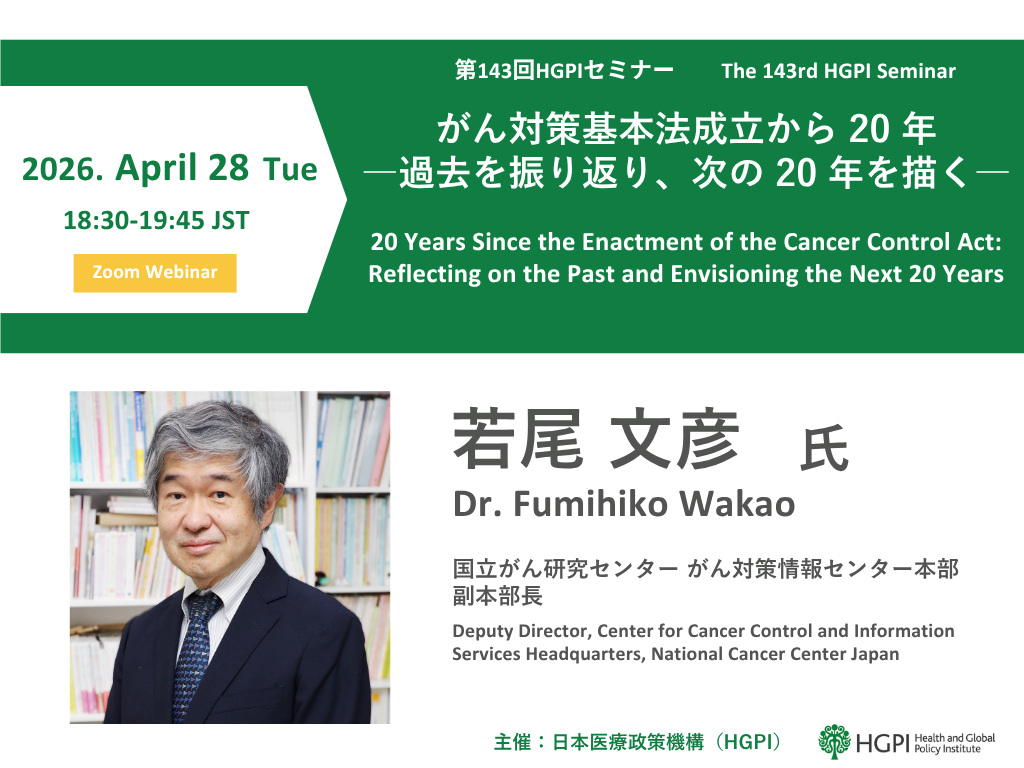
[Event Report] The 143rd HGPI Seminar “20 Years Since the Enactment of the Cancer Control Act: Reflecting on the Past and Envisioning the Next 20 Years” (April 28, 2026)
-
2026-03-11
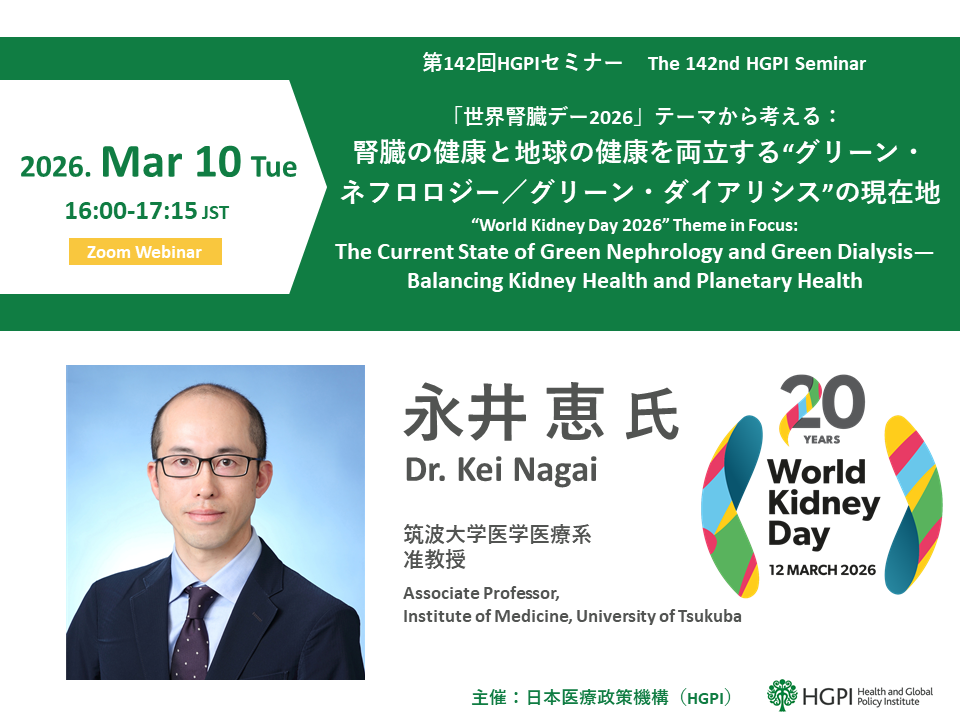
[Event Report] The 142nd HGPI Seminar “World Kidney Day 2026” Theme in Focus: The Current State of Green Nephrology and Green Dialysis—Balancing Kidney Health and Planetary Health (March 10, 2026)
-
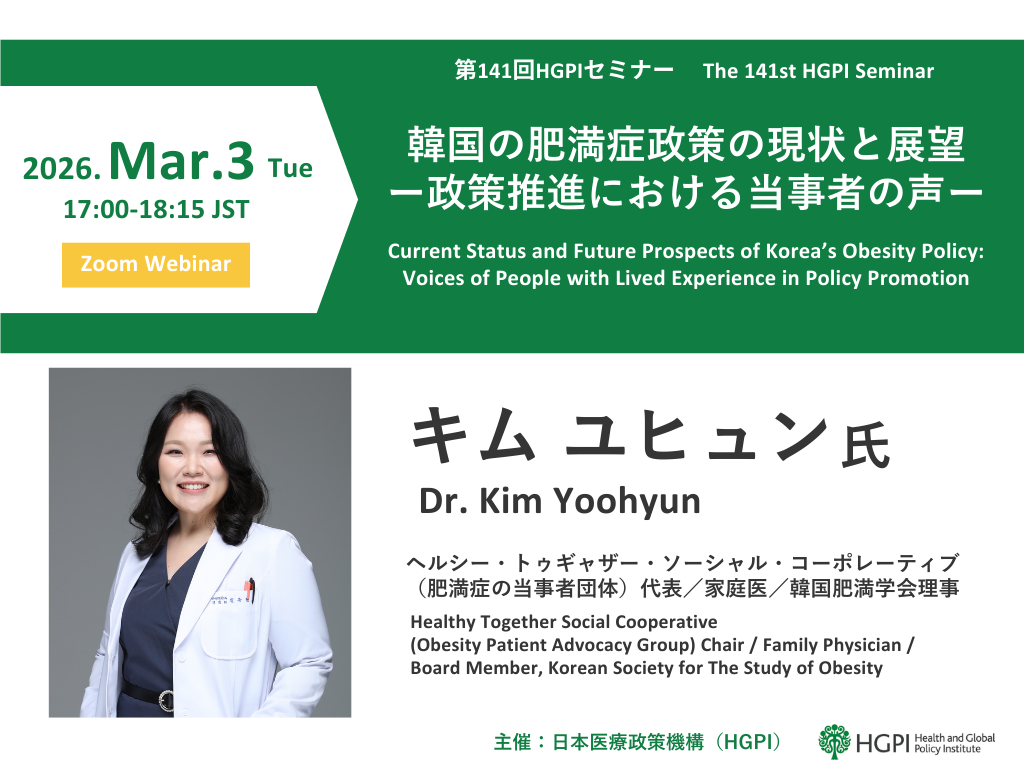
2026-04-06
[Event Report] The 141st HGPI Seminar “Current Status and Future Prospects of Korea’s Obesity Policy: Voices of People with Lived Experience in Policy Promotion” (March 3, 2026)
-
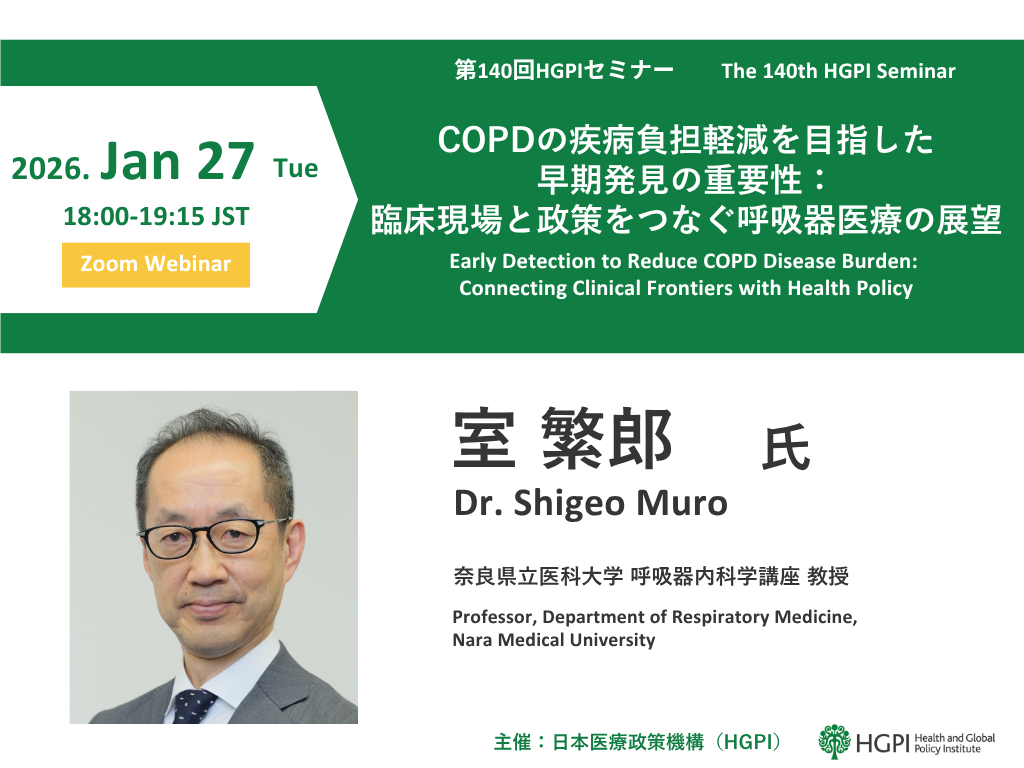
2026-03-26
[Event Report] The 140th HGPI Seminar “Early Detection to Reduce COPD Disease Burden: Connecting Clinical Frontiers with Health Policy” (January 27, 2026)
Top Research & Recommendations Posts
Featured Posts
-
2026-05-18
[Registration Closed] Kick-off Panel Discussion “From Africa and Japan, Drawing from Perspectives Around the World:A Platform for Cultivating a Philosophical Health Dialogue Together” (June 15, 2026)
![[Registration Closed] Kick-off Panel Discussion “From Africa and Japan, Drawing from Perspectives Around the World:A Platform for Cultivating a Philosophical Health Dialogue Together” (June 15, 2026)](https://hgpi.org/en/wp-content/uploads/sites/2/HGPI_20260615_Eyecathch_panel-discussion-From-Japan-and-Africa-in-Discussion-with-the-World_2.png)
-
2026-08-28
[Announcement] The 3rd Kiyoshi Kurokawa Award: Call for Nominations (Deadline: November 30, 2026)
![[Announcement] The 3rd Kiyoshi Kurokawa Award: Call for Nominations (Deadline: November 30, 2026)](https://hgpi.org/en/wp-content/uploads/sites/2/Kiyoshi-Kurokawa-Award_3rd_nominations_eyecatch_caseB_ENG_web_20260929_v0.5.jpg)
-
2026-09-01
[Registration Closed] HGPI Salon 2025-2026 Looking Ahead to the Future of Japan’s Social Security System “Session 6: Japan’s Health Policy through the Lens of Global Security” (October 13, 2026)
![[Registration Closed] HGPI Salon 2025-2026 Looking Ahead to the Future of Japan’s Social Security System “Session 6: Japan’s Health Policy through the Lens of Global Security” (October 13, 2026)](https://hgpi.org/en/wp-content/uploads/sites/2/HGPISalon2025-20266.png)
-
2026-09-17
[Registration Open] (Webinar) The 145th HGPI Seminar “Toward Better AMR Measures at Elderly Care Facilities—Considering Infectious Disease Control in a Super-Aged Society From a Policy Perspective” (October 27, 2026)
-
2026-10-06
[Registration Open] (Webinar) The 146th HGPI Seminar “How We Can Build a Society That Supports Choices Around Organ Donation: Exploring Decision-Making by Citizens and a Multi-Layered Approach Through Strategic Social Marketing” (November 9, 2026)
![[Registration Open] (Webinar) The 146th HGPI Seminar “How We Can Build a Society That Supports Choices Around Organ Donation: Exploring Decision-Making by Citizens and a Multi-Layered Approach Through Strategic Social Marketing” (November 9, 2026)](https://hgpi.org/en/wp-content/uploads/sites/2/HGPI_20261001_Eyecatch_HGPIseminer-146th-1.png)
