


[Event Report] HGPI Special Seminar “Building a Society Where People Live with Blood Disorders: The Future of Blood Disorder Policy as Examined from the Frontlines of Home-Based Care × Lived Experience Research” (June 12, 2026)
date : 8/24/2026
Tags: Blood Disorders, HGPI Seminar, NCDs

![[Event Report] HGPI Special Seminar “Building a Society Where People Live with Blood Disorders: The Future of Blood Disorder Policy as Examined from the Frontlines of Home-Based Care × Lived Experience Research” (June 12, 2026)](https://hgpi.org/en/wp-content/uploads/sites/2/HGPI_20260515_HGPI-Special-Seminar-Blood-Disorders-1.png)
For this seminar, held as a special edition in conjunction with World Blood Donor Day (June 14), we welcomed two speakers who approach blood disorder policy from different perspectives. The first speaker was Dr. Kota Ohashi, Director at Totus Homecare Clinic and Representative of NPO Hemato-Homecare Network. Drawing on his own experience of facing blood cancer, Dr. Ohashi has been at the forefront of home-based blood transfusion and home-based hematology care, supporting patients as they transition from hospital-based treatment to community and home care. The second speaker was Dr. Junichi Kawata, Project Research Fellow at the Department of Public Policy, Human Genome Center, The Institute of Medical Science, The University of Tokyo. Diagnosed with chronic myeloid leukemia (CML) in his twenties, Dr. Kawata draws on his lived experience of long-term treatment and returning to everyday life while advancing research on patient and public involvement (PPI). He also leads patient community activities as Vice Representative of “Izumi” (The Association of Chronic Myeloid Leukemia Patients and Families) and contributes directly to national policymaking as a member of the Cancer Control Promotion Council of the Ministry of Health, Labour and Welfare.
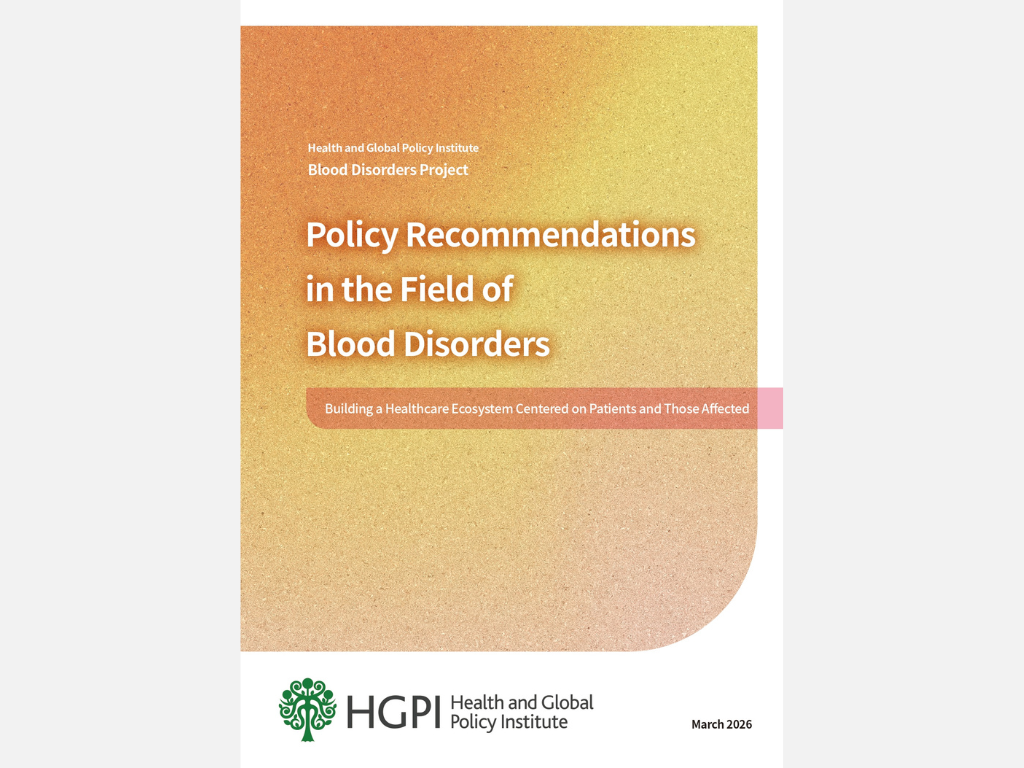
Advances in treatment have transformed many blood disorders from acute conditions requiring intensive treatment into chronic conditions that must be managed over the long term. As a result, the challenge for healthcare is increasingly shifting from “curative medicine” toward “medicine that supports living with illness”. In April 2026, Health and Global Policy Institutes (HGPI) Blood Disorders Project published “Policy Recommendations in the Field of Blood Disorders: Building a Healthcare Ecosystem Centered on Patients and Those Affected,” presenting four pillars and ten recommendations to realize this transition. To deepen discussion of these themes, this seminar brought together perspectives on the future of community-based collaboration from the frontlines of home-based care alongside those of a patient-researcher engaged directly in health policy. Dr. Ohashi and Dr. Kawata each shared their own perspectives on pathways toward building a society where people can live well with blood disorders.
<POINTS>
- As advances in treatment have transformed many blood disorders into conditions managed over the long term, the burdens of “time toxicity” and “financial toxicity” have emerged as major challenges for patients. Expanding home-based care is essential to enabling patients to spend more time living their own lives outside the hospital.
- Although home-based transfusion was formally established through the publication of medical society guidelines in 2017, the hurdles of equipment and staffing requirements make it difficult to expand in areas where it is not economically viable. Sustaining specialized care at home will require establishing career pathways for community hematologists and strengthening collaboration between hospitals and clinics.
- PPI, which brings the perspectives of patients and citizens into research and policy, is increasingly being incorporated into Japan’s health policy, with the cancer field as one leading example. However, patient surveys in CML reveal challenges in mutual understanding of treatment indicators and treatment goals, and the infrastructure for putting shared decision-making (SDM) into practice has not kept pace.
- For many patients with blood disorders, financial burden is a challenge for continuing treatment, and in CML, regional disparities in prescription duration mean that patients receiving the same treatment face large differences in annual out-of-pocket costs depending on where they live. Patient organizations’ advocacy around the high-cost medical expense benefit system shows that, alongside PPI, traditional citizen-led advocacy remains just as important in addressing these challenges.
■ Dr. Kota Ohashi: “Supporting ‘Living with’ Blood Disorders: From the Frontlines of Home-Based Care and Community Collaboration”
From “Curative Medicine” to “Medicine that Supports Living with Illness”: A Transformation in Blood Disorder Care
While the number of patients with blood cancers has shown a relative increase alongside population aging, outcomes for patients with blood disorders have improved dramatically over the past half century. In CML, the ten-year survival rate has risen from below 30% to over 90% since the approval of molecular-targeted therapies in 2001, and advances in hematopoietic stem cell transplantation and maintenance therapy have likewise extended survival in acute myeloid leukemia (AML). Treatment eligibility has also expanded to include older patients and those with comorbidities.
With the spread of new treatment approaches, care for blood disorders has shifted from traditional, fixed-period regimens that end after a set course toward continuous treatment that controls disease progression itself, a model described as until PD (progressive disease) treatment. This has given rise to new challenges: “time toxicity,” the burden of time spent in treatment and hospital visits, and “financial toxicity,” the ongoing financial strain of long-term care costs. For this reason, facing these burdens, besides just the disease itself, has become important for patients with blood disorders and also for the healthcare providers involved in their care.
Transfusion for Patients with Blood Disorders, and Making Home-Based Transfusion a Reality
For patients with blood disorders, transfusion is the cornerstone of treatment. In a patient survey conducted by the Hemato-Homecare Network, more than half of respondents named blood transfusion when asked what they wanted from home-based care, showing how deeply transfusion is woven into patients’ daily lives. From the perspective of hospitals, the absence of nearby facilities capable of performing transfusions has long been pointed out as the single greatest barrier to discharging patients to home care, showing how important transfusions are for patients with blood disorders.
The publication of the “Guidelines for Home-based Red Blood Cell Transfusion” by The Japan Society of Transfusion Medicine and Cell Therapy in 2017 marked an important step in formally establishing home-based transfusion in Japan. The requirements for the storage of blood products and the monitoring and handling of adverse reactions during and after the procedure are strict. Estimates suggest providers need to perform approximately 50 to 60 transfusions to recover the initial investment, making the barrier to adoption high. In areas with low population density, this can make home-based transfusion unprofitable, raising concerns about regional disparities. However, the Hemato-Homecare Network runs an equipment-lending program to lower this barrier. Through this program, a home care clinic in Okinawa Prefecture with no prior transfusion experience was able to begin providing home-based transfusion for a ten-year-old boy, after the network shared equipment and expertise with the clinic.
Enabling Specialized Care at Home: Building the Infrastructure for Community-Based Hematology Care
One of the most defining structural characteristics of hematology care in Japan is the overwhelming concentration of hematologists in hospital settings. The overall pool of hematologists is small to begin with, and compared to other fields, the number able to work in community settings is very small. As a result, even patients whose condition could safely be managed in the community end up being seen by hospital-based hematologists.
Three approaches were proposed to address this challenge: (1) increasing the number of young physicians aiming to work in hematology; (2) identifying hematologists who are already working in community settings but are not recognized or utilized as community hematologists; and (3) enabling hospital-based hematologists to provide regular outreach services at community clinics. The career pathway for community hematologists remains undeveloped, and establishing it is a central challenge for the entire field.
■ Dr. Junichi Kawata: “Changing ‘Living with’ Blood Disorders: Healthcare and Policy ‘Co-Created’ with Patients and Citizens”
Patient and Public Involvement in Japan’s Cancer Policy
PPI refers to the participation of patients and citizens as partners in medical research and policymaking, a practice that has spread within the field of medical research since the 2000s. PPI aims to collaborate directly with researchers and policymakers to improve the quality and relevance of research and policy, rather than pursuing self-directed empowerment or peer learning as in tojisha-kenkyu (self-support research). While a unified definition of PPI has not yet been established in Japan, the Japan Agency for Medical Research and Development (AMED) published a PPI guidebook in 2019 (currently under revision), and research funding bodies are also increasingly requiring PPI to be incorporated from the research planning stage.
In Japan’s cancer field, PPI was introduced ahead of other fields with the enactment of the Basic Act on Cancer Control in 2007 serving as a turning point. This law mandated the inclusion of patients, family members, and the bereaved in the Cancer Control Promotion Council, effectively embodying PPI principles before the term was widely used in Japan. The current Fourth Basic Plan to Promote Cancer Control Programs (2023) positions the advancement of PPI as a foundational area. Japan’s healthcare policy is steadily progressing from a system led by the government and healthcare providers to one where the perspectives of patients and citizens are incorporated into policymaking.
Shared Decision-Making in CML: Gaps Revealed by Patient Surveys
SDM is an approach in which patients and healthcare providers bring together their respective information and values to jointly arrive at a choice that both can accept, making it an important process in determining a course of treatment. This process has become especially important in CML. CML is a type of rare cancer, and since the approval of molecular-targeted therapies in 2001, its ten-year survival rate has risen above 90%, making it a disease that allows patients to live as long as healthy individuals. However, it is a disease that requires lifelong medication, where the treatment goal is not cure but sustained remission, and where treatment continues with medications adjusted for side effects and drug resistance. For this reason, as treatment options have grown more complex, the importance of SDM in terms of the balance between treatment and daily life is increasing.
Meanwhile, a survey of CML patients on SDM conducted by “Izumi” found that only around 54% of patients understood even the IS value, which is the indicator most frequently used in CML care. The survey also found that 17.7% of patients had never discussed treatment goals with their physician at all. As a premise for SDM, it is desirable that the knowledge and information needed for mutual discussion are shared in advance. Given this premise, although SDM is critically important in CML, the infrastructure to support it remains insufficient, and it is important to continue monitoring whether SDM is genuinely being put into practice.
Challenges Faced by CML Patients, and “Izumi’s” Efforts to Address Them
For many patients with CML and other blood disorders, financial burden significantly affects the continuation of treatment. A survey conducted by “Izumi” found that 15% of CML patients had considered pausing medication for financial reasons, and some patients had done so without informing their physician. If the cost of continuing treatment were to increase, as could happen amid policy discussions over raising the out-of-pocket ceiling under the high-cost medical expense benefit system, this kind of treatment interruption could become more common.
CML also faces a less visible but significant problem: regional disparity. A three-month prescription is generally considered optimal because it minimizes the number of times patients exceed the monthly out-of-pocket ceiling under the high-cost medical expense benefit system. However, some prefectures and medical institutions limit prescriptions to one or two months, resulting in two- to threefold differences in annual out-of-pocket costs for patients on the same treatment depending on where they live. Moreover, a considerable number of patients with blood disorders overall already face what the World Health Organization (WHO) classifies as catastrophic health expenditure, defined as medical expenses accounting for 40% or more of a household’s capacity to pay. This rate is notably high compared to other disease areas.
Against this backdrop, “Izumi,” together with the Japan Federation of Cancer Patient Groups and the Japan Patients Association (JPA), among other organizations, launched activities opposing the increase in the out-of-pocket ceiling under the high-cost medical expense benefit system, including an emergency petition campaign and meetings with cabinet ministers. Although the increase was ultimately approved, the campaign nevertheless demonstrated that traditional citizen-led advocacy — including petitions, lobbying, and direct appeals — remains indispensable alongside PPI.
■ Discussion and Q&A
During the discussion following the lectures, several themes arising from the presentations were discussed. Regarding PPI, it was noted that the real question is how to face the reality that not everyone can gain a deep understanding of medical knowledge. While SDM is the baseline goal for all patients regardless of their engagement level, PPI often develops as patients gain perspectives beyond their own experiences and contribute to broader issues affecting others. PPI itself spans a wide spectrum of participation, ranging from expressing preferences regarding drug formulations to involvement in policy development. The challenge ahead is building structures that can accommodate participation at every level.
Regarding the gaps in SDM revealed by the patient survey, it was pointed out that both physicians and patients tend to leave treatment goals as an unspoken assumption, without actually discussing with each other what those goals are. It was also emphasized that channels for providing information and educational materials should be developed together with patients. Additionally, it was suggested that community nurses and others close to patients’ daily lives can provide space for conversations about values and priorities that are difficult to have within the limited time of a single outpatient visit. On hospital-community collaboration, both speakers agreed that the goal is not placing specialist expertise in every local clinic, but building lateral networks that allow community healthcare providers to consult hematologists as needed.
A pre-submitted question also asked how patients’ voices in blood policy should evolve as the treatment landscape changes. It was suggested that if applying hospital-based safety standards directly to home-based care prevents patients from fully benefiting from available care, the system itself should be reconsidered, with enabling patients to live as well as possible treated as the top priority. It was also noted that financial burden cannot be separated from the clinical realities of blood disorders, and that decision-making regarding out-of-pocket expenses needs to incorporate the voices of those living with the disease, not merely through formal mechanisms, but in ways that reflect their everyday reality.
[Event Overview]
- Speakers:
Dr. Kota Ohashi (Director, Totus Homecare Clinic / Representative, NPO Hemato-Homecare Network)
Dr. Junichi Kawata (Project Research Fellow, Department of Public Policy, Human Genome Center, The Institute of Medical Science, The University of Tokyo) - Date & Time: Friday, June 12, 2026, 18:30-20:00 JST
- Format: Online (Zoom webinar)
- Language: Japanese
- Participation Fee: Free
- Capacity: 500 participants
■ Speaker Profiles
Dr. Kota Ohashi (Director, Totus Homecare Clinic / Representative, NPO Hemato-Homecare Network)
Dr. Kota Ohashi is Director of TOTUS Home Care Clinic, which he founded in 2016. After experiencing leukemia while studying engineering at the University of Tokyo, he entered the School of Medicine at Institute of Science Tokyo as a bachelor’s transfer student. He trained and worked at Tokyo Medical Center and the National Cancer Center Hospital East. His work focuses on community-based collaboration and home medical care for patients with hematologic diseases. He is a board-certified hematologist, palliative care specialist and supervisor, and home care specialist and supervisor. He also serves as Clinical Professor at Institute of Science Tokyo and Visiting Professor at St. Marianna University School of Medicine.
Dr. Junichi Kawata (Project Research Fellow, Department of Public Policy, Human Genome Center, The Institute of Medical Science, The University of Tokyo)
Project Research Fellow, Department of Public Policy, Human Genome Center, The Institute of Medical Science, The University of Tokyo. Specializes in medical sociology, cancer survivorship, ELSI, and patient and public involvement (PPI/E). Diagnosed with chronic myeloid leukemia (CML) at 22, withdrew from Taisho University’s Faculty of Human Studies, later re-enrolled and completed a doctoral degree (Human Studies) at the graduate school. Vice Representative of The Association of CML patients & families “Izumi”. Member of the Cancer Control Promotion Council, Ministry of Health, Labour and Welfare.
Related Posts
-
2026-08-14
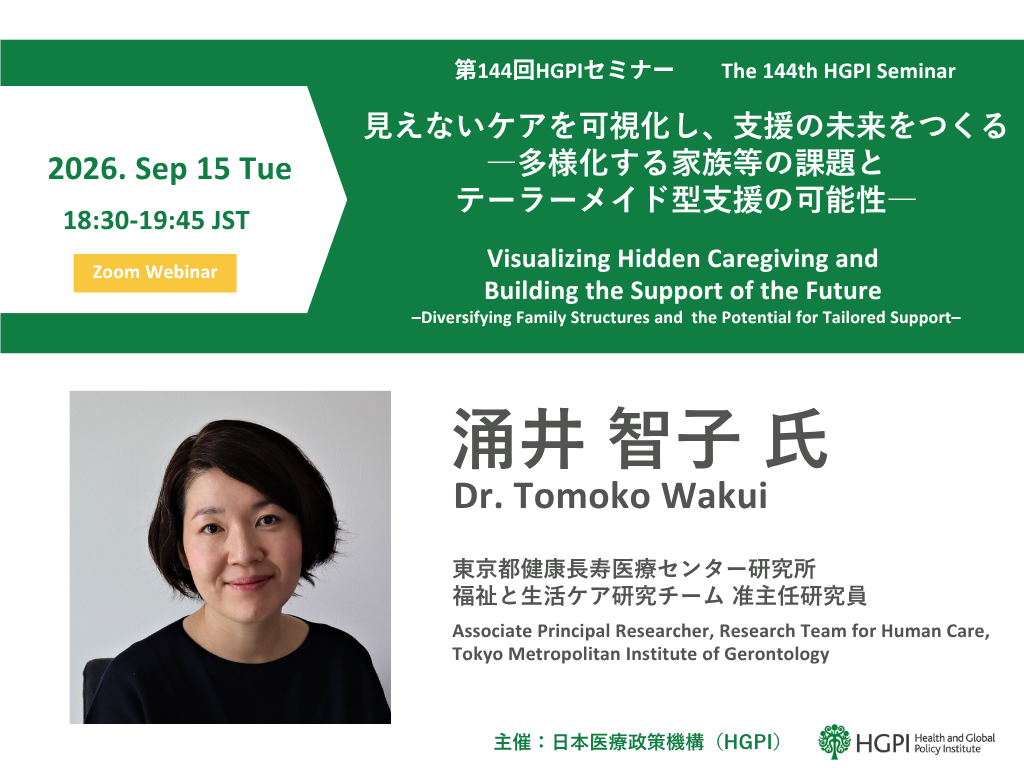
[Registration Closed] (Webinar) The 144th HGPI Seminar “Visualizing Hidden Caregiving and Building the Support of the Future – Diversifying Family Structures and the Potential for Tailored Support”(September 15, 2026)
-
2026-05-29
[Policy Recommendations] Policy Recommendations in the Field of Blood Disorders "Building a Healthcare Ecosystem Centered on Patients and Those Affected" (April 13, 2026)
-
2026-05-25
[In the Media] Release of the Policy Recommendations in the Field of Blood Disorders (Mix Online, April 14, 2026; and others)
-
2025-09-01
[Discussion Points] Blood Disorders Measures Promotion Project “Current Issues and Prospects for Advancing Blood Disorders Control Promotion” (July 23, 2025)
Top Research & Recommendations Posts
Featured Posts
-
2026-05-18
[Registration Closed] Kick-off Panel Discussion “From Africa and Japan, Drawing from Perspectives Around the World:A Platform for Cultivating a Philosophical Health Dialogue Together” (June 15, 2026)
![[Registration Closed] Kick-off Panel Discussion “From Africa and Japan, Drawing from Perspectives Around the World:A Platform for Cultivating a Philosophical Health Dialogue Together” (June 15, 2026)](https://hgpi.org/en/wp-content/uploads/sites/2/HGPI_20260615_Eyecathch_panel-discussion-From-Japan-and-Africa-in-Discussion-with-the-World_2.png)
-
2026-08-28
[Announcement] The 3rd Kiyoshi Kurokawa Award: Call for Nominations (Deadline: November 30, 2026)
![[Announcement] The 3rd Kiyoshi Kurokawa Award: Call for Nominations (Deadline: November 30, 2026)](https://hgpi.org/en/wp-content/uploads/sites/2/Kiyoshi-Kurokawa-Award_3rd_nominations_eyecatch_caseB_ENG_web_20260929_v0.5.jpg)
-
2026-09-01
[Registration Closed] HGPI Salon 2025-2026 Looking Ahead to the Future of Japan’s Social Security System “Session 6: Japan’s Health Policy through the Lens of Global Security” (October 13, 2026)
![[Registration Closed] HGPI Salon 2025-2026 Looking Ahead to the Future of Japan’s Social Security System “Session 6: Japan’s Health Policy through the Lens of Global Security” (October 13, 2026)](https://hgpi.org/en/wp-content/uploads/sites/2/HGPISalon2025-20266.png)
-
2026-09-17
[Registration Open] (Webinar) The 145th HGPI Seminar “Toward Better AMR Measures at Elderly Care Facilities—Considering Infectious Disease Control in a Super-Aged Society From a Policy Perspective” (October 27, 2026)
![[Registration Open] (Webinar) The 145th HGPI Seminar “Toward Better AMR Measures at Elderly Care Facilities—Considering Infectious Disease Control in a Super-Aged Society From a Policy Perspective” (October 27, 2026)](https://hgpi.org/en/wp-content/uploads/sites/2/HGPIseminar145.png)
-
2026-10-06
[Registration Open] (Webinar) The 146th HGPI Seminar “How We Can Build a Society That Supports Choices Around Organ Donation: Exploring Decision-Making by Citizens and a Multi-Layered Approach Through Strategic Social Marketing” (November 9, 2026)
![[Registration Open] (Webinar) The 146th HGPI Seminar “How We Can Build a Society That Supports Choices Around Organ Donation: Exploring Decision-Making by Citizens and a Multi-Layered Approach Through Strategic Social Marketing” (November 9, 2026)](https://hgpi.org/en/wp-content/uploads/sites/2/HGPI_20261001_Eyecatch_HGPIseminer-146th-1.png)
