
[Public Comment Submission] Conference of the Parties to the Convention on Biological Diversity “Call for Peer Review of the Draft Global Action Plan on Biodiversity and Health” (February 12, 2024)
date : 3/4/2024
Tags: Planetary Health

![[Public Comment Submission] Conference of the Parties to the Convention on Biological Diversity “Call for Peer Review of the Draft Global Action Plan on Biodiversity and Health” (February 12, 2024)](https://hgpi.org/en/wp-content/uploads/sites/2/HGPI_240212_BDCOPeyecatch.jpg)
The Health and Global Policy Institute (HGPI) Planetary Health Team submitted its written opinion on the “Updated draft of the Global Action Plan on Biodiversity and Health” by the Executive Secretary of the Conference of the Parties (COP) to the Convention on Biological Diversity. (The call for public comments is now closed.)
Biodiversity supports human lives and brings numerous blessings to human beings, while biodiversity loss causes various impacts including those on human health. To encourage worldwide cooperation in tackling biodiversity issues, the Convention on Biological Diversity was adopted in 1992. The Convention has three objectives: the conservation of biological diversity, the sustainable use of the components of biological diversity, and the fair and equitable sharing of the benefits arising out of the utilization of genetic resources. The Conference of the Parties (COP), as the governing body of the Convention, has been held roughly once every two years, which advances the implementation of the Convention.
The previous Fifteenth meeting of the Conference of the Parties (COP15) took place in 2021 and 2022. During COP15, the “Kunming-Montreal Global Biodiversity Framework” was adopted, which was the post-2020 global biodiversity framework and included targets for 2030. Additionally, a draft global action plan to integrate biodiversity and health considerations into national policies, strategies, programs, and accounts was requested to be finalized by the next meeting (COP16). The draft global action plan has been in development since the Fourteen meeting (COP14).
The COP requested that the Executive Secretary invite feedback from Parties, other governments, indigenous peoples and local communities, and relevant stakeholders for the updated draft, and the Secretariat issued a call to participate in the peer-review process. The draft based on feedback in the peer-review process will be reviewed by the Subsidiary Body on Scientific, Technical and Technological Advice (SBSTTA).
The HGPI Planetary Health Team has participated in this peer-review process by submitting its written opinion on the draft global action plan. This contribution is part of a broader effort to ensure that the perspectives and insights from a diverse range of stakeholders are considered in the finalization of the action plan.
The comments include the following perspectives
- The link between biodiversity loss and the emergence and spread of infectious and non-infectious diseases, as well as the increase in health disparities, is well known. It is believed that the conservation and sustainable use of biodiversity can aid in the prevention, reduction, and proactive management of diseases. However, it has been pointed out that there is a need for concrete evidence to support this relationship.
- In the context of Sustainable Development Goal 3, “Ensure healthy lives and promote well-being for all at all ages“, the deterioration of the environment is seen as a major threat that heightens the physical, mental, and emotional vulnerability of children and youth. This poses a significant risk to their health and the realization of their full developmental potential. The importance of considering the poor and socially vulnerable is also emphasized.
- It is recommended to integrate the interrelationship between biodiversity and health into national health strategies and biodiversity strategies. This includes plans for mental health, nutrition, and the control of infectious and non-infectious diseases, as well as child development. Furthermore, this incorporates perspectives of the poor, vulnerable populations, women, and children, and addresses health inequalities to reduce disparities.
- The proposal suggests establishing a national focus on biodiversity and public health to enhance coordination, implementation, and the sharing of best practices between nations. Additionally, it calls for the development and strengthening of national coordination mechanisms on biodiversity and health interlinkages, thus ensuring they are interdisciplinary and inter-ministerial.
- To reduce pollution from agriculture, aquaculture, fisheries, and forestry, sustainable agricultural practices should be leveraged. This includes using integrated pest management to reduce the need for chemical pesticides and herbicides, as well as antimicrobials, which cover the management of antibiotics in livestock.
For more information on this Peer-Review Draft Global Action Plan on Biodiversity and Health, please click here.
Related Posts
-
2023-11-24
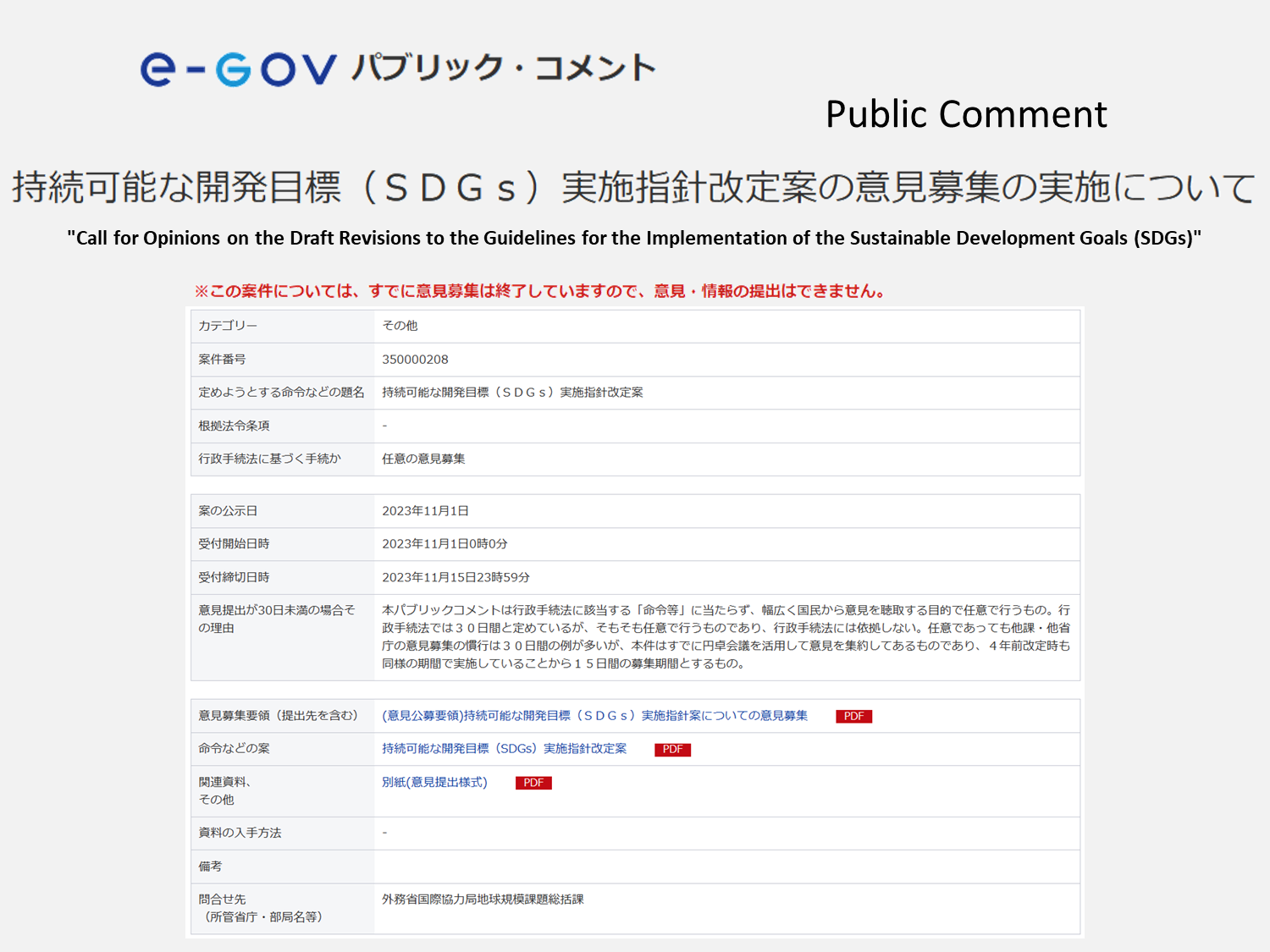
[Public Comment Submission] Ministry of Foreign Affairs "Call for Opinions on the Draft Revisions to the Guidelines for the Implementation of the Sustainable Development Goals (SDGs)" (November 22, 2023)
-
2024-02-27
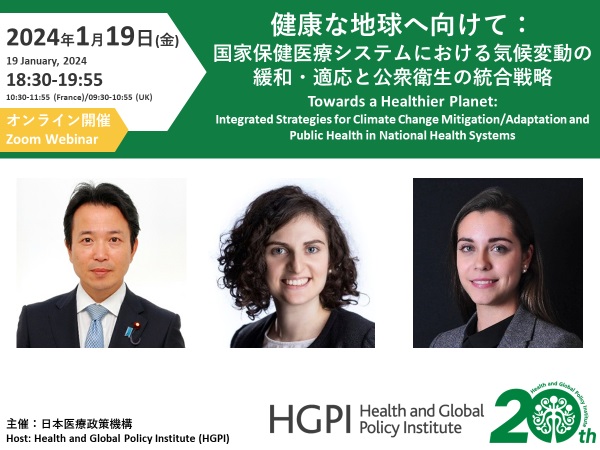
[Event Report] Planetary Health Online Seminar - Towards a Healthier Planet: Integrated Strategies for Climate Change Mitigation/Adaptation and Public Health in National Health Systems (January 19, 2024)
-
2024-02-19
[HGPI Policy Column] (No.40) — From the Planetary Health Project “Part 7: Introduction of SMI's Recommendations for Accelerating Net Zero Health System Delivery”
-
2024-02-16
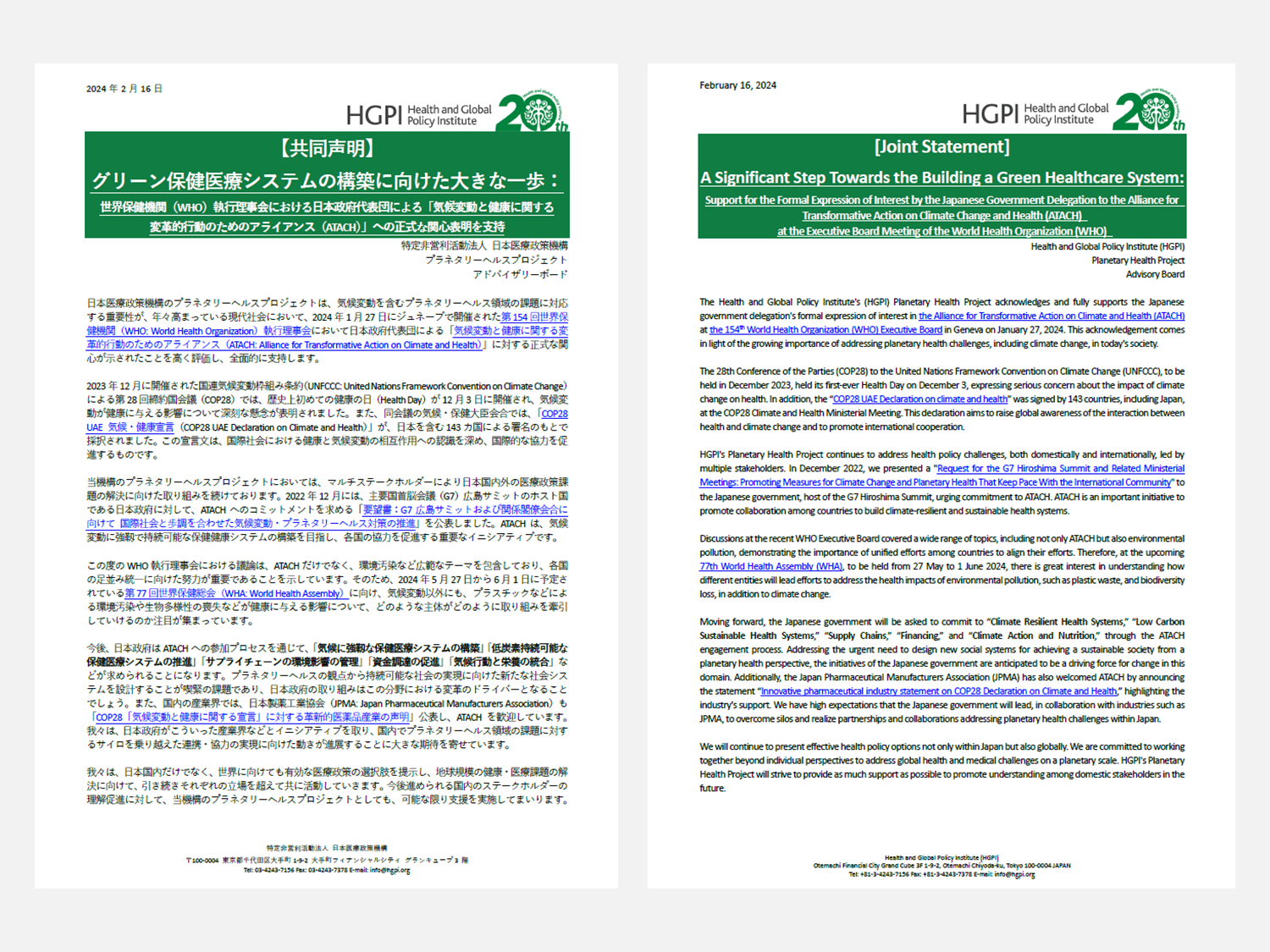
[Announcement] A Significant Step Towards the Building a Green Healthcare System: Support for the Formal Expression of Interest by the Japanese Government Delegation to the ATACH at the Executive Board Meeting of the WHO (February 16, 2024)
Top Research & Recommendations Posts
Featured Posts
-
2026-05-18
[Registration Closed] Kick-off Panel Discussion “From Africa and Japan, Drawing from Perspectives Around the World:A Platform for Cultivating a Philosophical Health Dialogue Together” (June 15, 2026)
![[Registration Closed] Kick-off Panel Discussion “From Africa and Japan, Drawing from Perspectives Around the World:A Platform for Cultivating a Philosophical Health Dialogue Together” (June 15, 2026)](https://hgpi.org/en/wp-content/uploads/sites/2/HGPI_20260615_Eyecathch_panel-discussion-From-Japan-and-Africa-in-Discussion-with-the-World_2.png)
-
2026-08-28
[Announcement] The 3rd Kiyoshi Kurokawa Award: Call for Nominations (Deadline: November 30, 2026)
![[Announcement] The 3rd Kiyoshi Kurokawa Award: Call for Nominations (Deadline: November 30, 2026)](https://hgpi.org/en/wp-content/uploads/sites/2/Kiyoshi-Kurokawa-Award_3rd_nominations_eyecatch_caseB_ENG_web_20260929_v0.5.jpg)
-
2026-09-01
[Registration Closed] HGPI Salon 2025-2026 Looking Ahead to the Future of Japan’s Social Security System “Session 6: Japan’s Health Policy through the Lens of Global Security” (October 13, 2026)
![[Registration Closed] HGPI Salon 2025-2026 Looking Ahead to the Future of Japan’s Social Security System “Session 6: Japan’s Health Policy through the Lens of Global Security” (October 13, 2026)](https://hgpi.org/en/wp-content/uploads/sites/2/HGPISalon2025-20266.png)
-
2026-09-17
[Registration Open] (Webinar) The 145th HGPI Seminar “Toward Better AMR Measures at Elderly Care Facilities—Considering Infectious Disease Control in a Super-Aged Society From a Policy Perspective” (October 27, 2026)
![[Registration Open] (Webinar) The 145th HGPI Seminar “Toward Better AMR Measures at Elderly Care Facilities—Considering Infectious Disease Control in a Super-Aged Society From a Policy Perspective” (October 27, 2026)](https://hgpi.org/en/wp-content/uploads/sites/2/HGPIseminar145.png)
-
2026-10-06
[Registration Open] (Webinar) The 146th HGPI Seminar “How We Can Build a Society That Supports Choices Around Organ Donation: Exploring Decision-Making by Citizens and a Multi-Layered Approach Through Strategic Social Marketing” (November 9, 2026)
![[Registration Open] (Webinar) The 146th HGPI Seminar “How We Can Build a Society That Supports Choices Around Organ Donation: Exploring Decision-Making by Citizens and a Multi-Layered Approach Through Strategic Social Marketing” (November 9, 2026)](https://hgpi.org/en/wp-content/uploads/sites/2/HGPI_20261001_Eyecatch_HGPIseminer-146th-1.png)
