


[Public Comment Submission] Comments on the Establishment of an Independent Panel on AMR (July 25, 2025)
date : 8/22/2025
Tags: AMR

![[Public Comment Submission] Comments on the Establishment of an Independent Panel on AMR (July 25, 2025)](https://hgpi.org/en/wp-content/uploads/sites/2/HGPI_20250725_IPEAcomment.png)
To strengthen the scientific evidence that underpins action against antimicrobial resistance (AMR), an online consultation was held on the establishment of the Independent Panel for Evidence for Action against AMR (IPEA). Health and Global Policy Institute (HGPI) and AMR Alliance Japan also submitted a comment. The consultation was led by four international organizations, collectively known as the Quadpartite—the World Health Organization (WHO), the Food and Agriculture Organization of the United Nations (FAO), the World Organisation for Animal Health (WOAH), and the United Nations Environment Programme (UNEP). It sought broad input from stakeholders to develop founding documents for the panel that would ensure scientific credibility, independence, and policy relevance. The call for comments is now closed.
The proposal to establish the IPEA was originally recommended in a report submitted by the Interagency Coordination Group on AMR (IACG) to the UN Secretary-General in 2019. More recently, the Political Declaration of the High-Level Meeting on Antimicrobial Resistance, adopted at the 79th UN General Assembly in September 2024, called on the four international organizations to establish the IPEA in 2025. The panel’s mission is to support Member States’ responses to AMR by facilitating the generation and use of multisectoral, scientific evidence. The declaration also calls for the panel to be established by making use of existing resources and avoiding duplication of ongoing efforts, after an open and transparent consultation with all Member States on its composition, mandate, scope and deliverables.
Evidence-based policymaking is essential for effective AMR countermeasures. However, existing data is inadequate and tends to be fragmented across sectors, making it difficult for policymakers to assess, prioritize, and implement effective solutions. Gaps in critical evidence hinder progress and weaken the rationale for sustainable financing and interventions. The IPEA is expected to illustrate the impact of objective, authoritative science-policy bodies in building global consensus and fostering action on complex issues. Its purpose is to equip Member States with reliable evidence to guide informed policy and funding decisions and to promote high-impact interventions against AMR across diverse contexts.
HGPI joined the AMR Multi-Stakeholder Partnership Platform in 2023. Within this platform, HGPI participated in the drafting process of the recommendation—published ahead of the 79th UN General Assembly in September 2024—that included the establishment of the IPEA. HGPI endorsed the recommendation and published the Japanese translation to promote broader awareness within Japan. Moving forward, we will continue to contribute to global AMR initiatives through policy advocacy and international collaboration, working toward the effective establishment of the IPEA and alignment with Japan’s AMR policies.
Related Posts
-
2025-07-22
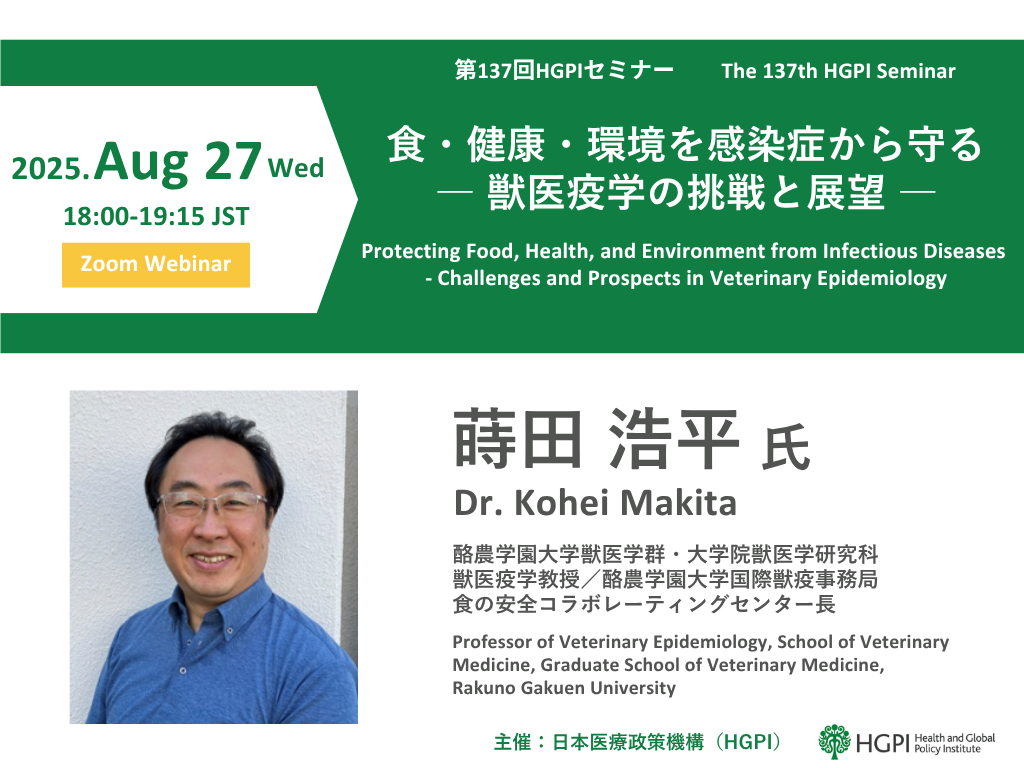
[Registration Closed] (Webinar) The 137th HGPI Seminar "Protecting Food, Health, and Environment from Infectious Diseases - Challenges and Prospects in Veterinary Epidemiology" (August 27, 2025)
-
2025-08-08
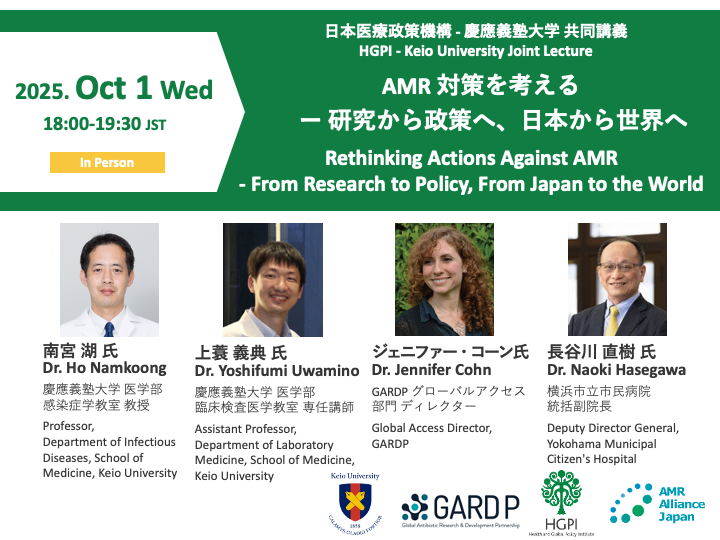
[Registration Closed] HGPI-Keio University Joint Lecture “Rethinking Actions Against AMR: From Research to Policy, From Japan to the World” (October 1, 2025)
-

2025-08-04
[Event Report] International Policy Dialogue “Advancing Action on AMR – Sustainable Policies, Financing, and Global Partnerships” (June 26, 2025)
-
2025-07-14
[Public Comment Submission] Antimicrobial Resistance (AMR) Project “FY2025 Tokyo Metropolitan Citizens’ Project Proposal Initiative” Project Proposal (May 30, 2025)
-
2025-07-08
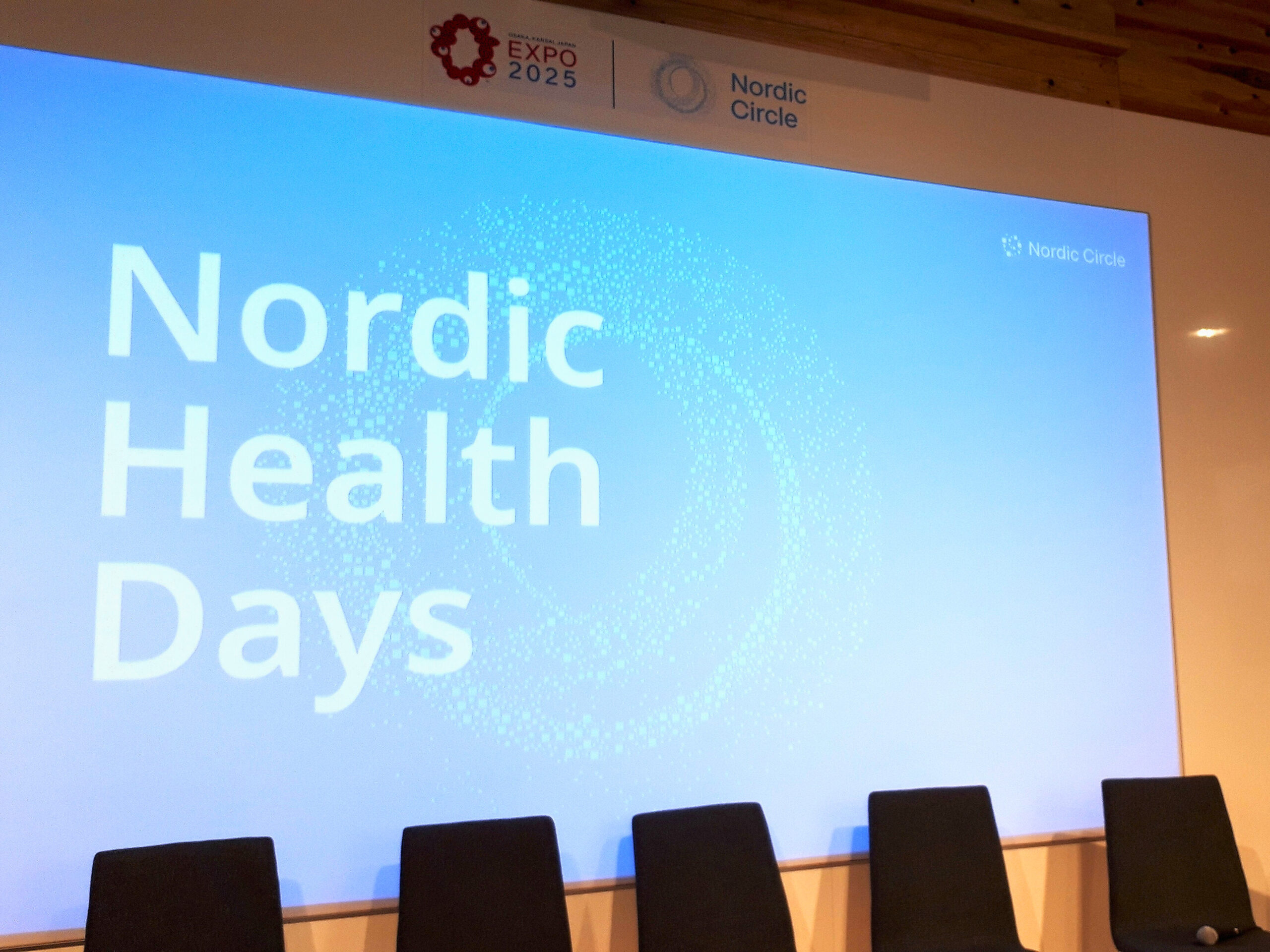
[Activity Report] “Nordic Health Days” at the Nordic Pavillion, Expo 2025 Osaka, Kansai, Japan (June 25-26, 2025, Yumeshima, Osaka)
-
2025-07-01
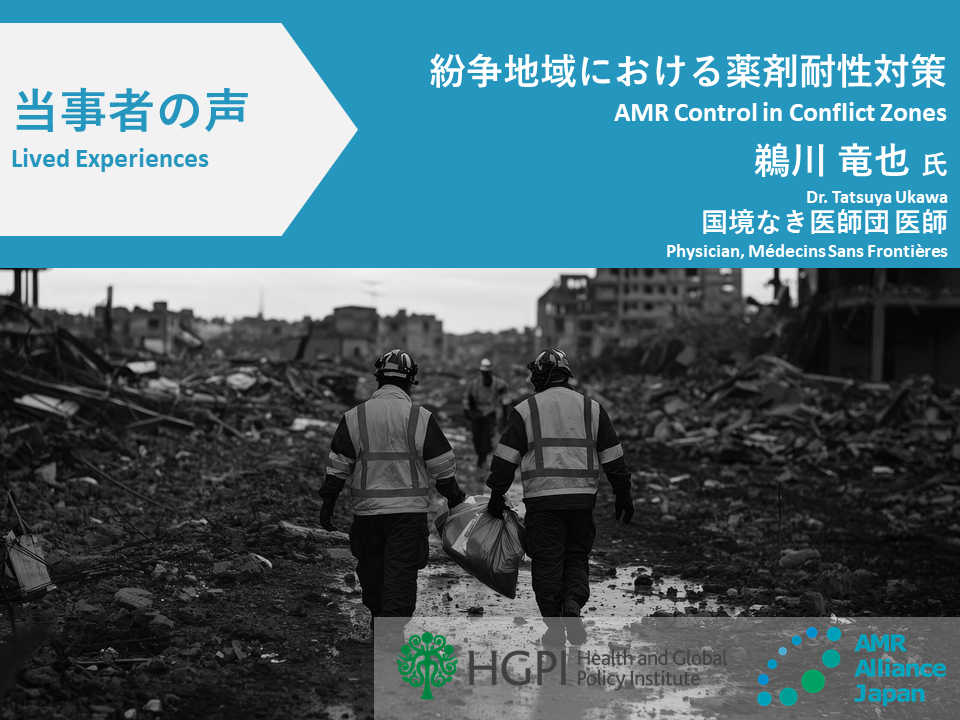
[Lived Experiences] AMR Control in Conflict Zones: Challenges and New Perspectives on AMR Control in Conflict Zones as Seen in Medical Practice in the Gaza Strip (July 1, 2025)
-
2025-06-02
[Policy Recommendations] Recommendation for the Basic Policy on Economic and Fiscal Management and Reform 2025: Toward Promoting Measures Against Antimicrobial Resistance (AMR) (May 29, 2025)
Top Research & Recommendations Posts
Featured Posts
-
2026-05-18
[Registration Closed] Kick-off Panel Discussion “From Africa and Japan, Drawing from Perspectives Around the World:A Platform for Cultivating a Philosophical Health Dialogue Together” (June 15, 2026)
![[Registration Closed] Kick-off Panel Discussion “From Africa and Japan, Drawing from Perspectives Around the World:A Platform for Cultivating a Philosophical Health Dialogue Together” (June 15, 2026)](https://hgpi.org/en/wp-content/uploads/sites/2/HGPI_20260615_Eyecathch_panel-discussion-From-Japan-and-Africa-in-Discussion-with-the-World_2.png)
-
2026-08-28
[Announcement] The 3rd Kiyoshi Kurokawa Award: Call for Nominations (Deadline: November 30, 2026)
![[Announcement] The 3rd Kiyoshi Kurokawa Award: Call for Nominations (Deadline: November 30, 2026)](https://hgpi.org/en/wp-content/uploads/sites/2/Kiyoshi-Kurokawa-Award_3rd_nominations_eyecatch_caseB_ENG_web_20260929_v0.5.jpg)
-
2026-09-01
[Registration Closed] HGPI Salon 2025-2026 Looking Ahead to the Future of Japan’s Social Security System “Session 6: Japan’s Health Policy through the Lens of Global Security” (October 13, 2026)
![[Registration Closed] HGPI Salon 2025-2026 Looking Ahead to the Future of Japan’s Social Security System “Session 6: Japan’s Health Policy through the Lens of Global Security” (October 13, 2026)](https://hgpi.org/en/wp-content/uploads/sites/2/HGPISalon2025-20266.png)
-
2026-09-17
[Registration Open] (Webinar) The 145th HGPI Seminar “Toward Better AMR Measures at Elderly Care Facilities—Considering Infectious Disease Control in a Super-Aged Society From a Policy Perspective” (October 27, 2026)
![[Registration Open] (Webinar) The 145th HGPI Seminar “Toward Better AMR Measures at Elderly Care Facilities—Considering Infectious Disease Control in a Super-Aged Society From a Policy Perspective” (October 27, 2026)](https://hgpi.org/en/wp-content/uploads/sites/2/HGPIseminar145.png)
-
2026-10-06
[Registration Open] (Webinar) The 146th HGPI Seminar “How We Can Build a Society That Supports Choices Around Organ Donation: Exploring Decision-Making by Citizens and a Multi-Layered Approach Through Strategic Social Marketing” (November 9, 2026)
![[Registration Open] (Webinar) The 146th HGPI Seminar “How We Can Build a Society That Supports Choices Around Organ Donation: Exploring Decision-Making by Citizens and a Multi-Layered Approach Through Strategic Social Marketing” (November 9, 2026)](https://hgpi.org/en/wp-content/uploads/sites/2/HGPI_20261001_Eyecatch_HGPIseminer-146th-1.png)
