


[HGPI Policy Column] (No. 75) What Is the WHO Civil Society Commission? — The Institutionalization of Civil Society Participation in WHO and Japan’s Engagement
date : 7/29/2026
Tags: Global Health, Global Health Strategy, HGPI Policy Column

![[HGPI Policy Column] (No. 75) What Is the WHO Civil Society Commission? — The Institutionalization of Civil Society Participation in WHO and Japan’s Engagement](https://hgpi.org/en/wp-content/uploads/sites/2/columun-75.png.png)
<POINTS>
- The WHO Civil Society Commission (CSC) is a “civil society network operated under the WHO framework,” established to advance dialogue and collaboration between WHO and civil society more systematically.
- The CSC was conceived following dialogues on “social participation and accountability” held in 2020–2021; its Terms of Reference (ToR) were finalized in 2023, and it was formally launched in August of that year.
- The CSC’s role is to make recommendations on WHO’s civil society engagement at the global, regional, and country levels, thereby helping to advance WHO’s General Programme of Work (GPW) and the achievement of the Sustainable Development Goals (SDGs).
- The CSC is not an independent civil society coalition; it operates under WHO’s regulations and faces certain constraints regarding external communications, publications, and funding.
- Currently, Health and Global Policy Institute (HGPI) is the sole participant from Japan in the CSC and Japan-based civil society organizations are also encouraged to actively engage in the CSC framework.
Introduction
In recent years, a key issue in global health has been how to strengthen civil society’s engagement in policymaking. Complex challenges such as Universal Health Coverage (UHC), health emergency response, and climate change and health tend to create a significant gap between policymakers and those directly affected. To bridge that gap and ensure that policies are grounded in reality, the question is how to incorporate the insights of civil society-not just through intergovernmental discussions- into the policy-making process.
Amid this trend, the World Health Organization (WHO) established the Civil Society Commission (CSC). The CSC is positioned as a new initiative aimed at transforming the dialogue between WHO and civil society from a one-off exchange of views toward a more continuous and institutional mechanism. HGPI is participating in this initiative on behalf of Japan.
In this column, we will outline the background objectives, governance, past initiatives, future challenges, and involvement of Japan, and explore its significance.
Background and Process Leading to the Establishment of the CSC
The CSC was conceived following dialogues on “social participation and accountability” between the WHO Director-General and civil society held in 2020–2021. Subsequently, the Terms of Reference (ToR) were subsequently finalized in January 2023, and applications for participation began to be accepted from February of that year. Furthermore, the members of the Steering Committee were announced in July 2023, and the CSC was officially launched with the holding of its first meeting on August 24, 2023.
WHO views the CSC as a mechanism for delivering advice and recommendations from civil society to WHO in a more structured and systematic manner. WHO’s engagement with non-State actors had previously been institutionalized through frameworks such as the Framework of Engagement with Non-State Actors (FENSA); the CSC can be seen as an effort to further advance this trend and to explicitly strengthen the building of ongoing relationships with civil society.
In addition, the World Health Assembly (WHA)—WHO’s highest decision-making body—held in 2024, a resolution on “social participation” was adopted. Furthermore, the Fourteenth General Programme of Work, 2025–2028 (GPW 14)—the organization-wide strategic plan that forms the backbone of WHO’s overall activities—also sets out the strengthening of engagement with civil society, and the CSC is positioned as the body responsible for carrying this out. This indicates that the CSC is not a one-off committee but rather an institution deeply embedded in WHO’s medium- to long-term operational strategy.
Objectives and Role of the CSC
The CSC’s official mission is to strengthen dialogue and collaboration between WHO and civil society and to make recommendations on WHO’s civil society engagement at the global, regional, and country levels. Beyond this, it aims to accelerate the achievement of WHO’s General Programme of Work (GPW) and Sustainable Development Goals (SDGs).
Importantly, the CSC is not merely a “venue for listening to the voices of civil society,”; rather, it is expected to serve as a framework for improving the very nature of civil society participation within WHO’s policymaking and institutional operations. In other words, it plays a role in examining and making recommendations on the mechanisms of participation themselves—what kinds of consultations WHO should conduct, how to encourage more diverse civil society participation, and how to enhance the quality and transparency of participation. In this sense, the CSC can be described as an institutional foundation that shapes the rules and practices of civil society participation within WHO.
Governance and Institutional Design of the CSC
The CSC is not an independent legal entity or external organization but rather a “WHO-hosted network” operated under WHO’s regulations. This point is crucial for understanding the nature of the CSC.
Structurally, it consists of a Steering Committee comprising up to 25 organizations, a General Meeting held once a year, Working Groups established for specific themes, and a Secretariat located within WHO. The Steering Committee is responsible for coordinating strategic direction and overseeing the Working Groups, while the General Meeting reviews annual reports and work plans.
Initiatives to Date
Since its launch in 2023, the CSC has held annual general meetings and carried out concrete work through its working groups. Official documents indicate that, at least through 2024–2025, the following three areas will be prioritized.
The first is improving WHO’s civil society consultation processes. The Working Groups are expected to analyze various consultation processes—including the drafting of WHA resolutions, the preparation of WHO normative documents, and intergovernmental negotiations—and to compile better standard procedures and practical proposals for consultation.
The second is taking stock of the civil society participation mechanisms that exist within WHO. The aim is to map out what participation opportunities exist across WHO’s various departments and to make proposals for improving existing mechanisms and for new approaches to dialogue.
The third is providing recommendations for the WHO Civil Society Engagement Strategy (2025–2028). The CSC plays a role in compiling opinions and experiences from the civil society and reflecting them in WHO’s medium-term civil society strategy.
Furthermore, in 2025, the CSC’s first research findings on civil society engagement in the WHA resolution-drafting process were published as a WHO publication, suggesting that the CSC is beginning to function not merely as a deliberative body but also as a forum for synthesizing insights and proposing institutional reforms.
The Significance of the CSC and the Challenges That Have Emerged
The significance of the CSC lies in its effort to shift civil society participation within WHO from an ad hoc to an institutional framework. If civil society can engage in the process of policy document development and decision-making processes at an earlier stage and in a more structured manner, both the quality of participation and accountability have the potential to improve.
In particular, if consultation procedures are made transparent and participation rules are standardized during the formation of WHA resolutions and WHO strategy documents, there is potential to avoid participation that merely goes through the motions of listening to opinions and to move closer to substantive policy dialogue.
However, the challenges are also clear. The most significant challenge is that the institutional design itself can affect representativeness. As long as self-funding is the principle, participation tends to be skewed toward non-governmental organizations (NGOs) with sufficient financial and human resources, making it difficult for grassroots groups and organizations with severe resource constraints to participate on an ongoing basis. This is an issue directly linked to the inclusivity of civil society participation.
In addition, a system requiring WHO approval for external communications and the production of deliverables—while maintaining trust and alignment with WHO—may weaken civil society’s autonomy and its ability to make swift joint recommendations. Whether the CSC will function as “part of the WHO’s internal governance” or continue to serve as “a forum connecting independent civil society voices” will depend largely on how it is operated going forward.
Furthermore, the external evaluation to be conducted in two years will be a critical milestone that determines the CSC’s legitimacy. If the evaluation methods, the scope of results disclosure, and how the findings are incorporated into subsequent improvements remain unclear, trust in the system could be undermined. Conversely, if this evaluation is conducted transparently and effectively, the CSC has the potential to evolve into a more mature mechanism.
Conclusion
The CSC is an initiative aimed at transforming the relationship between WHO and civil society into one that is more institutionalized, sustained, and strategic. Although it was established only recently, it has already begun to play concrete roles, such as drafting recommendations through its working groups and providing input to WHA and WHO strategic documents.
At the same time, the CSC is a mechanism operated under WHO’s regulations and faces institutional constraints in terms of funding, communications, autonomy, and representativeness. Whether this framework functions as a venue for effective participation or remains a formalized institution will depend on the nature of the external evaluation and on the accumulation of actual practice.
For Japan, the CSC is not merely a new WHO body. It is an important gateway for connecting civil society insights to global health policy and engaging in international rule-making. However, participation from Japan is currently limited to the HGPI, making it difficult for the voices of Japanese civil society to be heard in international rule-making forums. It will be necessary to watch closely how the institutionalization of social participation in WHO progresses, and what role Japanese civil society can play within it, while considering concrete next steps.
References
- World Health Organization. WHO Civil Society Commission.
https://www.who.int/about/collaboration/civil-society-and-ngo-engagement/civil-society-commission - World Health Organization. WHO Civil Society Steering Committee meeting.
https://www.who.int/news-room/events/detail/2023/08/24/default-calendar/who-civil-society-steering-committee-meeting - World Health Organization. Terms of Reference of the WHO Civil Society Commission.
https://cdn.who.int/media/docs/default-source/documents/about-us/collaborations/civil-society/terms-of-reference-who-cso-commission.pdf - World Health Organization. Global Health Strategy 2025–2028 / GPW 14.
https://cdn.who.int/media/docs/default-source/documents/about-us/general-programme-of-work/global-health-strategy-2025-2028.pdf - World Health Organization. WHO Civil Society Commission participants list.
https://cdn.who.int/media/docs/default-source/documents/about-us/collaborations/civil-society/who-civil-society-commission-participants.pdf - Health and Global Policy Institute. Information related to the WHO Civil Society Commission.
https://hgpi.org/events/who-20250317.html - World Health Organization. World Health Assembly endorses resolution on social participation.
https://www.who.int/news/item/29-05-2024-world-health-assembly-endorses-resolution-on-social-participation - World Health Organization. Framework of Engagement with Non-State Actors (FENSA).
https://apps.who.int/gb/ebwha/pdf_files/WHA69/A69_R10-en.pdf - World Health Organization. Working Groups, WHO Civil Society Commission.
https://www.who.int/about/collaboration/civil-society-and-ngo-engagement/civil-society-commission/working-groups - World Health Organization. ToR: WG1 Civil Society Consultations.
https://cdn.who.int/media/docs/default-source/documents/about-us/collaborations/civil-society/tor-wg1-civil-society-consultations.pdf - World Health Organization. ToR: WG2 Civil Society Engagement Mechanisms.
https://cdn.who.int/media/docs/default-source/documents/about-us/collaborations/civil-society/tor-wg2-civil-society-engagement-mechanisms.pdf - World Health Organization. ToR: WG3 WHO Civil Society Engagement Strategy.
https://cdn.who.int/media/docs/default-source/documents/about-us/collaborations/civil-society/tor-wg3-who-cs-engagement-strategy.pdf - World Health Organization. Civil society engagement in the development of World Health Assembly resolutions and decisions: lessons and examples from the Seventy-seventh session.
https://www.who.int/publications/i/item/9789240103788
Authors
Honoka Hiraka (Senior Associate, Health and Global Policy Institute)
Hikaru Sato (Associate, Health and Global Policy Institute)
Hinako Iwakura (Program Specialist, Health and Global Policy Institute)
Joji Sugawara (Vice President, Health and Global Policy Institute)
Related Posts
-
2026-07-01
[HGPI Policy Column] (No.74) “The Meaning of Considering Decision-Making Methods in Policy: The Policy-Making Process in the AI Era”
-
2026-06-19
[HGPI Policy Column] (No.73) — From the Planetary Health Project “Part 18: Planetary Health Diet: A Dietary Guideline for the Health of People and the Planet”
-
2026-06-22
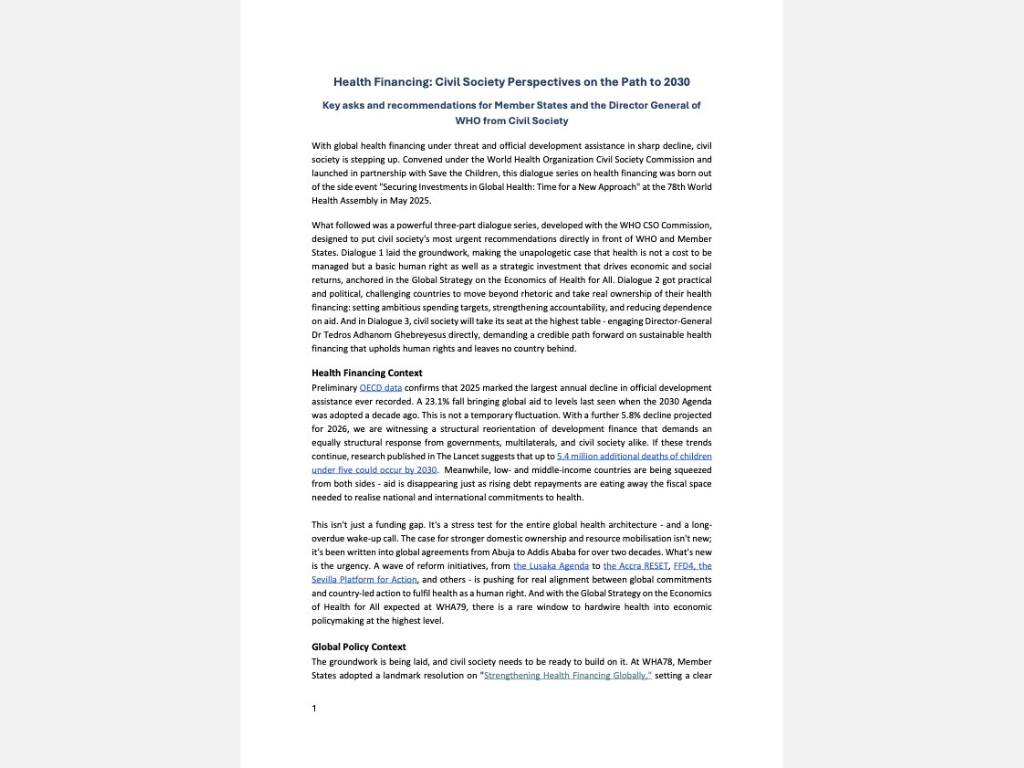
[Announcement] WHO CSC Recommendations on “Sustainable Health Financing”: Publication and Endorsement (May 19, 2026)
-

2025-03-17
[Announcement] HGPI Participates in the WHO Civil Society Commission (March 17, 2025)
Top Research & Recommendations Posts
Featured Posts
-
2026-05-18
[Registration Closed] Kick-off Panel Discussion “From Africa and Japan, Drawing from Perspectives Around the World:A Platform for Cultivating a Philosophical Health Dialogue Together” (June 15, 2026)
![[Registration Closed] Kick-off Panel Discussion “From Africa and Japan, Drawing from Perspectives Around the World:A Platform for Cultivating a Philosophical Health Dialogue Together” (June 15, 2026)](https://hgpi.org/en/wp-content/uploads/sites/2/HGPI_20260615_Eyecathch_panel-discussion-From-Japan-and-Africa-in-Discussion-with-the-World_2.png)
-
2026-08-28
[Announcement] The 3rd Kiyoshi Kurokawa Award: Call for Nominations (Deadline: November 30, 2026)
![[Announcement] The 3rd Kiyoshi Kurokawa Award: Call for Nominations (Deadline: November 30, 2026)](https://hgpi.org/en/wp-content/uploads/sites/2/Kiyoshi-Kurokawa-Award_3rd_nominations_eyecatch_caseB_ENG_web_20260929_v0.5.jpg)
-
2026-09-01
[Registration Closed] HGPI Salon 2025-2026 Looking Ahead to the Future of Japan’s Social Security System “Session 6: Japan’s Health Policy through the Lens of Global Security” (October 13, 2026)
![[Registration Closed] HGPI Salon 2025-2026 Looking Ahead to the Future of Japan’s Social Security System “Session 6: Japan’s Health Policy through the Lens of Global Security” (October 13, 2026)](https://hgpi.org/en/wp-content/uploads/sites/2/HGPISalon2025-20266.png)
-
2026-09-17
[Registration Open] (Webinar) The 145th HGPI Seminar “Toward Better AMR Measures at Elderly Care Facilities—Considering Infectious Disease Control in a Super-Aged Society From a Policy Perspective” (October 27, 2026)
![[Registration Open] (Webinar) The 145th HGPI Seminar “Toward Better AMR Measures at Elderly Care Facilities—Considering Infectious Disease Control in a Super-Aged Society From a Policy Perspective” (October 27, 2026)](https://hgpi.org/en/wp-content/uploads/sites/2/HGPIseminar145.png)
-
2026-10-06
[Registration Open] (Webinar) The 146th HGPI Seminar “How We Can Build a Society That Supports Choices Around Organ Donation: Exploring Decision-Making by Citizens and a Multi-Layered Approach Through Strategic Social Marketing” (November 9, 2026)
![[Registration Open] (Webinar) The 146th HGPI Seminar “How We Can Build a Society That Supports Choices Around Organ Donation: Exploring Decision-Making by Citizens and a Multi-Layered Approach Through Strategic Social Marketing” (November 9, 2026)](https://hgpi.org/en/wp-content/uploads/sites/2/HGPI_20261001_Eyecatch_HGPIseminer-146th-1.png)
