


(Event Report)2nd Session of “Action on Health Technology” Series~Health Technology Implementation around the World: Learning from Netherlands~
date : 5/13/2016

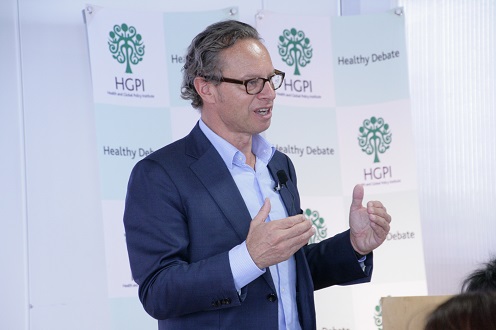
The Netherlands has overcome various regulatory bottlenecks and policy barriers to become one of the leading nations in the field of health technology including telemedicine and healthcare ICT. In this session, Mr. Tas has not only presented the latest technology in health care and the current situation of the Netherlands, but also provided an insight into the Netherlands’ experiences of policy making in this field from policy formulation and negotiation to implementation, evaluation and revision/adjustment. This session provided an opportunity for an open multi-stakeholder discussion for effective policy development with experts including private, public and academic sectors.
Opening Remarks
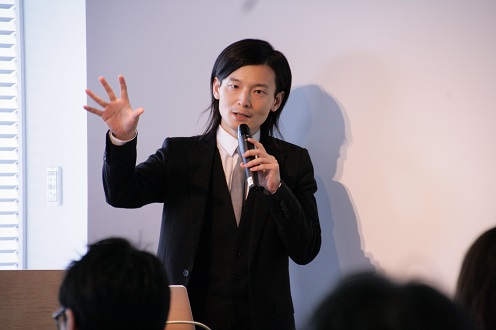
Prof. Hiroaki Miyata of Keio University addressed 4 critical areas in which health technology will bring significant impact to; “Cost Effectiveness”, “Specialty”, “Space” and “Time”. Health technology will improve cost effectiveness and shorten waiting time for laboratory examination. Integration of information by specialists on cloud platform and utilization of cloud data to identify best and personalized care for each patient will soon be possible by health technology.
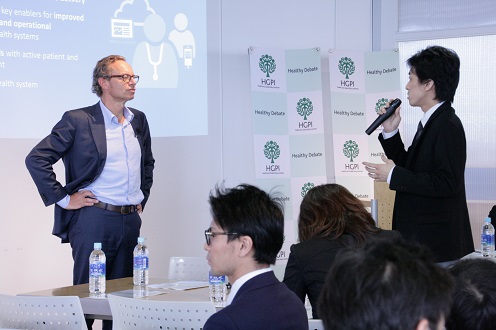
Presentation(Mr. Jeroen Tas)
In the challenging time for healthcare history, the current healthcare system fails to adjust to the changing landscape with rise of chronic diseases, and financial resource constraints. Mr. Tas presented 4 key transitions healthcare must encounter; “Episodic to Continuous”, “Provider care to Patient centric”, “Fragmented to Connected”, and “Volume to Value”.
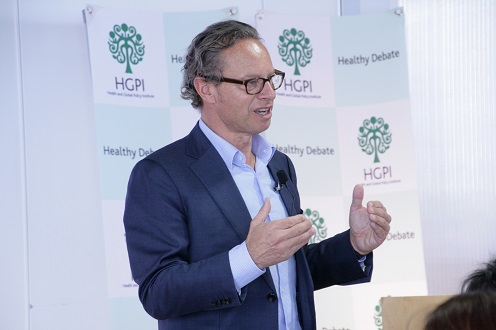
Describing it as “strange”, Mr. Tas elaborated particularity of healthcare and its obstacles, which can be overcome by use of technology. One critical point indicated was that healthcare is organized around providers while other industries are organized around consumers. He expressed further need of shift to “patient centric”. In addition, medical system needs to shift away from fee-for-service payment models and transform to be more preventive and cost effective. Having daughter with diabetes type 1, Mr. Tas promoted personalized care for each patient and his or her family.
In addition, Mr. Tas mentioned the current platform in the Netherlands by collaboration with the government and private sectors as a best practice of public private partnership for healthcare ICT.
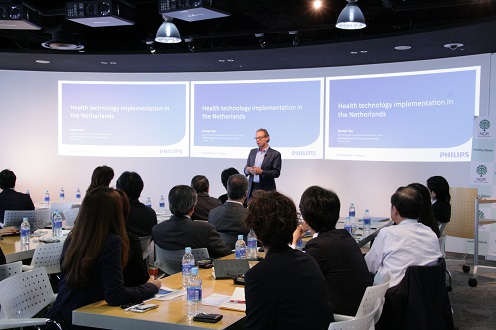
After Mr. Tas’ presentation, he and experts from private, public and academic sectors had vibrant discussion and Q&A session to foster policy making in Japan.
Closing Remarks
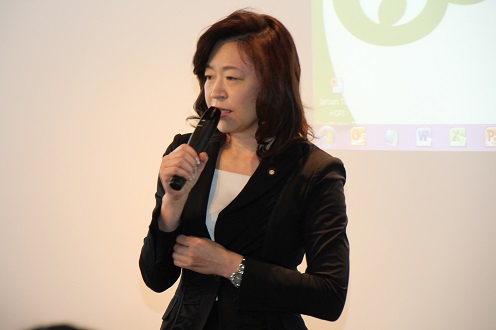
Coucillor Michiyo Yakushiji closed the session, urging leadership of legislative body to overcome regulatory bottlenecks and facilitate building new technology from Japan.
Exhibition date:2016-04-27

Top Research & Recommendations Posts
Featured Posts
-
2026-05-18
[Registration Closed] Kick-off Panel Discussion “From Africa and Japan, Drawing from Perspectives Around the World:A Platform for Cultivating a Philosophical Health Dialogue Together” (June 15, 2026)
![[Registration Closed] Kick-off Panel Discussion “From Africa and Japan, Drawing from Perspectives Around the World:A Platform for Cultivating a Philosophical Health Dialogue Together” (June 15, 2026)](https://hgpi.org/en/wp-content/uploads/sites/2/HGPI_20260615_Eyecathch_panel-discussion-From-Japan-and-Africa-in-Discussion-with-the-World_2.png)
-
2026-08-28
[Announcement] The 3rd Kiyoshi Kurokawa Award: Call for Nominations (Deadline: November 30, 2026)
![[Announcement] The 3rd Kiyoshi Kurokawa Award: Call for Nominations (Deadline: November 30, 2026)](https://hgpi.org/en/wp-content/uploads/sites/2/Kiyoshi-Kurokawa-Award_3rd_nominations_eyecatch_caseB_ENG_web_20260929_v0.5.jpg)
-
2026-09-01
[Registration Closed] HGPI Salon 2025-2026 Looking Ahead to the Future of Japan’s Social Security System “Session 6: Japan’s Health Policy through the Lens of Global Security” (October 13, 2026)
![[Registration Closed] HGPI Salon 2025-2026 Looking Ahead to the Future of Japan’s Social Security System “Session 6: Japan’s Health Policy through the Lens of Global Security” (October 13, 2026)](https://hgpi.org/en/wp-content/uploads/sites/2/HGPISalon2025-20266.png)
-
2026-09-17
[Registration Open] (Webinar) The 145th HGPI Seminar “Toward Better AMR Measures at Elderly Care Facilities—Considering Infectious Disease Control in a Super-Aged Society From a Policy Perspective” (October 27, 2026)
![[Registration Open] (Webinar) The 145th HGPI Seminar “Toward Better AMR Measures at Elderly Care Facilities—Considering Infectious Disease Control in a Super-Aged Society From a Policy Perspective” (October 27, 2026)](https://hgpi.org/en/wp-content/uploads/sites/2/HGPIseminar145.png)
-
2026-10-06
[Registration Open] (Webinar) The 146th HGPI Seminar “How We Can Build a Society That Supports Choices Around Organ Donation: Exploring Decision-Making by Citizens and a Multi-Layered Approach Through Strategic Social Marketing” (November 9, 2026)
![[Registration Open] (Webinar) The 146th HGPI Seminar “How We Can Build a Society That Supports Choices Around Organ Donation: Exploring Decision-Making by Citizens and a Multi-Layered Approach Through Strategic Social Marketing” (November 9, 2026)](https://hgpi.org/en/wp-content/uploads/sites/2/HGPI_20261001_Eyecatch_HGPIseminer-146th-1.png)
