


[Event Report] Planetary Health Project: Fourth Advisory Board Meeting of FY2025 “Planetary Health—Establishing a Sustainable Earth’s Environment” (February 19, 2026)
date : 3/9/2026
Tags: Planetary Health

![[Event Report] Planetary Health Project: Fourth Advisory Board Meeting of FY2025 “Planetary Health—Establishing a Sustainable Earth’s Environment” (February 19, 2026)](https://hgpi.org/en/wp-content/uploads/sites/2/アイキャッチ_ADB_2025年_プラネタリーヘルス_第4回.png)
Health and Global Policy Institute (HGPI) convened the fourth Advisory Board Meeting of its Planetary Health Project for fiscal year 2025 on February 19, 2026. This project serves as a platform for dialogue and consensus-building among experts from industry, government, academia, and civil society to examine the impacts of climate change, biodiversity loss, and environmental pollution on health, and to build sustainable healthcare systems.
In this meeting, which concluded FY2025, significant achievements were reported in both international policy contributions and domestic implementation. Regarding global collaboration, progress was shared on HGPI’s involvement in the adoption of the “Belém Health Action Plan (BHAP)” at COP30, the inclusion of Japanese case studies in the United Nations Human Rights Council (UNHRC) report, and the signing of a Memorandum of Understanding (MOU) with Health Care Without Harm Southeast Asia (HCWH SEA). For domestic implementation, HGPI presented the “Compendium of Case Studies on Greening Healthcare Facilities (Vol. 1),” which analyzes pioneering practices at three hospitals, and offered six insights for overcoming the “triple constraints” (declining revenues, soaring construction costs, and lack of investment funds). During the latter half of the meeting, participants exchanged views on strategic directions for FY2026, including the development of a logical framework for “Synergies between Health Promotion and Environmental Protection”—where preventing chronic diseases reduces the consumption of medical resources and contributes to lowering environmental footprints—as well as plans for in-person Carbon Footprint (CFP) calculation training.
■ Key Discussion Topics:
The meeting focused on the following themes, serving as a bridge from the FY2025 summary to “policy implementation” in the coming year:
- Contributions to and Recognition in International Frameworks: It was reported that the “Belém Health Action Plan (BHAP),” which HGPI helped draft, was formally adopted at COP30. Additionally, Japan’s experience with pollution compensation was officially recognized as a “Best Practice” in a UNHRC report.
- Decarbonizing the Supply Chain: Regarding interventions for supply chain emissions (Scope 3), which account for the majority of the healthcare sector’s footprint, participants confirmed the need for initiatives aligned with international procurement standards discussed by the Alliance for Transformative Action on Climate and Health (ATACH).
- Greening Healthcare Facilities and the “Triple Constraints”: Through the practical cases of three hospitals, the importance of strategic investment—achieving environmental impact reduction, management improvement, and disaster resilience as an integrated whole—was shared, even under the “triple constraints” of financial and economic pressures.
- Education for Practitioners and Implementation Support: A plan was approved to hold a 1.5- to 2-day in-person training session in Tokyo in November 2026. This program will utilize a “Carbon Footprint (CFP) Calculation Tool” to help healthcare institutions understand and visualize their own emissions.
- Priority Agenda for FY2026: Proposals were made to visualize the process of converting reduced medical demand into carbon indicators, strengthen healthcare resilience as regional hubs for heatstroke prevention, and organize challenges for implementing “Circular Healthcare.”
<Fourth Advisory Board Meeting Agenda>
17:00–17:05 Opening and Introduction
17:05–17:20 Activity Report (Global trends such as BHAP and ATACH, international collaboration with HCWH, Greening Case Studies, and CFP training plans)
17:20–17:50 Expert Presentations
17:50–18:25 Discussion on Key Agenda Items (FY2026 outlook and feedback, improving Advisory Board operations)
18:25–18:30 Future Schedule and Closing
■Advisory Board Members: (titles omitted; in no particular order)
Industry
- Satoru Arima (Sustainability Planning & Management Group, Sustainability Department, Daiichi Sankyo Co., Ltd.)
- Yutaka Mitsutake (Director, Japan Sustainability, AstraZeneca K.K.)
- Sayuri Takimoto (Associate Director, Government Affairs & Policy, Corporate Affairs Division, AstraZeneca K.K.)
- Kentaro Kawamura (Head, Sustainability Department, Market Access & External Affairs Division, Novo Nordisk Pharma Ltd.)
- Mami Handa (Senior Group Manager, Sustainability Group, Market Access & External Affairs Division, Novo Nordisk Pharma Ltd.)
- Ryohei Yamagata (Sustainability Manager, Market Access & External Affairs Division, Novo Nordisk Pharma Ltd.)
Government
- Satoshi Ezoe (Senior Assistant Minister for Global Health, Minister’s Secretariat, Ministry of Health, Labour and Welfare)
- Masato Izutsu (Senior Coordinator, Global Health, International Affairs Division, Ministry of Health, Labour and Welfare)
- Haruhiko Hakuno (Director General, Environmental Health Department, Ministry of the Environment Japan)
- Shoko Misaka (Senior Officer for International Cooperation, International Affairs Division, Ministry of Health, Labour and Welfare)
- Yoshie Nakayama (Director, Heat Illness Policy Office, Policy Planning Division, Environmental Health Department, Ministry of the Environment)
Academia
- Kenji Fuma (Specially Appointed Professor, Co-Creative Organization for Green Society, Shinshu University / CEO, Neural, Inc.)
- Masahiro Hashizume (Professor, Department of Global Health Policy, Graduate School of Medicine, The University of Tokyo)
- Yukiko Imada (Associate Professor, Division of Climate System Research, Atmosphere and Ocean Research Institute and Department of Earth and Planetary Science, University of Tokyo)
- Saori Kashima (Director, Center for the Planetary Health and Innovation Science (PHIS); Associate Professor, Environmental Health Sciences Laboratory, Hiroshima University)
- Naoki Kondo (Professor and Chair, Department of Social Epidemiology, Graduate School of Medicine and Public Health, Kyoto University)
- Taiko Kudo (Visiting Professor, Research Institute for Humanity and Nature)
- Keiko Nakamura (Emeritus Professor, Institute of Science Tokyo)
- Keisuke Nansai (Director, Material Cycles Division, National Institute for Environmental Studies)
- Masashi Soga (Associate Professor, Graduate School of Agricultural and Life Sciences, The University of Tokyo)
- Naoko Yamamoto (Vice President / Professor, International University of Health and Welfare; Director, Global Medical Cooperation Center)
- Hiroya Yamano (Professor, Department of Earth and Planetary Science, University of Tokyo; Senior Principal Researcher, Biodiversity Division, NIES)
- Shoji Yokobori (Professor, Department of Emergency and Critical Care Medicine, Nippon Medical School; Director, Advanced Critical Care Center, Nippon Medical School Hospital)
- Chiho Watanabe (Professor, School of Tropical Medicine and Global Health, Nagasaki University)
Civil Society / Youth
- Makoto Haraguchi (Fellow, Sustainability Department, MS&AD Insurance Group Holdings, Inc.)
- Yoshio Uetsuka (Supreme Adviser & Special Member, Japan R-SUD Association)
- So Sugawara (Representative Director, Green innovation)
- Kinya Hamaguchi (Executive Board Member, Japan Medical Association)
- Yusuke Sakurai (Secretary-General, Japan Zero Carbon Welfare Council)
- Yukari Nakano (Executive Director, Japanese Nursing Association)
- Masafumi Nozawa (Director, Healthcare Division, Corporate Finance Dept. Div. 6, Development Bank of Japan)
- Yusuke Matsuo (Director, Business Task Force, Institute for Global Environmental Strategies)
- Akihito Watanabe (Health Specialist, Human and Social Development Office, Sectors Group, Asian Development Bank)
- Green Practice Japan
- AMSA Japan (Asian Medical Students’ Association Japan)
- IFMSA-Japan (International Federation of Medical Students’ Associations Japan)
- jagh-s (Japan Association for Global Health, Students Section)
Secretariat
- Joji Sugawara (President, HGPI)
- Eri Cahill (Associate, HGPI)
- Shu Suzuki (Senior Associate, HGPI)
Related Posts
-
2025-11-17
[Announcement] HGPI Endorses the “Belém Health Action Plan” (November 14, 2025)
-
2025-11-27
[Public Comment Submission] The UN Special Rapporteur’s Call for Input on Protecting Clean Air (October 16, 2025)
-
2025-11-11
[Event Report] From Vision to Action: Greening Japan’s Healthcare “Online Seminar: Climate and Health 101” (September 13, 2025)
-
2025-10-31
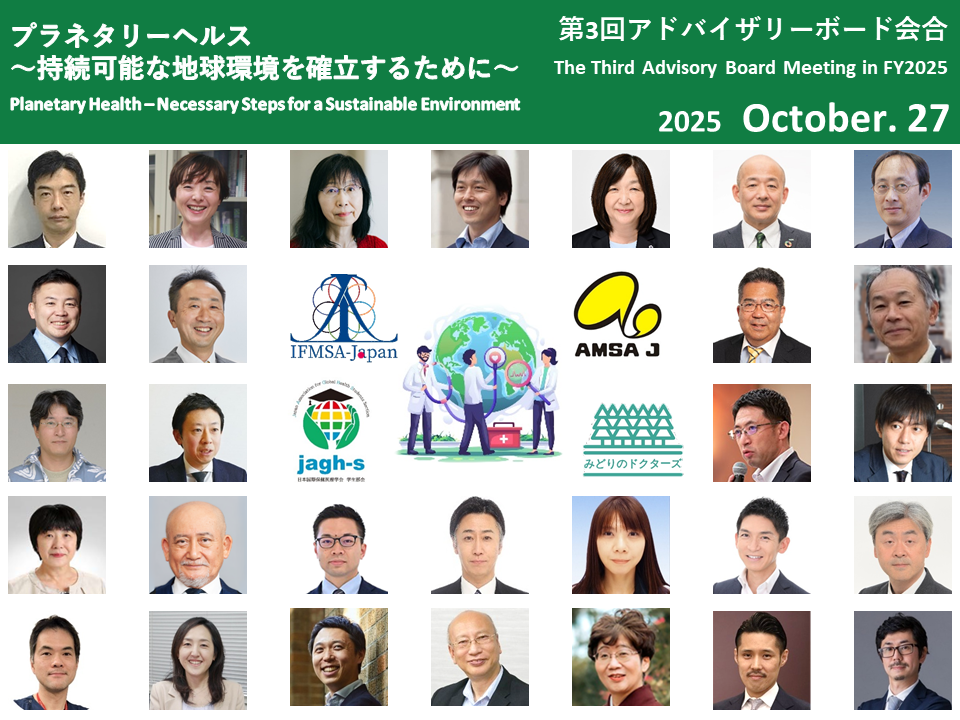
[Event Report] Planetary Health Project: Third Advisory Board Meeting of FY2025 (October 27, 2025)
Top Research & Recommendations Posts
- [Policy Recommendations] Joint Statement “Protecting the Health of Both the Planet and People — A Japan-Model Planetary Health Strategy to Turn the Climate Crisis into an Opportunity for Health, the Economy, and Growth” (June 24, 2026)
- [Policy Recommendations] Improving Patient Access to Genomic Cancer Medicine (August 10, 2023)
- [Research Report] Perceptions, Knowledge, Actions and Perspectives of Healthcare Organizations in Japan in Relation to Climate Change and Health: A Cross-Sectional Study (November 13, 2025)
- [Research Report] Energy Conservation and Greenhouse Gas Emissions Reduction in Healthcare Facilities: Case Studies from New Construction and Facility Renewal (March 16, 2026)
- [Policy Recommendations] Developing a National Health and Climate Strategy for Japan (June 26, 2024)
- [Research Report] AMR Policy Update #6: The New Global Action Plan on AMR (Part 1)
- [Recommendations] Strengthening Epidemiology Education in the Veterinary Field for the One Health Era (June 19, 2026)
- [Policy Recommendations] Reshaping Japan’s Immunization Policy for Life Course Coverage and Vaccine Equity: Challenges and Prospects for an Era of Prevention and Health Promotion (April 25, 2025)
- [Public Comment Submission] “The 7th Science, Technology and Innovation Basic Plan” (Draft) (February 19, 2026)
- [Policy Recommendations] Mental Health Project: Recommendations on Three Issues in the Area of Mental Health (July 4, 2025)
Featured Posts
-
2026-06-04
[Registration Open] (Webinar) The 3rd J-PEP Seminar “Social Participation of People with Intractable Diseases and the Potential of a New Way of Working — ‘RD Workers’ — Lessons from Policy Advocacy Practice” (July 22, 2026)
![[Registration Open] (Webinar) The 3rd J-PEP Seminar “Social Participation of People with Intractable Diseases and the Potential of a New Way of Working — ‘RD Workers’ — Lessons from Policy Advocacy Practice” (July 22, 2026)](https://hgpi.org/en/wp-content/uploads/sites/2/HGPI_20260722_The3rd-J-PEPseminar.jpg)
-
2026-06-15
[Registration Open] (Hybrid Format) Multidisciplinary Symposium for Cardiology, Nephrology, and Metabolic Medicine “Future Actions for Making Full Use of the Health Checkup System: Connecting Checkups to Treatment From the Perspective of Data Linkage” (July 6, 2026)
![[Registration Open] (Hybrid Format) Multidisciplinary Symposium for Cardiology, Nephrology, and Metabolic Medicine “Future Actions for Making Full Use of the Health Checkup System: Connecting Checkups to Treatment From the Perspective of Data Linkage” (July 6, 2026)](https://hgpi.org/en/wp-content/uploads/sites/2/cvd-ckd-ncd-20260706_r2.png)
-
2026-06-19
[Recommendations] Strengthening Epidemiology Education in the Veterinary Field for the One Health Era (June 19, 2026)
![[Recommendations] Strengthening Epidemiology Education in the Veterinary Field for the One Health Era (June 19, 2026)](https://hgpi.org/en/wp-content/uploads/sites/2/HGPI_eyecatch_20260619_AMR_Recommendations.png)
-
2026-06-24
[Policy Recommendations] Joint Statement “Protecting the Health of Both the Planet and People — A Japan-Model Planetary Health Strategy to Turn the Climate Crisis into an Opportunity for Health, the Economy, and Growth” (June 24, 2026)
![[Policy Recommendations] Joint Statement “Protecting the Health of Both the Planet and People — A Japan-Model Planetary Health Strategy to Turn the Climate Crisis into an Opportunity for Health, the Economy, and Growth” (June 24, 2026)](https://hgpi.org/en/wp-content/uploads/sites/2/JS_20260624_ENG.png)
-
2026-07-02
[Research Report] Medical Practitioner Interviews on the Current State and Issues for Interdepartmental Collaboration in Clinical Practice for Chronic Kidney Disease (June 30, 2026)
![[Research Report] Medical Practitioner Interviews on the Current State and Issues for Interdepartmental Collaboration in Clinical Practice for Chronic Kidney Disease (June 30, 2026)](https://hgpi.org/en/wp-content/uploads/sites/2/ckd-ncd-20260630-top_ENG.png)
