


[Announcement] HGPI Endorses the UHC2030 Global Compact for Progress Towards Universal Health Coverage (March 31, 2026)
date : 4/20/2026

![[Announcement] HGPI Endorses the UHC2030 Global Compact for Progress Towards Universal Health Coverage (March 31, 2026)](https://hgpi.org/en/wp-content/uploads/sites/2/HGPI_20260331_UHC2030_Compact.jpg)
Health and Global Policy Institute (HGPI) is pleased to officially announce that it has joined UHC2030, a global multi-stakeholder platform to accelerate the achievement of Universal Health Coverage (UHC), and has signed and endorsed its official document, the “Global Compact for progress towards universal health coverage.”
UHC2030 is an international platform co-hosted by the World Health Organization (WHO), the World Bank, and the Organisation for Economic Co-operation and Development (OECD). It brings together governments, international organizations, civil society, the private sector, and philanthropic organizations to achieve UHC as set out in target 3.8 of the Sustainable Development Goals (SDGs)—namely, “a state in which all people have access to appropriate quality health services at affordable costs.”
To become a member of UHC2030, organizations are required to sign the Global Compact, which constitutes a commitment to building and strengthening equitable and resilient health systems based on the following five key principles:
- Leaving no one behind: Equity, non-discrimination, and a rights-based approach
- Transparency and accountability for results
- Evidence-based national health strategies and leadership
- Making health systems everybody’s business: Active engagement of citizens, communities, civil society, and the private sector
- International cooperation based on mutual learning and development effectiveness
As an independent think tank engaging diverse domestic and international stakeholders, HGPI has long provided evidence-based policy options. By joining UHC2030, HGPI will further strengthen its advocacy activities and policy recommendations toward the UN High-Level Meeting on UHC scheduled for 2027, and contribute to institutional reforms in global health and the building of resilient health systems.
For more information on UHC2030 and the Global Compact, please visit the UHC2030 website.
■ About UHC2030
UHC2030 is a global, multi-stakeholder platform dedicated to accelerating sustainable progress toward Universal Health Coverage (UHC). Hosted by the World Health Organization (WHO) in collaboration with the World Bank and the Organisation for Economic Co-operation and Development (OECD), it aims to achieve a world where all people have access to the full range of quality health services they need, when and where they need them, without financial hardship. Members include governments, civil society organizations, the private sector, UN agencies, and other international organizations who join by endorsing the Global Compact. Together, they work to build equitable and resilient health systems that leave no one behind. UHC2030 operates through three key pathways for change: advocacy (influencing political and social decision-making to advance UHC), accountability (tracking the implementation of UHC commitments), and alignment (convening stakeholders to strengthen coherence with national health plans and structures). The platform is governed by a Steering Committee, Secretariat, and Political Panel. UHC2030 evolved in 2016 from the International Health Partnership (IHP+), established in 2007, transforming to respond to the health-related Sustainable Development Goals.
Related Posts
-
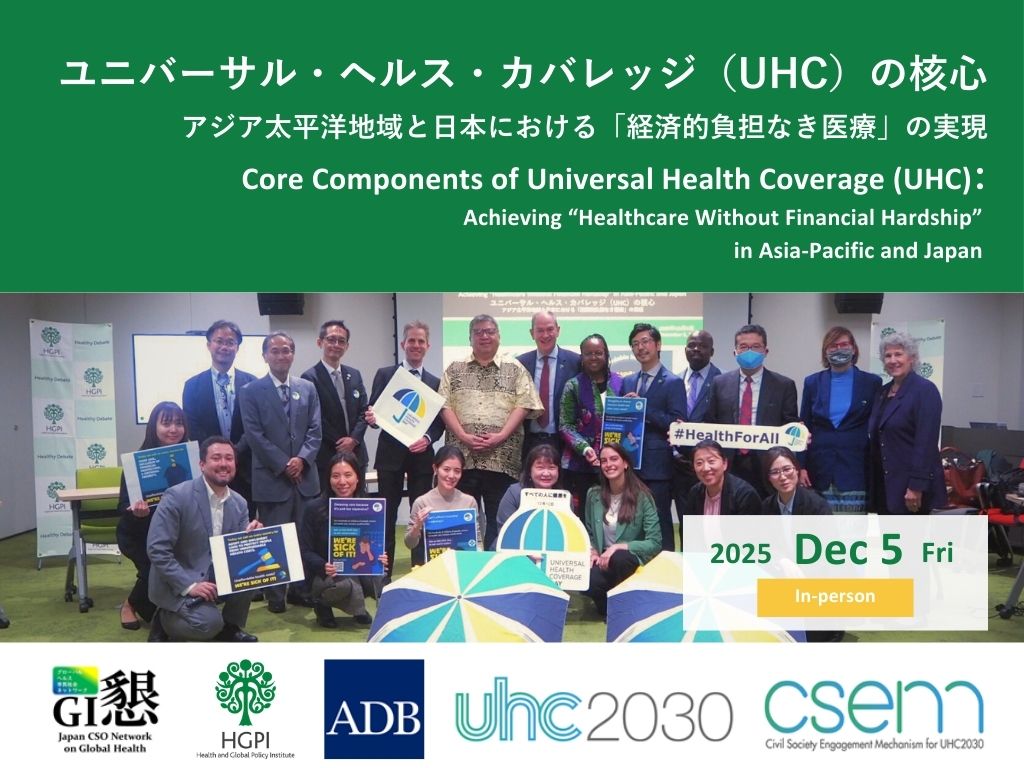
2025-12-11
[Event Report] Core Components of Universal Health Coverage (UHC): Achieving “Healthcare Without Financial Hardship” in Asia-Pacific and Japan (December 5, 2025)
-
2025-11-01
[Announcement] HGPI’s Member Appointed to the CSEM Advisory Group of UHC2030 (November 1, 2025)
-
2025-09-18
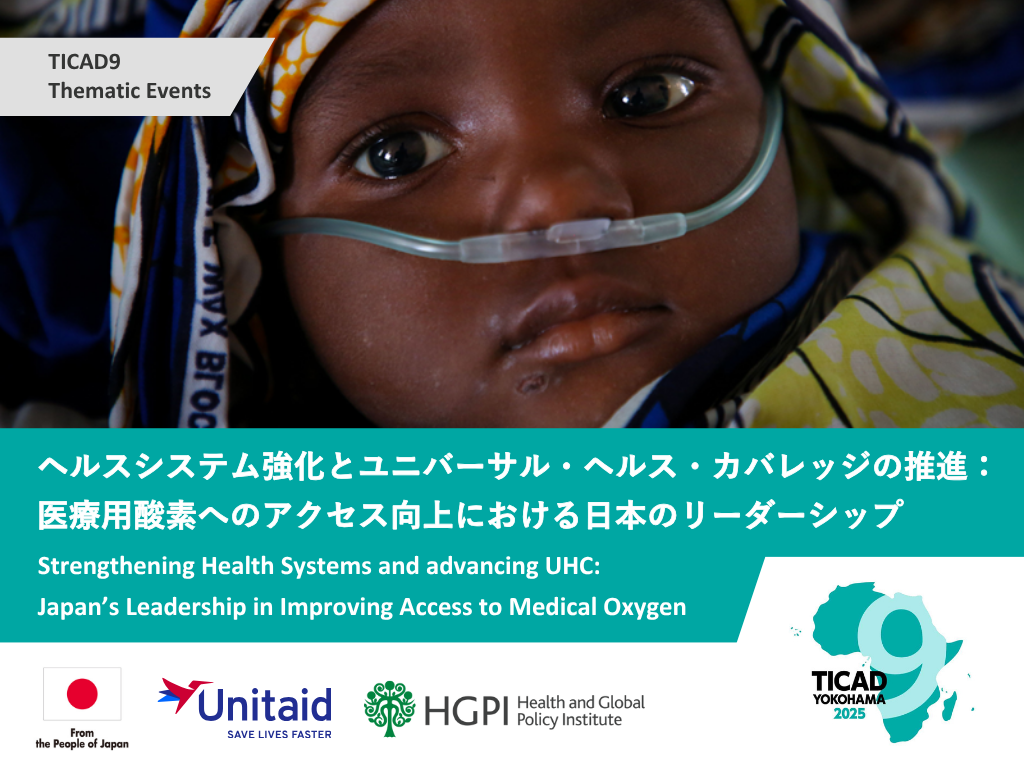
[Event Report] TICAD9 Thematic Event “Strengthening Health Systems and advancing UHC: Japan’s Leadership in Improving Access to Medical Oxygen” (August 20, 2025)
-

2025-03-17
[Announcement] HGPI Participates in the WHO Civil Society Commission (March 17, 2025)
-
2021-10-18
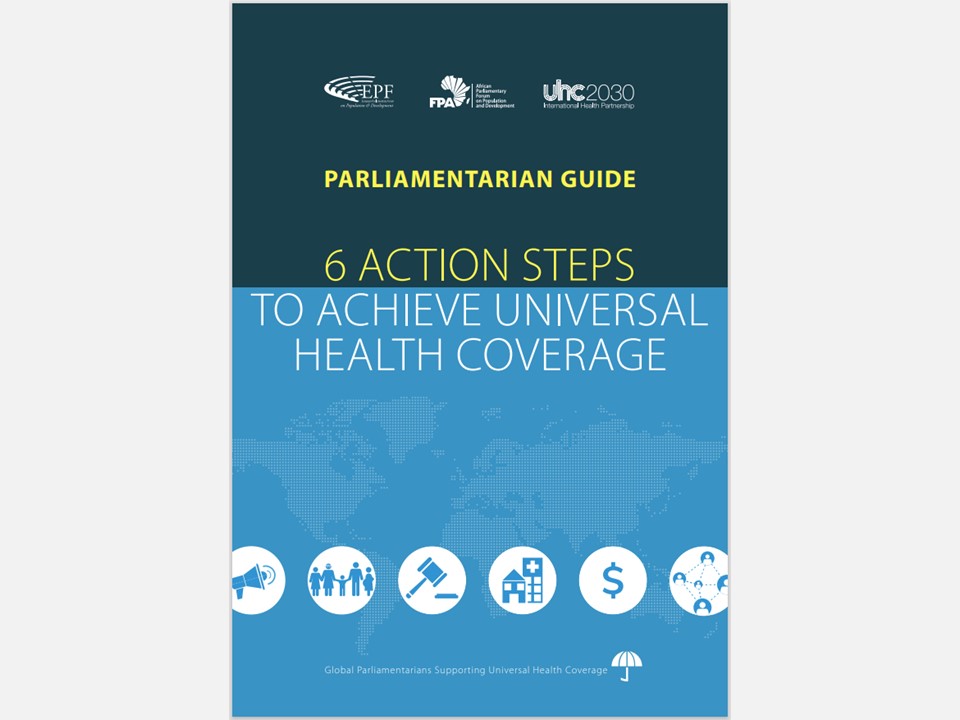
[Announcement] Release of the Parliamentarian Guide on UHC (September 28, 2021)
-
2021-05-28
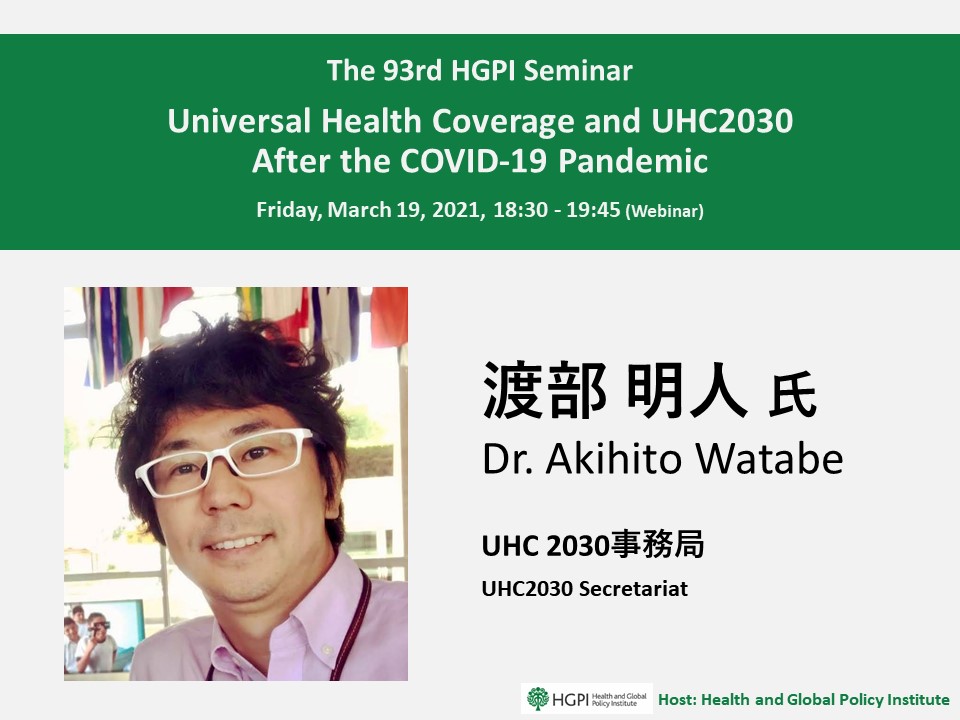
[Event Report] The 93rd HGPI Seminar—Universal Health Coverage and UHC2030 After the COVID-19 Pandemic (March 19, 2021)
-
2025-04-23
[HGPI Policy Column] (No.58) — From the Global Health Strategy Project — “Toward Fair Health Systems: The Power of Data in Advancing UHC and Supporting Health Financing”
Top Research & Recommendations Posts
Featured Posts
-
2026-05-18
[Registration Closed] Kick-off Panel Discussion “From Africa and Japan, Drawing from Perspectives Around the World:A Platform for Cultivating a Philosophical Health Dialogue Together” (June 15, 2026)
![[Registration Closed] Kick-off Panel Discussion “From Africa and Japan, Drawing from Perspectives Around the World:A Platform for Cultivating a Philosophical Health Dialogue Together” (June 15, 2026)](https://hgpi.org/en/wp-content/uploads/sites/2/HGPI_20260615_Eyecathch_panel-discussion-From-Japan-and-Africa-in-Discussion-with-the-World_2.png)
-
2026-08-28
[Announcement] The 3rd Kiyoshi Kurokawa Award: Call for Nominations (Deadline: November 30, 2026)
![[Announcement] The 3rd Kiyoshi Kurokawa Award: Call for Nominations (Deadline: November 30, 2026)](https://hgpi.org/en/wp-content/uploads/sites/2/Kiyoshi-Kurokawa-Award_3rd_nominations_eyecatch_caseB_ENG_web_20260929_v0.5.jpg)
-
2026-09-01
[Registration Closed] HGPI Salon 2025-2026 Looking Ahead to the Future of Japan’s Social Security System “Session 6: Japan’s Health Policy through the Lens of Global Security” (October 13, 2026)
![[Registration Closed] HGPI Salon 2025-2026 Looking Ahead to the Future of Japan’s Social Security System “Session 6: Japan’s Health Policy through the Lens of Global Security” (October 13, 2026)](https://hgpi.org/en/wp-content/uploads/sites/2/HGPISalon2025-20266.png)
-
2026-09-17
[Registration Open] (Webinar) The 145th HGPI Seminar “Toward Better AMR Measures at Elderly Care Facilities—Considering Infectious Disease Control in a Super-Aged Society From a Policy Perspective” (October 27, 2026)
![[Registration Open] (Webinar) The 145th HGPI Seminar “Toward Better AMR Measures at Elderly Care Facilities—Considering Infectious Disease Control in a Super-Aged Society From a Policy Perspective” (October 27, 2026)](https://hgpi.org/en/wp-content/uploads/sites/2/HGPIseminar145.png)
-
2026-10-06
[Registration Open] (Webinar) The 146th HGPI Seminar “How We Can Build a Society That Supports Choices Around Organ Donation: Exploring Decision-Making by Citizens and a Multi-Layered Approach Through Strategic Social Marketing” (November 9, 2026)
![[Registration Open] (Webinar) The 146th HGPI Seminar “How We Can Build a Society That Supports Choices Around Organ Donation: Exploring Decision-Making by Citizens and a Multi-Layered Approach Through Strategic Social Marketing” (November 9, 2026)](https://hgpi.org/en/wp-content/uploads/sites/2/HGPI_20261001_Eyecatch_HGPIseminer-146th-1.png)
