

[Policy Recommendations] “Moving AI-Assisted Diagnosis From ‘Approval’ to ‘Practice’: Creating an ‘AI-Assisted Diagnosis Adoption Voucher’ to Encourage Uptake by Healthcare Facilities” (November 26, 2026)
date : 11/26/2026
Tags: Other Activities

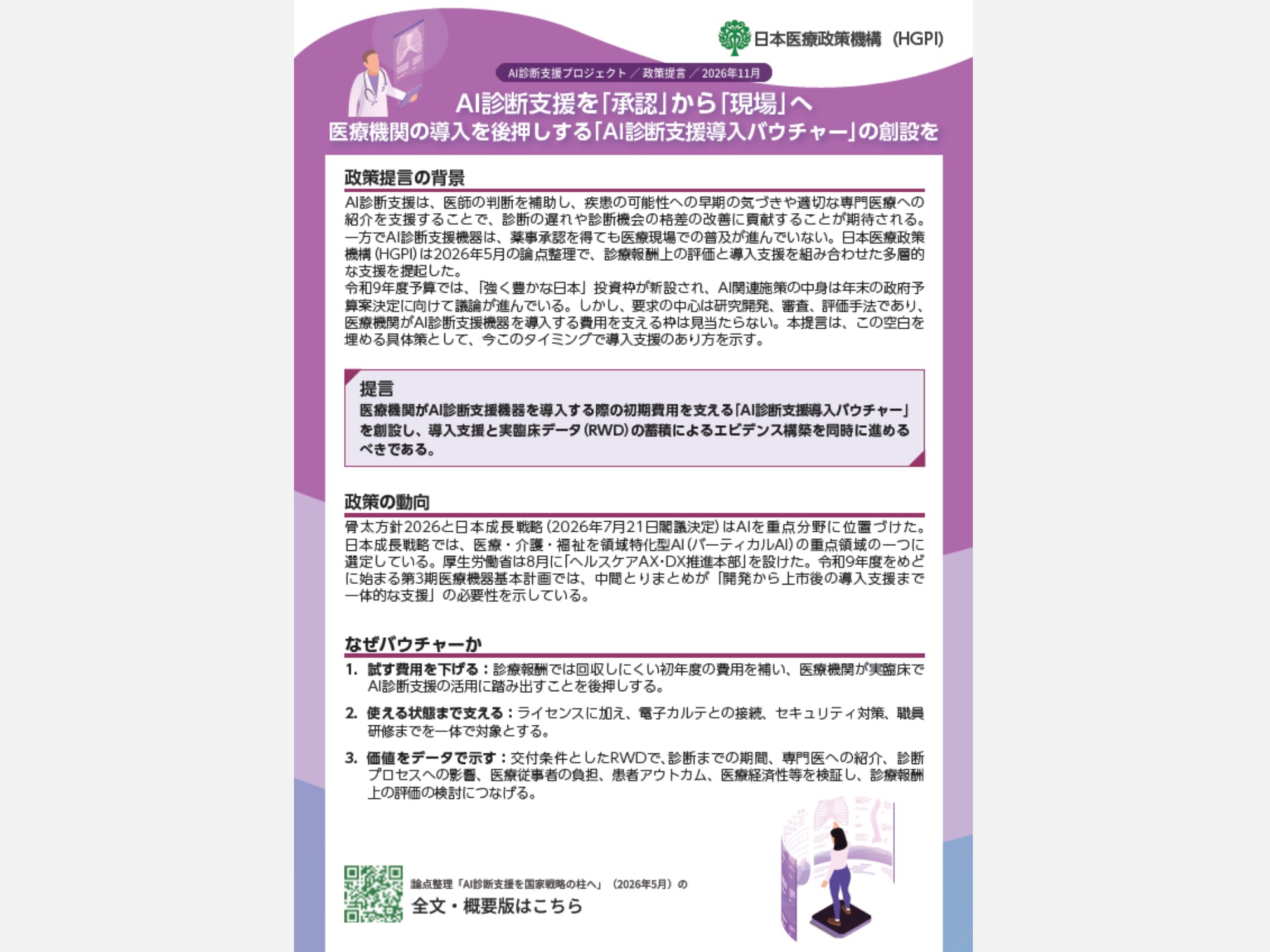
Health and Global Policy Institute (HGPI) has published policy recommendations titled “Moving AI-Assisted Diagnosis From ‘Approval’ to ‘Practice’: Creating an ‘AI-Assisted Diagnosis Adoption Voucher’ to Encourage Uptake by Healthcare Facilities.”
AI-enabled diagnostic support devices assist physicians in making diagnoses. However, even after receiving regulatory approval, many of these devices have yet to be widely adopted in clinical settings. To address this issue, the policy recommendations propose an “AI-Assisted Diagnosis Adoption Voucher” that would cover the initial costs healthcare facilities face when introducing these devices.
Beyond device usage fees, the voucher would also cover related costs, such as linking devices to electronic medical records and training staff, so that healthcare facilities can make AI-assisted diagnosis part of daily care. The policy recommendations also aim to build a system in which clinical data collected after adoption (real-world data, or RWD) are used to assess effectiveness and inform reimbursement decisions under the medical fee schedule, thus enabling healthcare facilities to continue using the devices after the subsidy ends.
Recommendation
An “AI-Assisted Diagnosis Adoption Voucher” should be established to cover the initial costs healthcare facilities face when introducing AI-enabled diagnostic support devices. This voucher should be used both to support adoption and to build evidence by accumulating RWD.
■Background
AI-enabled diagnostic support devices assist physicians in early detection of possible diseases and referral of patients to appropriate specialist care. They are anticipated to help reduce diagnostic delays and narrow gaps in access to diagnosis. However, Japan’s policies to promote the real-world deployment of AI-assisted diagnosis still have room to develop relative to those of other countries. In this context, the interim report toward the Third Basic Plan for Medical Devices, released in March 2026, pointed to the need for “integrated support from development through adoption support after market launch.” 1 Building on this, in May 2026, HGPI published a discussion paper titled “Positioning AI-Assisted Diagnosis as a Pillar of National Strategy: Multi-Stakeholder Discussion Points for a Sustainable Healthcare System,” which outlined key issues for expanding the use of AI-assisted diagnosis in clinical settings.
Since then, the policy foundation for promoting AI in healthcare has been taking shape. Japan’s Growth Strategy, approved by the Cabinet in July 2026, named healthcare, long-term care, and welfare as one of the priority areas for vertical AI (domain-specific AI). 2 In August 2026, the Ministry of Health, Labour and Welfare (MHLW) established its Healthcare AX/DX Promotion Headquarters, headed by the Minister, to drive AI transformation (AX) and digital transformation (DX) in the healthcare sector. However, the healthcare items in the FY2027 budget requests focus mainly on research and development, regulatory review, and evaluation methods. Support for healthcare facilities to cover the cost of adopting AI-enabled diagnostic support devices is not among the main requested items. 3 Policy documents recognize the need for adoption support, but the budget requests leave a gap in this area. This proposal presents concrete measures to fill this gap before the government finalizes its draft budget at the end of the year.
■Key Features of the AI-Assisted Diagnosis Adoption Voucher
The policy recommendations propose a voucher that provides continuous support, from subsidizing initial costs to assessing effectiveness after adoption, so that healthcare facilities can introduce and utilize AI-enabled diagnostic support devices in daily care. The results of these assessments will inform considerations such as revisions to the medical fee schedule, with the goal of establishing a framework that enables healthcare facilities to continue using the devices after the subsidy ends.
| 1. Lowering the Trial Costs | Covers first-year costs that are hard to recover through the medical fee schedule, encouraging use in real-world clinical practice |
| 2. Covering Implementation Costs | Packaged financial support covering device usage fees along with costs of linking electronic medical records, increasing security measures, and training staff |
| 3. Demonstrating Value With Data | Uses RWD collected as a condition of the voucher to assess effectiveness and inform discussions on the medical fee schedule |
With regard to program design, the policy recommendations propose starting with a pilot program that limits both the number of participating healthcare facilities and the budget. Rather than the government designating specific products or companies, approved products that meet set requirements would be registered through an open call, with healthcare facilities free to choose from among them. The voucher would be issued to healthcare facilities rather than to individual physicians, and the conditions for eligibility would include cooperating in providing the necessary data to assess effectiveness.
■Toward Sustained Uptake
The policy recommendations call for gradually expanding the program to more healthcare facilities based on the results of the pilot program, and for consideration of a system combining multiple mechanisms to aid continuous use after the subsidy ends. In addition to revising the medical fee schedule, this could include provisional insurance coverage and mixed billing arrangements. The goal is to establish a system in which local healthcare facilities can provide early detection of possible diseases and connect patients to appropriate specialist care. Such a system is especially crucial for intractable and rare diseases, where specialists are scarce and diagnoses often take a long time.
■Acknowledgments
HGPI would like to express its sincere gratitude to the Advisory Board members who shared their valuable insights for the discussion paper on which these policy recommendations are based. HGPI compiled these policy recommendations as an independent health policy think tank and is solely responsible for their content. They do not represent the views of the Advisory Board members or the organizations to which they belong.
■Advisory Board Members (Titles Omitted, in Japanese syllabary order)
Hiroshi Oguro (Representative Director, Japan Patients Association)
Sho Okiyama (Founder and CEO, Aillis, Inc. / Representative Director, AI Safety Promotion Organization)
Yasuhiro Suzuki (President, International University of Health and Welfare/ Former Chief Medical and Global Health Officer, Ministry of Health, Labour and Welfare)
Tomohiro Tada (President, Council for AI Medical Devices)
Kenichi Tsujita (Professor of Cardiology, Kumamoto University / Representative Director, Integrated ATTR-CM Partnership on AI Cardiac Technology)
Yukiko Nishimura (President, Advocacy Service for Rare and Intractable Diseases (ASrid))
Misako Hamamura (President, Alexion Pharma GK)
Ryuichiro Yagi (CEO, Korbato Health Co., Ltd.)
■Full Text of the Policy Recommendations
*The English version of the policy recommendations will be available in due course.
1 “Interim Report Toward the Formulation of the Third Basic Plan for Medical Devices” MHLW, 2026 (March 2026)
2 “Japan’s Growth Strategy” Cabinet Secretariat, 2026 (Cabinet decision on July 21, 2026; Section II.2.(1)③ “Vertical AI,” footnote 3)
3 “FY2027 Budget Request” MHLW, 2026; “Overview of FY2027 Budget Requests” Ministry of Economy, Trade and Industry (METI), 2026
Top Research & Recommendations Posts
Featured Posts
-
2026-08-28
[Announcement] The 3rd Kiyoshi Kurokawa Award: Call for Nominations (Deadline: November 30, 2026)

-
2026-11-05
[Registration Open] HGPI Salon 2025-2026 Looking Ahead to the Future of Japan’s Social Security System “Session 7: Where We’ve Been and Where We’re Going: Lessons from Pandemic Response” (December 18, 2026)
-
2026-11-20
[Policy Recommendations] Towards Strengthening Microbiological Diagnostics as a Foundation for AMR Control (November 24, 2026)