


Geneva Health Forum 2012 Participation Report
date : 4/20/2012

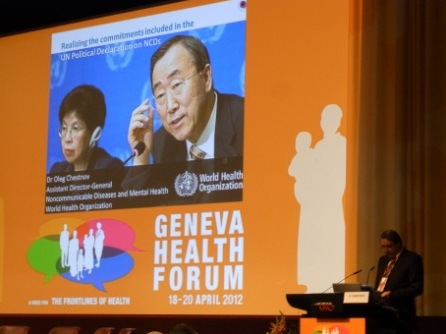
Held since 2006, this latest fourth session was titled ‘A Critical Shift to Chronic Conditions: Learning From the Frontliners’, with discussion being conducted around the theme of non-communicable diseases (NCD), a joint agenda held by both high-income and low-income countries alike.
NCD became the agenda for the U.N. High Level Meeting held in September 2011, however what with this year set to see the determination of an international monitoring hub and goals, the main theme of this forum concerned in what way international cooperation and strategy at the country level should be executed.
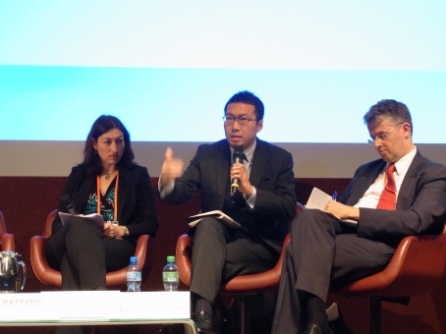
On the third day of this forum, HGPI Director Ryoji Noritake also participated as a panelist in the session ‘National & Global Non-Communicable Diseases Platforms: The Best Way Forward’ (20 April, 12:30-14:00). Other panelists included Samantha Battams (Global Health Europe, Global Health Programme, Graduate Institute of International and Development Studies, Geneva, Switzerland), Gaudenz Silberschmidt (International Affairs Division, Swiss Federal Office of Public Health, Bern, Switzerland), Judith Watt (NCD Alliance, London, UK), Olivier Raynaud (World Economic Forum, Geneva, Switzerland), and Ruth Veale (Environment and Safety Department, BEUC [the European Consumers’ Organisation], Brussels, Belgium).
In this session, the importance of bottom-up activities by multi-stakeholders in individual countries together with global cooperation was highlighted in relation to tackling NCD. HGPI’s Ryoji Noritake introduced the directionality for NCD control in accordance with Japan’s re-adjusted local health care plans, and commented on the importance of each country achieving progress through breaking down NCD control into the form of concrete policies, as well as setting global targets.
Finally, it was noted that the NCD issue does not just concern medicine and healthcare but is also an economic and environmental problem. The forum concluded with recognition of the importance and necessity of cooperation and participation from other government agencies concerning the environment, industry and education, in approaching large shared goals.
Exhibition date:2012-04-20
Top Research & Recommendations Posts
Featured Posts
-
2026-05-18
[Registration Closed] Kick-off Panel Discussion “From Africa and Japan, Drawing from Perspectives Around the World:A Platform for Cultivating a Philosophical Health Dialogue Together” (June 15, 2026)
![[Registration Closed] Kick-off Panel Discussion “From Africa and Japan, Drawing from Perspectives Around the World:A Platform for Cultivating a Philosophical Health Dialogue Together” (June 15, 2026)](https://hgpi.org/en/wp-content/uploads/sites/2/HGPI_20260615_Eyecathch_panel-discussion-From-Japan-and-Africa-in-Discussion-with-the-World_2.png)
-
2026-08-28
[Announcement] The 3rd Kiyoshi Kurokawa Award: Call for Nominations (Deadline: November 30, 2026)
![[Announcement] The 3rd Kiyoshi Kurokawa Award: Call for Nominations (Deadline: November 30, 2026)](https://hgpi.org/en/wp-content/uploads/sites/2/Kiyoshi-Kurokawa-Award_3rd_nominations_eyecatch_caseB_ENG_web_20260929_v0.5.jpg)
-
2026-09-01
[Registration Closed] HGPI Salon 2025-2026 Looking Ahead to the Future of Japan’s Social Security System “Session 6: Japan’s Health Policy through the Lens of Global Security” (October 13, 2026)
![[Registration Closed] HGPI Salon 2025-2026 Looking Ahead to the Future of Japan’s Social Security System “Session 6: Japan’s Health Policy through the Lens of Global Security” (October 13, 2026)](https://hgpi.org/en/wp-content/uploads/sites/2/HGPISalon2025-20266.png)
-
2026-09-17
[Registration Open] (Webinar) The 145th HGPI Seminar “Toward Better AMR Measures at Elderly Care Facilities—Considering Infectious Disease Control in a Super-Aged Society From a Policy Perspective” (October 27, 2026)
![[Registration Open] (Webinar) The 145th HGPI Seminar “Toward Better AMR Measures at Elderly Care Facilities—Considering Infectious Disease Control in a Super-Aged Society From a Policy Perspective” (October 27, 2026)](https://hgpi.org/en/wp-content/uploads/sites/2/HGPIseminar145.png)
-
2026-10-06
[Registration Open] (Webinar) The 146th HGPI Seminar “How We Can Build a Society That Supports Choices Around Organ Donation: Exploring Decision-Making by Citizens and a Multi-Layered Approach Through Strategic Social Marketing” (November 9, 2026)
![[Registration Open] (Webinar) The 146th HGPI Seminar “How We Can Build a Society That Supports Choices Around Organ Donation: Exploring Decision-Making by Citizens and a Multi-Layered Approach Through Strategic Social Marketing” (November 9, 2026)](https://hgpi.org/en/wp-content/uploads/sites/2/HGPI_20261001_Eyecatch_HGPIseminer-146th-1.png)
