

[Event Report] Global Health Education Program (G-HEP) 2024— Lecture 1: Introduction to Case Study Topics and Supervisors (June 19, 2024)
date : 7/5/2024
Tags: Global Health, Global Health Human Resources Development

![[Event Report] Global Health Education Program (G-HEP) 2024— Lecture 1: Introduction to Case Study Topics and Supervisors (June 19, 2024)](https://hgpi.org/en/wp-content/uploads/sites/2/HGPI_20240703_globalhealtheducationprogram_lecture1_eyechatch.jpg)
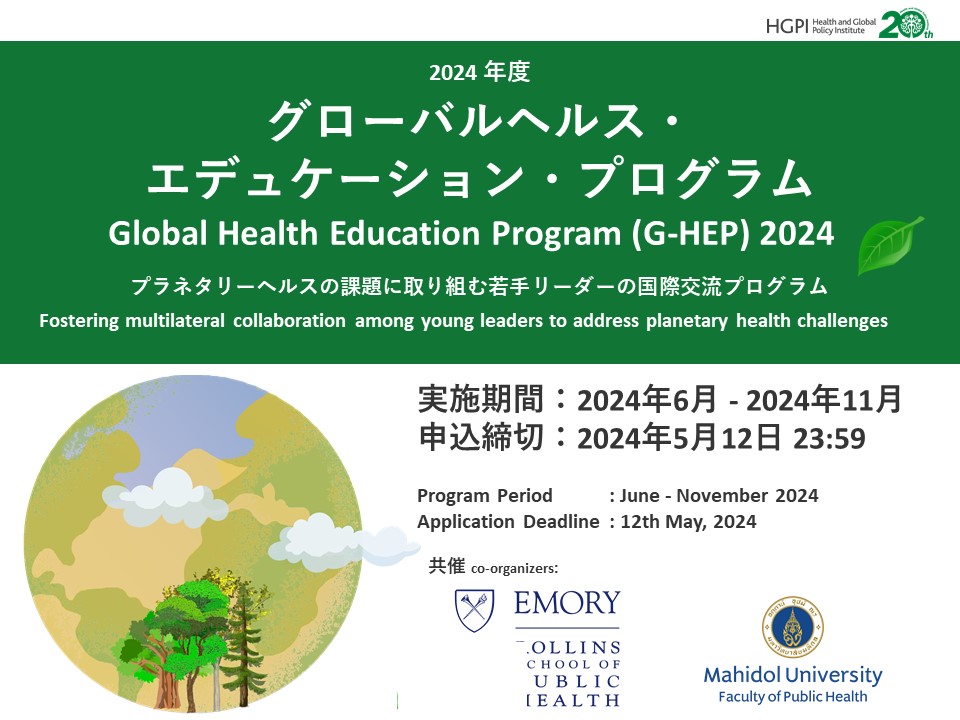
The 2024 Global Health Education Program (G-HEP) kicked off on June 19 with its first lecture held online across three time zones. This year’s G-HEP is organized together with Health and Global Policy Institute (HGPI), Faculty of Public Health at Mahidol University in Thailand, and the Rollins School of Public Health at Emory University in the United States (U.S.).
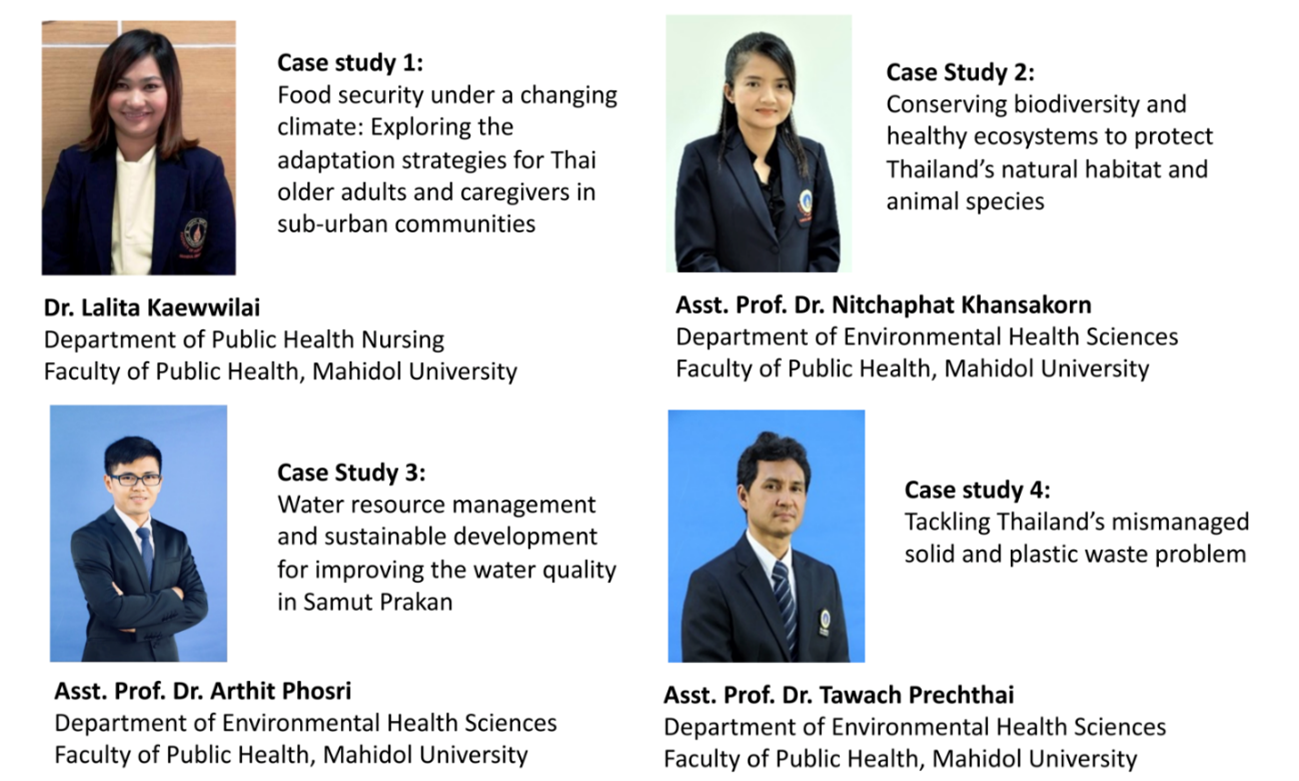
This year’s program theme, “Fostering multilateral collaboration among young leaders to address planetary health challenges,” welcomes 12 participants from five countries, who will participate for over a period of about 6 months in online lectures, group work on case study topics, and fieldwork in Thailand. The participants will prepare solutions and policy recommendations on the following four case study topics as a final project for the program to be presented in Japan.
Case Study Topics
1. Food security under a changing climate: Exploring the adaptation strategies for Thai older adults and caregivers in sub-urban communities
2. Conserving biodiversity and healthy ecosystems to protect Thailand’s natural habitat and animal species
3. Water resource management and sustainable development for improving the water quality in Samut Prakan
4. Tackling Thailand’s mismanaged solid and plastic waste problem
For the first lecture session, Dr. Sarawut Thepanondh, Associate Professor and Dean at the Faculty of Public Health, Mahidol University, welcomed everyone on the program with opening remarks. Following Dr. Thepanondh’s remarks, participants joined in an ice-breaking session to get to know each other. Finally, Asst. Prof. Dr. Arthit Phosri, Department of Environmental Health Sciences, Faculty of Public Health, Mahidol University, presented an overview of the climate change impacts in Thailand, the fieldwork location which will take place in Bang Krachao, Samut Prakan province, and introduced all the supervisors from Mahidol University to provide background to each of the case studies.
For the first and second phase of the program lectures and group work will be held online once a week from June through July 2024 to prepare the participants for the subsequent fieldwork phase in Thailand.
■ Lectures
Lecture 1: Introduction to Case Study Topics and Supervisors
Lecture 2: Climate Change: Current Changes in Global Environmental Systems
Lecture 3: Addressing Planetary Health Issues via Multidisciplinary Approach
Lecture 4: Insights from Collaborative Efforts: Practical Steps for Advancing Planetary
■ About Global Health Education Program (G-HEP)
The “Global Health Education Program (G-HEP)” vision is to establish a global community of young leaders that can work together to push global health agendas forward and to conduct human resources training and development for the future. The partnership with the Mahidol University Faculty of Public Health which began in 2018 extended the program’s boundaries through interactions among young generations not only from Japan but from the ASEAN region as well. This year’s program welcomes Emory University Rollins School of Public Health bringing a U.S. perspective to the program along with participants of diverse professions and backgrounds. Participants in G-HEP can work together to deepen mutual understanding and cooperation for solving complex global public health issues.
■ About The Rollins School of Public Health at Emory University
 The Rollins School of Public Health at Emory University is ranked 3rd among all accredited schools and programs of public health in the United States. Located in Atlanta, known as the “Public Health Capital of the World,” the school draws strength from several unique local resources. The U.S. Centers for Disease Control and Prevention provides many of the school’s nearly 200 adjunct faculty. The Carter Center is involved in international health intervention programs that provide student practicum opportunities. Students can learn from both in the classroom and as interns in the field. Students join the Rollins community from all 50 states and from more than 40 foreign countries to contribute to the school and apply knowledge to promote health and prevent disease in human populations.
■ About The Faculty of Public Health at Mahidol University
 The Faculty of Public Health at Mahidol University, established in 1948 is the first public health academic institution in Thailand. At present, the Faculty of Public Health produces approximately 1,400 graduates in several majors from the Bachelor, Masters, and Doctoral levels. The faculty plays an integral role as an academic leader in the Asia-Pacific region, contributing to the development of the country on academic management, training, as well as academic service to Asia-Pacific countries. Since 1976, the faculty has been running the Master of Public Health – International Program, with over 1250 graduates from 42 different countries.
This project is supported by The Japan Foundation.
Related Posts
Top Research & Recommendations Posts
Featured Posts
-
2026-05-18
[Registration Closed] Kick-off Panel Discussion “From Africa and Japan, Drawing from Perspectives Around the World:A Platform for Cultivating a Philosophical Health Dialogue Together” (June 15, 2026)
![[Registration Closed] Kick-off Panel Discussion “From Africa and Japan, Drawing from Perspectives Around the World:A Platform for Cultivating a Philosophical Health Dialogue Together” (June 15, 2026)](https://hgpi.org/en/wp-content/uploads/sites/2/HGPI_20260615_Eyecathch_panel-discussion-From-Japan-and-Africa-in-Discussion-with-the-World_2.png)
-
2026-08-28
[Announcement] The 3rd Kiyoshi Kurokawa Award: Call for Nominations (Deadline: November 30, 2026)
![[Announcement] The 3rd Kiyoshi Kurokawa Award: Call for Nominations (Deadline: November 30, 2026)](https://hgpi.org/en/wp-content/uploads/sites/2/Kiyoshi-Kurokawa-Award_3rd_nominations_eyecatch_caseB_ENG_web_20260929_v0.5.jpg)
-
2026-09-01
[Registration Closed] HGPI Salon 2025-2026 Looking Ahead to the Future of Japan’s Social Security System “Session 6: Japan’s Health Policy through the Lens of Global Security” (October 13, 2026)
![[Registration Closed] HGPI Salon 2025-2026 Looking Ahead to the Future of Japan’s Social Security System “Session 6: Japan’s Health Policy through the Lens of Global Security” (October 13, 2026)](https://hgpi.org/en/wp-content/uploads/sites/2/HGPISalon2025-20266.png)
-
2026-09-17
[Registration Open] (Webinar) The 145th HGPI Seminar “Toward Better AMR Measures at Elderly Care Facilities—Considering Infectious Disease Control in a Super-Aged Society From a Policy Perspective” (October 27, 2026)
![[Registration Open] (Webinar) The 145th HGPI Seminar “Toward Better AMR Measures at Elderly Care Facilities—Considering Infectious Disease Control in a Super-Aged Society From a Policy Perspective” (October 27, 2026)](https://hgpi.org/en/wp-content/uploads/sites/2/HGPIseminar145.png)
-
2026-10-06
[Registration Open] (Webinar) The 146th HGPI Seminar “How We Can Build a Society That Supports Choices Around Organ Donation: Exploring Decision-Making by Citizens and a Multi-Layered Approach Through Strategic Social Marketing” (November 9, 2026)
![[Registration Open] (Webinar) The 146th HGPI Seminar “How We Can Build a Society That Supports Choices Around Organ Donation: Exploring Decision-Making by Citizens and a Multi-Layered Approach Through Strategic Social Marketing” (November 9, 2026)](https://hgpi.org/en/wp-content/uploads/sites/2/HGPI_20261001_Eyecatch_HGPIseminer-146th-1.png)
