

[Public Comment Submission] Revision of the Vision for Tokyo’s Natural Parks (Interim Summary) (October 14, 2026)
date : 11/2/2026
Tags: Planetary Health

The Planetary Health Project at Health and Global Policy Institute (HGPI) has submitted four project proposals in response to the “Revision of the Vision for Tokyo’s Natural Parks (Interim Summary)” introduced by the Tokyo Metropolitan Government’s Bureau of Environment. Please note that the call for proposals has already closed.
The Vision for Tokyo’s Natural Parks is a Tokyo Metropolitan Government plan that sets out the direction for the conservation and use of natural parks in Tokyo. The current revision outlines policy measures for the next 10 years, and its Interim Summary was compiled at the 160th meeting of the Tokyo Metropolitan Government Natural Environment Conservation Council held on September 1, 2026. Following this, comments were invited from Tokyo residents and businesses from September 15 to October 14, 2026.
Comments received will be reported by the Tokyo Metropolitan Government to the Natural Environment Conservation Council, which will continue its deliberations based on them. In addition to their environmental roles, such as conserving biodiversity, recharging water sources, and absorbing carbon, natural parks play an important role as places where Tokyo residents can connect with nature and nurture their physical and mental health. Amid ongoing social changes such as the progression of climate change and the declining birthrate and aging population, this Vision, which will shape the future of natural parks over the next decade, will have a significant impact on the lives of Tokyo residents from both environmental and health perspectives.
A Planetary Health Perspective: Natural Parks as a Foundation for the Health of Tokyo Residents
At HGPI, we advocate for stronger integration of environmental and health policies in Tokyo’s governance from the perspective of planetary health, which recognizes that the health of the planet and human health are inseparable. As the Natural Parks Act sets out contributing to the health of citizens as one of its purposes, natural parks are inherently closely linked to people’s health.
However, while the Interim Summary expresses expectations that natural parks will contribute to improving well-being and promoting health, it does not sufficiently address coordination with health and medical plans or set out concrete measures aimed at health. Furthermore, its discussion of climate change impacts focuses mainly on ecosystems, hiking trails, and facilities, without addressing the health impacts on people who visit natural parks.
With these concerns in mind, the four comments submitted by HGPI focus on positioning natural parks as a foundation that supports the health and climate resilience of Tokyo residents, and on creating an environment where everyone can enjoy the health benefits of nature through heat countermeasures and collaboration with the medical and welfare sectors. The summaries of these comments are as follows.
HGPI’s Comments to Support the Health and Climate Resilience of Tokyo Residents through Natural Parks
Comment 1: Positioning Natural Parks as a “Foundation for the Health of Tokyo Residents” and as “Green Infrastructure”
Noting that health and medical plans are not included in the Vision’s “Positioning of the Plan,” HGPI called for the Tokyo Health Promotion Plan 21 (Third Term) and the Tokyo Climate Change Adaptation Plan to be explicitly listed as related plans. HGPI also proposed that, with regard to the Tokyo 2050 Strategy, the Vision indicate its relationship not only with greenery policies but also with climate change adaptation measures, including heat countermeasures, and explicitly state the importance of ensuring consistency with health policies. A 2015 report published by the World Health Organization (WHO) and the Secretariat of the Convention on Biological Diversity (CBD), “Connecting Global Priorities: Biodiversity and Human Health,” shows that reduced contact with the natural environment and biodiversity can lower the diversity of the human microbiota, potentially leading to immune dysfunction and non-communicable diseases, and that access to green spaces contributes to increased physical activity and better mental health. Biodiversity conservation therefore holds “preventive medical value” by contributing to disease prevention and the maintenance and promotion of health. Moreover, the forests and hills of natural parks serve as green infrastructure that supports the climate resilience of the entire city through water source recharge, landslide prevention, carbon absorption and sequestration, and heat mitigation. From these perspectives, HGPI proposed that the section on the “Ideal Form of Tokyo’s Natural Parks” explicitly state that natural parks are a foundation supporting the physical and mental health of Tokyo residents (the contemporary significance of “health” as referred to in the Natural Parks Act) and green infrastructure that enhances climate resilience.
Comment 2: Addressing Heatstroke Risks for Visitors and Positioning Visitor Centers as Heat Refuges
HGPI called for health impacts on visitors, such as heatstroke, to be addressed under Issue 1, “Progression of Climate Change and Its Impacts on Natural Parks.” Temperatures exceeding 40°C have been recorded in Ome and Hachioji, which serve as gateways to natural parks. Half of all people involved in mountain accidents are aged 60 or older, and middle-aged and older people also face a higher risk of severe heatstroke. Meanwhile, current heatstroke countermeasures focus mainly on urban areas and indoor settings, leaving natural parks prone to becoming a gap in these efforts. HGPI therefore proposed positioning visitor centers, which are located along hiking routes and equipped with indoor rest spaces and staff, as designated cooling shelters and TOKYO Cool Share Spots, and promoting their designation and registration through collaboration between the Tokyo Metropolitan Government and local towns and villages. HGPI also called for evaluating the heat mitigation function of prefectural natural parks in hilly areas adjacent to urban districts, which can serve as accessible places for nearby residents to escape the heat, and for incorporating this function into the perspectives of conservation and utilization.
Comment 3: Adding Heat Stress Index (WBGT Wet Bulb Globe Temperature) Information to “Improving Convenience through AI and Other Technologies”
The new leading project “Improving Convenience through AI and Other Technologies” centers on visualizing congestion and digitizing maps and guides, but does not include information on heat risks, which are increasing due to climate change. HGPI therefore proposed making use of the information infrastructure of the Tokyo WBGT Map, already operated by the Tokyo Metropolitan Government, so that users can view the heat stress index(WBGT: Wet Bulb Globe Temperature) at major trailheads and near summits, as well as the issuance status of heatstroke alerts, together with congestion information. HGPI also called for incorporating WBGT-based warnings and guidance to rest areas such as visitor centers into the smartphone apps, smartwatches, and other devices envisioned under the leading project “Ensuring Visitor Safety through AI and Other Technologies.” Rather than building a new system from scratch, this proposal aims to integrate the existing heatstroke-prevention information infrastructure into natural parks, creating an environment in which visitors can decide how to act based on both congestion and heat conditions.
Comment 4: Establishing “Social Prescribing (Green Prescriptions)” in Collaboration with the Medical and Welfare Sectors as a Leading Project
As evidence accumulates that spending time in nature benefits physical and mental health, initiatives in which healthcare professionals prescribe “time in nature” are being institutionalized in countries around the world, including PaRx in Canada, Park Rx America in the United States, and green social prescribing promoted by the National Health Service (NHS) in the United Kingdom. The Vision already includes measures that could serve as destinations for social prescribing, such as renewing trails as short trails and enhancing inclusive programs. However, these remain within the context of tourism and recreation and are not connected to medical and welfare settings. HGPI therefore proposed establishing a new leading project, “Promoting Health through Connection with Nature (Green Prescriptions),” and implementing model projects in prefectural natural parks in hilly areas easily accessible from central Tokyo, in collaboration with the Bureau of Public Health, municipalities, medical institutions, Community General Support Centers, Councils of Social Welfare, and other stakeholders. In line with the principle of Universal Health Coverage (UHC), HGPI also called for considering access support, such as transportation and accompaniment services and consideration of costs, so that older people, people with disabilities, families raising children, people facing financial difficulties, and others are not left behind. In addition, HGPI called for monitoring visitors’ well-being indicators and the occurrence of accidents such as heatstroke through the “Visitor Use Survey” and reflecting the findings in policy evaluation.
For more details regarding the initiative, please click here (Japanese only).
Top Research & Recommendations Posts
Featured Posts
-
2026-08-28
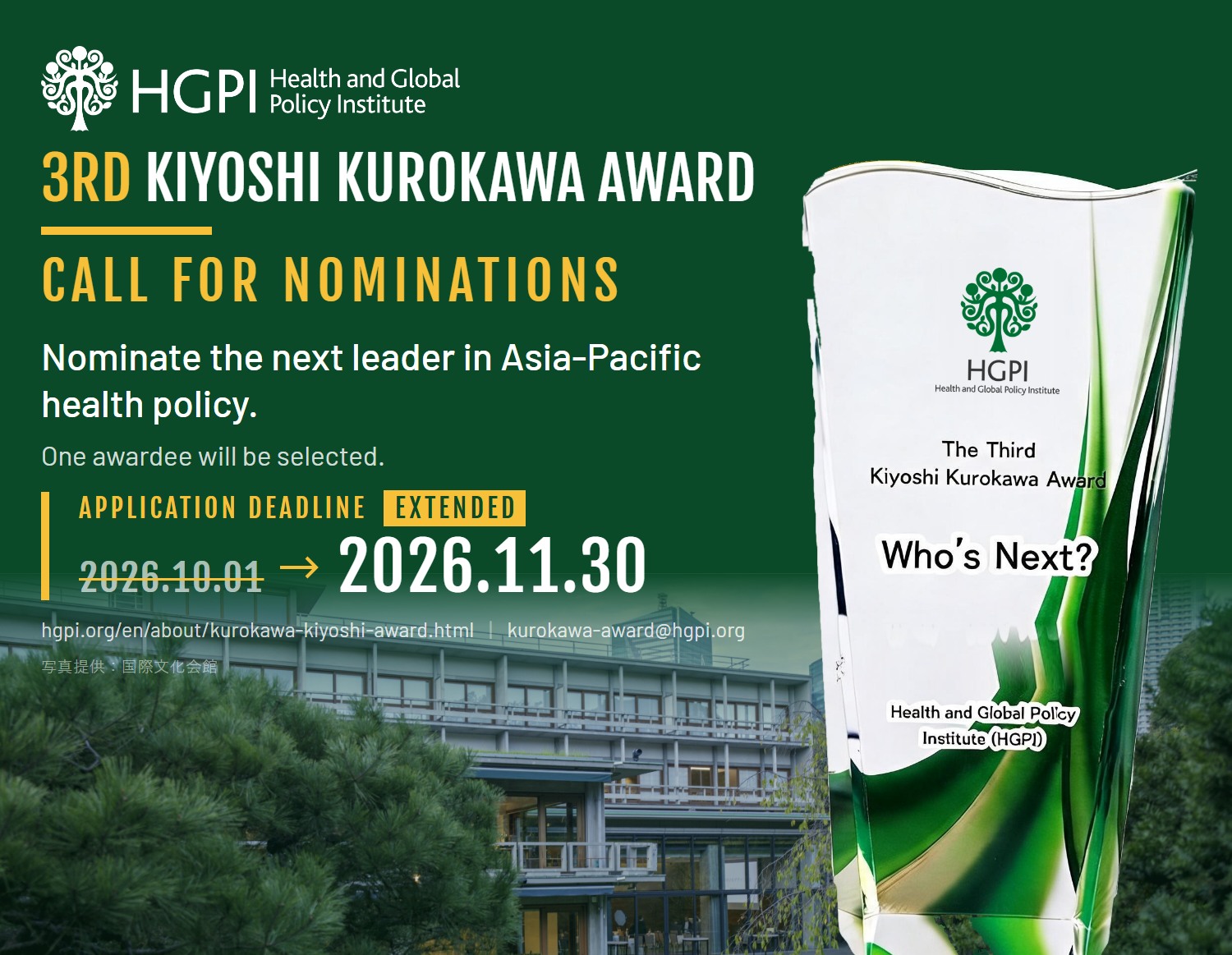
[Announcement] The 3rd Kiyoshi Kurokawa Award: Call for Nominations (Deadline: November 30, 2026)
-
2026-10-06
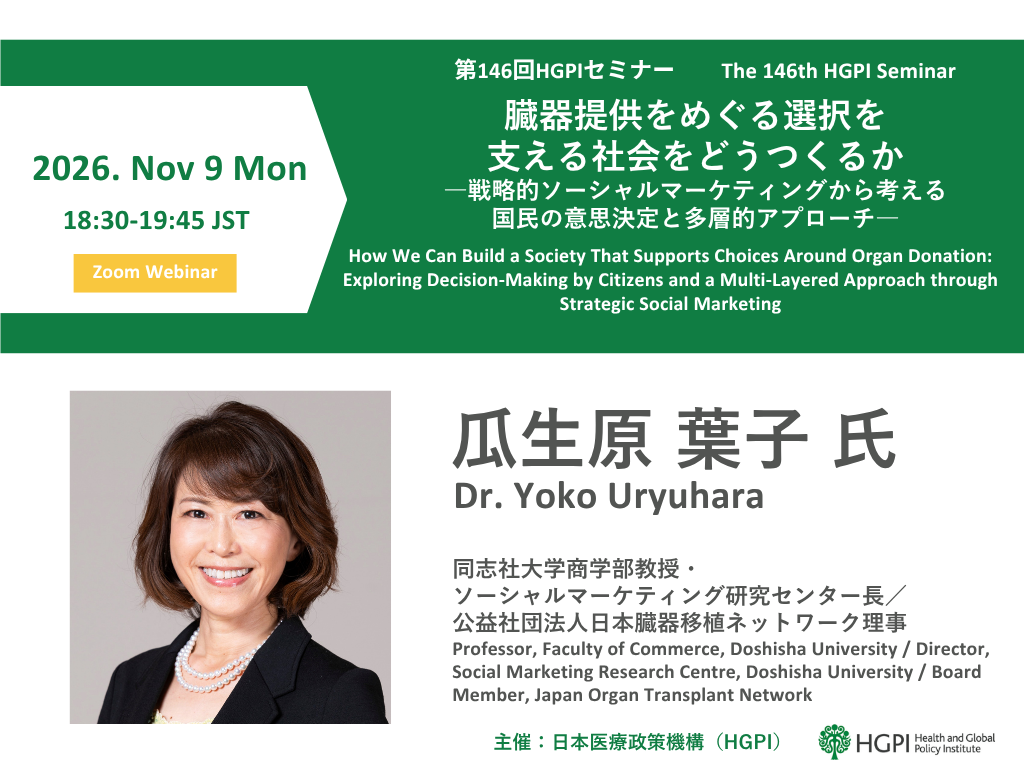
[Registration Open] (Webinar) The 146th HGPI Seminar “How We Can Build a Society That Supports Choices Around Organ Donation: Exploring Decision-Making by Citizens and a Multi-Layered Approach Through Strategic Social Marketing” (November 9, 2026)
-
2026-10-19
[HGPI Policy Column] (No.78) — From the Blood Disorders Project “Quality of Life in Long-Term Blood Cancer Care: Insights from Canada”
-
2026-10-28
[Policy Recommendations] Driving Progress in Intractable and Rare Disease Policy Through Patient and Public Voices: Towards Redesigning Healthcare Delivery Systems Across Diagnosis (September 29, 2026)