
[HGPI Policy Column] (No. 80) The History and Future Prospects of the Field of Nutrition in Health Policy (Part 2) – Ensuring the “Dietary Guide for Japanese People” is Citizen-Centered
date : 11/17/2026

<POINTS>
- The U.E.N.O. Plan was presented by the Ministry of Health, Labour and Welfare (MHLW) in July 2026. Acknowledging that most government nutrition information targets professionals, the U.E.N.O. Plan includes plans for a guide designed for the general public. That plan’s tentative title is the “Dietary Guide for Japanese People” and it is scheduled for release by the end of FY2026.
- To ensure widespread utilization of the “Dietary Guide for Japanese People” among citizens, three perspectives will be important. First, in light of changes to the information landscape driven by social media and AI, it will be necessary to establish methods of communication that ensure accurate information reaches citizens. Second, evaluation methods must be designed to capture whether citizens actually apply the Guide to their daily diets. Third, when promoting healthy dietary habits, the Guide must take genetic and socioeconomic factors into account and avoid over-emphasizing the concept of individual culpability.
Introduction
On July 23, 2026, the Ministry of Health, Labour and Welfare (MHLW) presented the “U.E.N.O. Plan for Proactive Preventive Healthcare Measures from the MHLW: Understand, Exercise, Nourish, and Optimize for Better Health” (hereinafter referred to as the “U.E.N.O. Plan”). Past MHLW initiatives addressing lifestyle-related diseases and dementia have led to significant results, including one of the highest healthy life expectancies globally. However, because lifestyle-related diseases account for around 50% of total deaths and 30% of medical costs, in addition to measures for nutrition and dietary habits, the MHLW recognizes the need for action in areas including dementia, rehabilitation, and women’s health.
The Takaichi Cabinet has positioned proactive preventive healthcare as a key policy. Within this context, the MHLW has identified six priority areas for improving health literacy among citizens and for building out initiatives that will encourage behavioral change through proactive interventions from the government, health insurers, and other stakeholders. The MHLW anticipates that these initiatives will extend healthy life expectancy and strengthen the foundation of the social security system.
This column focuses on “nutrition and dietary habits,” which is one of the MHLW’s six priority areas. One specific measure currently being advanced is the formulation of guidelines under the tentative title, “Dietary Guide for Japanese People.” (Please note that this title is a provisional translation provided by Health and Global Policy Institute (HGPI).) Focusing on these guidelines, this column organizes information that has been publicized to date and discusses necessary perspectives for ensuring that future nutrition policy is citizen-centered.
The Positioning of and Measures for Nutrition and Dietary Habits in the U.E.N.O. Plan
In the U.E.N.O. Plan, the MHLW positions nutrition and dietary habits as vital for sustaining life and for enjoying a healthy and cultured lifestyle. Recognizing the close link between nutrition and dietary habits and the onset of lifestyle-related diseases, the MHLW points out that initiatives addressing changes in the food environment will be necessary. Additionally, the MHLW has indicated that steps will be taken to improve public literacy on appropriate nutrition and dietary habits that reduce disease risk.
The U.E.N.O. Plan also analyzes current circumstances, identifies challenges and problems, and outlines specific measures for nutrition and dietary habits. The analysis states that in addition to encouraging appropriate nutrition and dietary habits that will improve behavior and health on an individual basis, it will also be important to improve the food environment which underpins these habits. The Plan also touches upon the fact that the national Government has already set goals for healthy nutrition and dietary habits and has established dietary intake recommendations through initiatives such as “Health Japan 21 (Third Term)” and the “Dietary Reference Intakes (DRIs) for Japanese.”
The U.E.N.O. Plan identifies two challenges and problems. First, the majority of materials on the prevention of lifestyle-related diseases and related conditions presented by government entities or research institutions have been primarily intended for healthcare professionals. This information has not been widely disseminated to or utilized by the general public. Second, despite the fact that “Health Japan 21 (Third Term)” established dietary targets for items such as salt, fruits, and vegetables, actual consumption levels among the public deviate significantly from these targets. Efforts in this area must be strengthened.
As for specific measures, the U.E.N.O. Plan states that the national Government plans to formulate the “Dietary Guide for Japanese People” by the end of FY2026. From the perspective of reducing disease risk, this Guide will outline key dietary considerations and practical methods for implementing them in a clear, easy-to-understand, and evidence-based manner. Once the Guide is finalized, the national Government plans to collaborate with local governments and other such bodies to raise broad public awareness and encourage its active use.
Toward Citizen-Centered Nutrition Policy: Three Necessary Perspectives for the “Dietary Guide for Japanese People”
As discussed above, the intended audience for most of the material that has been presented by the Government or research institutions has been healthcare professionals, but the intended audience for the “Dietary Guide for Japanese People” in the U.E.N.O. Plan is the general public. This requires devising publication strategies and content that will effectively convey information to citizens. In pursuit of achieving citizen-centered health policy, HGPI has a track record of holding discussions that have engaged both citizens and experts. From this standpoint, we will discuss three vital perspectives that will be necessary for the widespread use of the “Dietary Guide for Japanese People” in the future.
The first perspective is designing methods of communication that will reach citizens. Despite advances in AI and ready access to information for everyone, inappropriate weight-loss methods and inaccurate dietary advice still often circulate on social media. No matter how scientifically sound a guide may be, it will not be fully utilized if it fails to reach citizens or if they do not understand it correctly. To avoid these outcomes, it will be necessary to keep in mind how the “Dietary Guide for Japanese People” will be disseminated after publication at the stage when its content and wording are still under consideration. One method may be to utilize public comments. In addition to soliciting feedback on the Guide’s content, public comments may provide an opportunity to verify the accessibility of its language and to ascertain whether its messages will be conveyed accurately when shared via social media or AI. Additionally, since the “Dietary Guide for Japanese People” committee lacks a citizen representative, conducting interviews and similar efforts will help clarify how citizens actually obtain food and nutrition information. Through these initiatives, consideration should simultaneously be given to which methods will be most effective in ensuring that accurate information reaches citizens.
The second perspective is the design of evaluation methods. When the “Dietary Guide for Japanese People” is finalized, the evaluation methods that will be used should be presented at the same time. For example, to encourage local governments to make active use of the Guide, one option may be to establish new evaluation indicators alongside existing items within “Health Japan 21 (Third Term),” the basic policy formulated in accordance with the Health Promotion Act. These indicators could include public awareness rates for the new Guide, or metrics based on it. When evaluation methods are designed, their scope should encompass citizen-centered outcomes, such as whether the “Dietary Guide for Japanese People” informs the routine dietary habits of those it reaches.
The third perspective is to avoid excessive framing of what are termed “dietary habits that are good for health” as a matter of individual culpability. It is becoming increasingly clear that the onset of diabetes and other non-communicable or lifestyle-related diseases stems not only from lifestyle habits, but also from inherited genetic factors. Long working hours and socioeconomic factors also affect dietary habits, and the reality that such factors cannot be addressed solely by individual efforts must not be forgotten. Understanding what constitutes “dietary habits that are good for health” is a separate issue from having an environment that enables one to implement those habits. Furthermore, maintaining personal health is not the only reason people eat. Given these points, because citizens will be the recipients of the information that is included in the Guide, listening to their voices will be essential.
Conclusion
This column discussed three key perspectives for the widespread use of the U.E.N.O. Plan’s upcoming “Dietary Guide for Japanese People.” These perspectives were: design methods of communication that will effectively reach citizens; establish evaluation methods for use after the Guide is finalized; and avoid excessive framing of “dietary habits that are good for health” as a matter of individual culpability. It is desirable that the final, published version of the Guide incorporates citizen voices for each of these perspectives. As a think tank dedicated to achieving citizen-centered health policy, HGPI would like to continue discussing this topic in the future.
[References]
- Ministry of Health, Labour and Welfare (MHLW). Announcing the U.E.N.O. Plan for Proactive Preventive Healthcare Measures from the MHLW: Understand, Exercise, Nourish, and Optimize for Better Health. Retrieved October 8, 2026, from https://www.mhlw.go.jp/stf/index_00154.html.
- MHLW. Working Group for the “Dietary Guide for Japanese People” (tentative title). Retrieved October 8, 2026, from https://www.mhlw.go.jp/stf/shingi/other-kenkou_202607.html.
- MHLW. Health Japan 21 (Third Term). Retrieved October 8, 2026, from https://www.mhlw.go.jp/stf/seisakunitsuite/bunya/kenkou_iryou/kenkou/kenkounippon21_00006.html.
- Japan Diabetes Society, ed. Evidence-based Practice Guideline for the Management of Diabetes. Tokyo: Nankodo; 2024. pp. 13–14, 17–19. Retrieved October 9, 2026, from https://www.jds.or.jp/modules/publication/index.php?content_id=4.
- Tanaka R, et al. Association between time-related work factors and dietary behaviors: results from the Japan Environment and Children’s Study (JECS). Environmental Health and Preventive Medicine, 23(1), 62 (2018).
[Authors]
Asako Okawa (Senior Associate, HGPI)
Shunichiro Kurita (Senior Manager, HGPI)
Top Research & Recommendations Posts
Featured Posts
-
2026-08-28
[Announcement] The 3rd Kiyoshi Kurokawa Award: Call for Nominations (Deadline: November 30, 2026)
-
2026-11-05
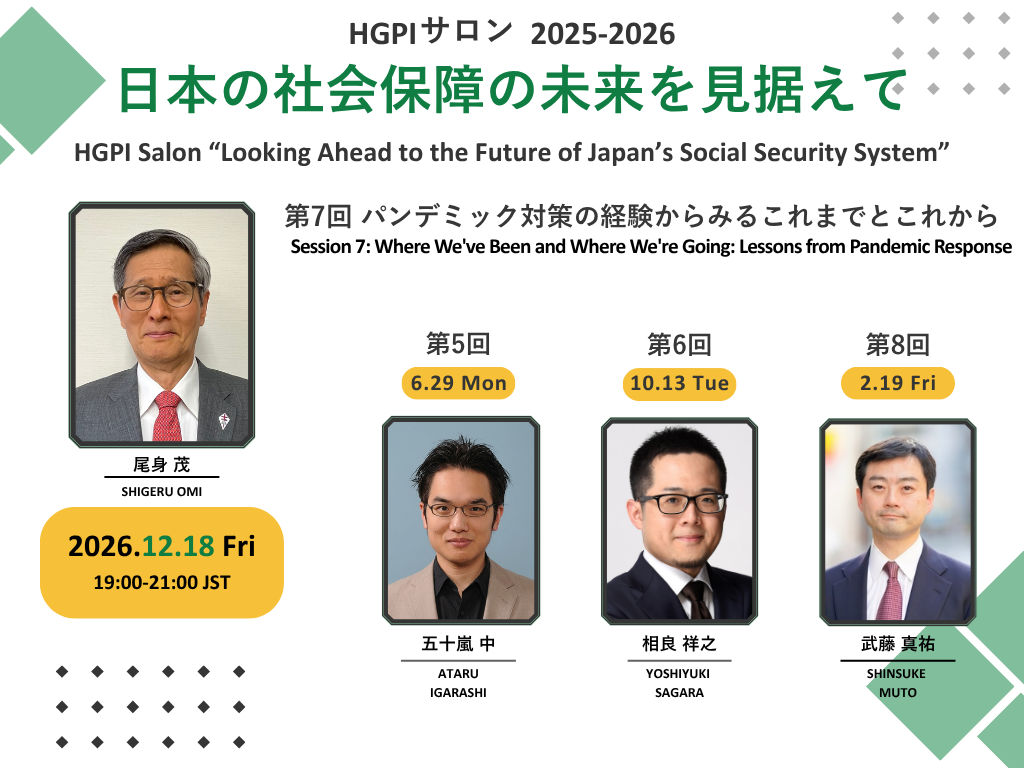
[Registration Open] HGPI Salon 2025-2026 Looking Ahead to the Future of Japan’s Social Security System “Session 7: Where We’ve Been and Where We’re Going: Lessons from Pandemic Response” (December 18, 2026)
-
2026-11-13
[Discussion Points] Addressing AMR Measures for an Era of Healthy Longevity: Ensuring Safety and Security for Older Adults in a Super-Aged Society (October 23, 2026)