

[Event Report] The 144th HGPI Seminar “Visualizing Hidden Caregiving and Building the Support of the Future – Diversifying Family Structures and the Potential for Tailored Support” (September 15, 2026)
date : 10/30/2026
Tags: Dementia, HGPI Seminar

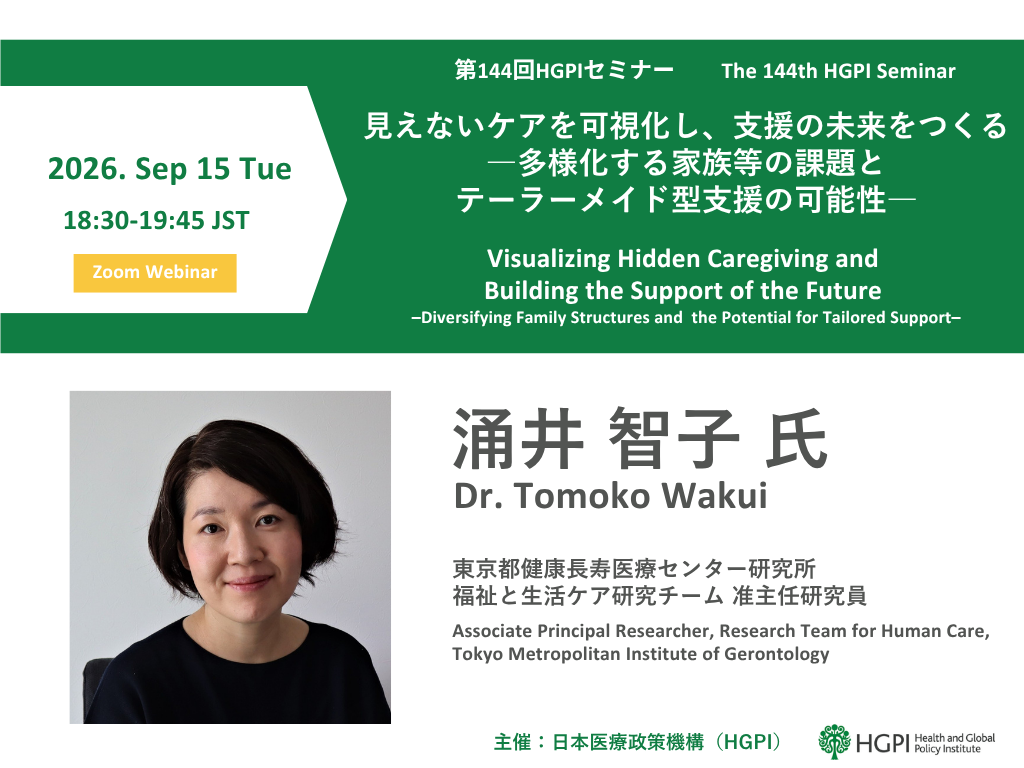
For this HGPI Seminar, we welcomed Dr. Tomoko Wakui (Associate Principal Researcher, Research Team for Human Care, Tokyo Metropolitan Institute of Gerontology). Dr. Wakui specializes in public health and gerontological social science, and her research focuses on the challenges faced in daily life by older people certified as needing long-term care and their family members who care for them.
Through its Dementia Project, Health and Global Policy Institute (HGPI) has held discussions that keep people living with dementia at the center, while also focusing on family members and others close to them, as well as professionals working at medical institutions and long-term care facilities. In April 2026, HGPI released the policy recommendations “The Future of Dementia Policy Surrounding Families and Others Who Care for People with Dementia”. Dr. Wakui contributed to the development of these recommendations as a member of the Advisory Board.
Following the enforcement of the Basic Act on Dementia to Promote an Inclusive Society (hereinafter, the “Basic Act on Dementia”) in January 2024, there is a growing need to build support systems that respect the dignity of people living with dementia. These systems must also enable people living with dementia, their family members, and others close to them to continue living with peace of mind in familiar communities. At the same time, family members and others close to them still have no choice but to take on roles that public systems cannot fully cover. These roles include coordinating services, accompanying people to medical visits, and keeping a watchful eye on them in daily life. In this seminar, Dr. Wakui drew on insights into changes in caregiver characteristics and challenges as family structures become more diverse. She also drew on insights from Care-VIP (Caregiving Visualization Project), a tailored family support program that uses Information and Communications Technology (ICT) to adjust the content and timing of support to each person’s day-to-day changes. Based on these insights, she spoke about future approaches to dementia policy and care in Japan. Her focus was on realizing an inclusive society in which people living with dementia, their family members, and others close to them can each live true to themselves.
<POINTS>
- Autonomy differs from independence, which means being able to live without anyone’s help. Autonomy refers to deciding for oneself how to live based on one’s own values and wishes. Regardless of whether a person receives support, what matters is that they can realize the way of life they value with the support of those around them.
- Each difficulty that arises in caregiving settings is not a problem for the person, their family, or professionals alone. These difficulties stem from changes in social structures relating to population, family, community, public finances, and technology. A perspective that captures both changes in society and scenes of daily life is needed.
- Care provided by families includes assistance that responds to the person’s clearly expressed needs. It also includes “unnamed long-term care,” in which family members anticipate changes and decide for themselves what is necessary. There is no right answer for this kind of care, and the better it works, the less visible it becomes as a problem. For these reasons, its necessity and effectiveness are difficult to evaluate, and it rarely connects to existing support.
- Recording and visualizing family caregiving has been confirmed to reduce depressive tendencies and perceived caregiving burden. Groups that have found it difficult to take part in conventional family support, such as male caregivers and full-time workers, were more likely to seek out the program. It can therefore serve as a new entry point for people who have had difficulty accessing support.
In a super-aged society, the question is not only how to maintain function, but how to support autonomy—the way of life each person values
Japan became a super-aged society as a result of two changes: increasing longevity and a declining birthrate. Longer average life expectancy is a major achievement of advances in medicine and society. At the same time, the continued decline in births has raised the share of older people in the population and shrunk the generations that support society. Responding to a super-aged society cannot be achieved through policies for older people alone. It is essential to create a social environment in which people can have and raise children with peace of mind. Meanwhile, systems such as health insurance, long-term care insurance, and community-based integrated care have been developed to support the lives of people already living with dementia and their families.
In the field of gerontology, “Successful Aging,” or growing older in good health while avoiding illness and functional decline, was long regarded as the ideal. However, advances in medicine and greater longevity mean that we now live longer with chronic diseases, dementia, and functional decline. This raises the question of what criteria should be used to evaluate medical and long-term care. Functional judgments alone are no longer enough, such as whether a gastrostomy can be performed or whether a person can withstand surgery. We must also ask who will manage care afterward, and how to consider the person’s enjoyment of eating and their quality of life (QOL). The challenge of a super-aged society is not only that the number of people who need care is increasing. It is also a qualitative challenge that cannot be reduced to a simple yes-or-no answer: how to support autonomy as each person understands it.
This is where the distinction between autonomy and independence becomes important. Autonomy differs from independence, which means being able to do everything in daily life without anyone’s help. According to the definition of the World Health Organization (WHO), autonomy means deciding for oneself how to live one’s daily life based on one’s own values and wishes. As long as people can make their own choices and express their wishes, their autonomy is maintained, regardless of whether they receive support. Care must support how people wish to live as they age, even when they have an illness or functional decline. Such a shift in how we think about care is now needed.
The population aged 75 and over, in which long-term care needs are concentrated, will reach two milestones in 2025 and 2050, requiring system design that anticipates a shrinking support base
Discussions of population aging usually focus on people aged 65 and over. Japan’s aging rate was 26.6% in 2015 and is projected to reach 30.0% in 2025 and 37.7% in 2050. When thinking about long-term care, however, the age group to watch is people aged 75 and over. Long-term care needs grow mainly in this age group, and older people aged 75 and over account for the majority of long-term care insurance service users. This is the background to the so-called “2025 Problem.” In 2025, the large baby boom generation reached the age of 75 and over, and in 2050, the second baby boom generation will do the same. Systems and support must be planned with this entire period in view. Meanwhile, the working-age population is shrinking, and the population that supports society will decrease in relative terms. If people aged 65 to 74, known as the “young-old,” could join the supporting side, there would be room to improve this balance.
The Long-Term Care Insurance System has enabled choice and care coordination, but the difficulties seen in care settings stem from changes in social structures, and care in the gaps between systems remains
In 2000, Japan introduced the Long-Term Care Insurance System as a public social security system. The current system grew out of accumulated experience, including the development of services from the 1960s onward and the problem of “social hospitalization” that arose after medical care for older people was made free of charge. A public social insurance system rests on certain social conditions: public trust in the system, small disparities, and a foundation that supports service quality under officially set prices.
Under this system, users gained the right to choose the services and providers they need. Care managers create care plans suited to each person’s condition and life, and the entry of diverse providers has expanded the options available. Long-term care in Japan has progressed from something families shouldered on their own to something in which social services can be combined according to each person’s needs. However, Community General Support Centers, the cornerstone of community-based integrated care, have taken on roles beyond those envisioned when the system was designed. They now serve as hubs of their communities and carry an extremely wide range of responsibilities.
The Basic Act on Dementia places at its center the dignity and autonomy of people living with dementia, social participation that reflects their voices, and their ability to continue living in their communities. It presented a new view of dementia, shifting from a society that supports people with dementia in a one-sided manner to an inclusive society built together with them. The question now is how to realize this vision in everyday life.
At the same time, there remains care that falls into the gaps between systems and continues to be provided by families. The number of people who need care is rising and care periods are growing longer. The care workforce is shrinking amid fiscal pressures, and the families and communities that provide care are contracting. Community General Support Centers are overburdened, and there is a gap between technological innovation and the conditions for implementing it in care settings. Each difficulty that arises in care settings is not a problem for the person, their family, or professionals alone. Behind these difficulties lie changes in social structures relating to family, community, public finances, and technology. At their root lies Japan’s current reality as a society with a declining population. We need a perspective that captures changes in society while also examining how they appear in daily life and care settings.
What we should learn from international practices is not how to reproduce their environments, but a shift in how we think about care toward supporting daily life and choice
Hogeweyk in the Netherlands, often called a “dementia village,” is known as a place where people living with dementia live their lives. It has a restaurant, a supermarket, and a movie theater, and it recreates the environment of a place where people live. This partly reflects the direction of Dutch legislation, which holds that people must not be confined in locked places. As a result, it is designed so that both people with dementia and people from outside can come and go.
Hogeweyk is grounded in three ideas. The first is eliminating institutional features (De-institutionalize). The second is changing how we think about care (Transform). The third is valuing ordinary life (Normalize). The first, environmental aspect is the one most often introduced, but similar efforts can be seen in many facilities for older people in Japan. What we should learn from are rather the latter two. Regarding the second point, everyday activities such as cleaning, laundry, and cooking are seen as part of care that creates daily life together. Staff are positioned not as people who provide care, but as people who support residents’ lives and create them together. Living in groups with people who share similar interests and lifestyles is another way of supporting each person to live as part of society. Regarding the third point, emphasis is placed on what each person wants to do and whether they have options to choose from. If asked whether a person with severe dementia should be allowed to use a knife, the answer is that of course they should, because they are cooking. The idea is not to eliminate risk entirely, but to support choices that reflect who each person is. Behavioral and psychological symptoms of dementia (BPSD) are also not assumed to occur simply because a person has dementia. Instead, the person is understood to have some reason for them, and the symptoms are understood in relation to the environment.
Hogeweyk’s concept is to slow, as much as possible through care, the decline in QOL that accompanies the progression of dementia. Another distinctive feature is a shared view that a choice to maintain high QOL is not uniformly rejected, even if it might shorten the time a person has left to live. This was introduced in the seminar as part of Hogeweyk’s philosophy. It reflects the value of not measuring the worth of life by its length alone. Similar ideas can be seen in facilities for older people in Germany. These facilities have adopted layouts that assume residents will walk on their own, as well as programs that are possible precisely because residents live in groups.
The question common to these practices is what we value in care. The InnovCare project, in which the Tokyo Metropolitan Institute of Gerontology also participates, is an international collaborative research project. It is led by Prof. Sébastien Lechevalier, an economist at the École des hautes études en sciences sociales (EHESS) who also heads the Franco-Japanese Foundation. The project proposes the concept of “Care-led Innovation,” or innovation that starts from the value of care. Rather than first developing new technologies and then applying them in care settings, this approach starts from daily care practice and the value it creates. From there, it considers the technologies, services, systems, and policies that are needed. Long-term care is often discussed in terms of burden and cost, but daily care contains wisdom for noticing small changes in the person being cared for.
Care provided by families includes assistance that responds to the person’s needs and “unnamed long-term care,” in which family members anticipate changes and make judgments
More than 7 million older people are certified as requiring support or long-term care, and the number of family members and others who care for them is estimated at about 5 million. This figure counts only primary caregivers. Some family members live elsewhere and visit to help, and others handle communication and paperwork from a distance. If they were included, the number of people actually providing support would be even larger. Japan has emphasized enabling people to continue living at home, but long-term care insurance services alone do not sustain older people’s lives. Support for the person and support for family members and others close to them must be considered as two sides of the same coin.
Family caregiving has changed greatly since long-term care insurance was introduced in 2000. As more women have entered the workforce, more people are working while providing care. Changes in views of the family and in household structures have also led to more male caregivers. The decline of three-generation households has led to increases in several types of households. These include households of older couples only, households in which an unmarried child cares for a parent, and older people living alone who are supported by family members living elsewhere. As a result, the challenges that arise have also become more diverse, including balancing work and caregiving, leaving work to provide care, and caregiver isolation. How to support these diverse family caregivers is key to the future of home care support.
Since the 1990s, family caregiving research has used the stress process model. This research has shown that instrumental care is a major source of burden, such as responding to difficulties with activities of daily living (ADL), instrumental activities of daily living (IADL), and BPSD. In Japan, long-term care insurance services have provided instrumental support, while Community General Support Centers and family caregiver associations have provided informational and emotional support. While these are essential, conventional support can also be hard to reach. Family caregiver associations that meet on weekday afternoons are difficult for working caregivers to attend. In general, people who are already under high stress and have little capacity to spare find it hardest to search for and visit places to consult on their own. Consultations are not limited to caregiving and often involve complex challenges intertwined with poverty, disability, and employment. Furthermore, caregiving situations are not the same every day. Even people with the same care level vary in their condition. The same person may differ between morning and evening or from one day to the next, and the same is true for the family members providing care. Rather than offering support designed for an average profile, we need a tailored perspective. Such a perspective captures daily changes and provides support when and in the form it is needed.
With this awareness, research is underway to visualize the support provided by families. The support families are generally assumed to provide involves responding to the person’s clear needs. Examples include assistance with ADL, IADL, and housework, accompanying the person to medical visits, coordinating services, and keeping watch over them. However, this is not all that families do.
“Unnamed long-term care” organizes these less visible forms of family care into the following categories. The first is assessing the person’s condition and adjusting that day’s support. This includes judgments such as, “They seem to be feeling well today, so I will keep an eye on them while they cook,” or “They say they want to skip day services, but should they really stay home?” The second is communication support. This includes explaining what the doctor said to the person in terms they can easily understand and conveying the person’s wishes to the care manager, serving as an interpreter within the family. The third is coordination support. This includes informing siblings about a parent’s situation and sharing care responsibilities, as well as preparing items needed for a hospital stay or day services. The fourth is adjusting the living environment to match functional decline. Changing the environment, such as replacing a complicated microwave with a simpler one, helps people keep doing things on their own and supports their autonomy. The fifth is maintaining physical and cognitive function. This includes introducing brain-training activities, establishing a regular daily rhythm, and arranging schedules so that the person is not left alone.
These forms of care do not necessarily begin at the person’s request. Family members provide them because they anticipate changes and value the person’s autonomy. Focusing on this difference, family care can be organized into two types. The first is “demand-based assistance,” which responds to the person’s needs. The second is “supply-driven support,” in which family members anticipate changes, judge what is necessary, and act accordingly. Most unnamed long-term care falls into the latter category and comes with its own difficulties. There is no right answer, and it is rarely recognized as caregiving. Because it does not appear as a problem when it is working well, its necessity and effectiveness are difficult to evaluate. As a result, it does not connect to existing support, and family members tend to shoulder the responsibility of making continuous judgments. The care that families provide every day needs to be reflected in assessments, and support must be designed to help both the person and their family.
Visualizing caregiving reduces family burden and encourages behavioral change, and can serve as an entry point for caregivers whom conventional support has not reached
It is against this background that CAREgiving Visualization Project (CARE-VIP) is being developed. By recording and visualizing family caregiving, it aims to provide practical support to caregivers themselves. It also aims to use the accumulated data for evidence-based policymaking and support design. It is based on the idea of self-quantification: measuring one’s own physical and emotional state, noticing changes and trends, and adjusting how one copes. This idea has been applied to family caregiving. The program is designed to capture not only caregiving records, but also the entire lives of the family members who provide care.
An effectiveness evaluation involving 1,628 family caregivers statistically confirmed that two months of use reduced both depressive tendencies and perceived caregiving burden. In interviews, participants said they realized how much time they had been spending on caregiving. Others said the program gave them an opportunity to reexamine their own lives. Keeping records clarifies caregiving as a set of tasks and helps caregivers provide care with meaning and purpose. Noticing reduced sleep and changes in their physical condition has also led caregivers to start using new services, such as short-stay services. Visualization brings not only the discovery of burdens, but also renewed recognition of what caregivers are already doing well.
An analysis of participation factors showed that certain groups were more likely to participate in the program. These were male caregivers, people working full-time, people providing care frequently, people who had been caregiving for a long time, and people with a heavy caregiving burden. All of these groups have been considered unlikely to appear in existing family support. Care-VIP is therefore expected not to compete with existing support, but to serve as an entry point for people who have had difficulty accessing support.
Accumulated records can be used not only for reflection but also for prediction. One study predicted family caregivers’ next-day QOL from their sleeping and waking patterns, and its accuracy exceeded that of random prediction. In addition, visualizing the times at which BPSD occur shows that some types occur at any time of day, while others tend to concentrate in the late afternoon or early morning. Understanding these patterns makes it possible to consider advice for families, the timing of home-visit and day services, and when to secure time for rest. Family support could make major progress by incorporating the time axis of daily life, in addition to the type of dementia and the type of BPSD.
Future home care support can be envisioned from five perspectives: respecting autonomy, capturing less visible care, data-driven personalization, returning professional knowledge to care settings, and technology as a complement
The future of community support for older people can be organized around five perspectives. The first is how to support the person’s autonomy and participation. Rather than focusing only on functional abilities as in the past, the aim is to help people maintain their choices and their ties with society in daily life. This applies not only to the person who needs care, but also to the autonomy of their family. The second is capturing the less visible care of everyday life and including it as a target of support. The third is making individualized support, based on daily data and responsive to changing needs, the standard. This is difficult to achieve through human effort alone, but current technology has made it possible to a considerable extent.
The fourth is returning the wisdom and experience of professionals, as well as the experiences of other family caregivers, to home care settings in real time. Most family caregivers are not care professionals. In most cases, they deal with situations such as BPSD while alone with the older person they care for. The immediate goal, therefore, is to deliver accumulated data to them as professional knowledge and practical experience. The fifth is positioning technology as a complement to, not a replacement for, human care. Developing technology as a tool that supports each person’s care and care in the community will greatly increase its versatility.
A future vision that integrates these elements is the plan to develop Care-VIP into a support infrastructure for communities. At home, smartphones and wearable devices capture daily patterns, which family members review and use. At the same time, these data are aggregated and returned to care settings as professional knowledge and practical experience. This creates a system in which families do not bear the responsibility alone. What caregiving involves and what feels burdensome differ by individual situation and change from day to day, even for the same person. We need a perspective that supports the person in continuing to live as themselves, and the family in continuing their own lives as well. The future of support lies in capturing hidden care and considering individual support and the timing of its delivery.
[Event Overview]
- Speaker: Dr. Tomoko Wakui (Associate Principal Researcher, Research Team for Human Care, Tokyo Metropolitan Institute of Gerontology)
- Date & Time: Tuesday, September 15, 2026; 18:30-19:45 JST
- Format: Online (Zoom Webinar)
- Language: Japanese
- Participation fee: Free
- Capacity: 500 participants
■ Speaker Profile
Dr. Tomoko Wakui (Associate Principal Researcher, Research Team for Human Care, Tokyo Metropolitan Institute of Gerontology)
After earning a Ph.D. in Health Science from the Division of Health Sciences and Nursing at the University of Tokyo Graduate School of Medicine, Dr. Tomoko Wakui assumed her current role in 2013. As a specialist in public health and gerontological social science, Dr. Wakui’s research focuses on the various challenges in daily life encountered by senior citizens certified as needing long-term care and their family members who are involved in providing it. Her efforts in recent years include establishing a support program to quantify long-term care provided by family caregivers, and conducting research in disaster preparedness support for senior citizens certified as needing long-term care and their families. She is also promoting the implementation of family caregiver support programs based on her research findings as well as their use in communities.
Top Research & Recommendations Posts
Featured Posts
-
2026-08-28
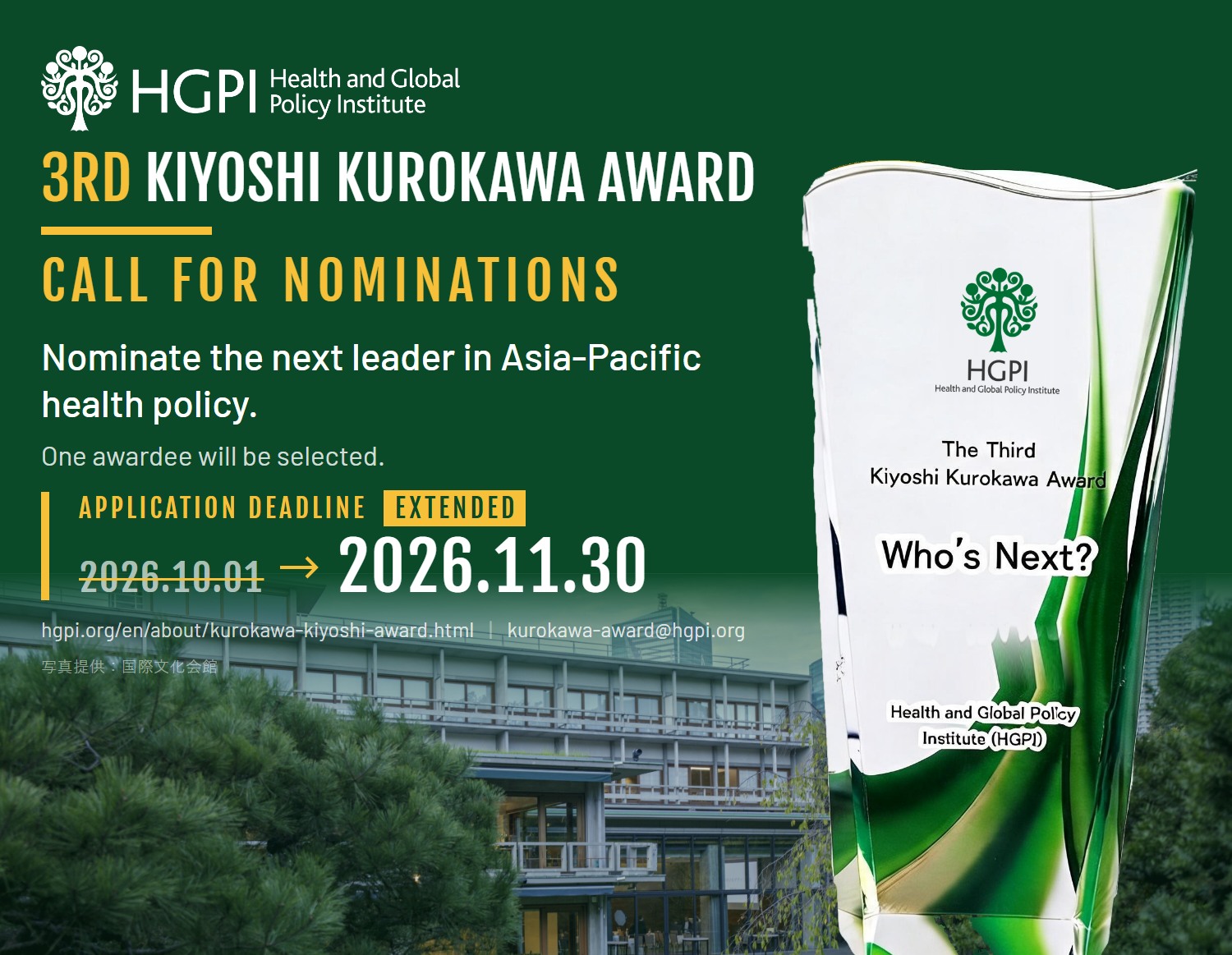
[Announcement] The 3rd Kiyoshi Kurokawa Award: Call for Nominations (Deadline: November 30, 2026)
-
2026-10-06
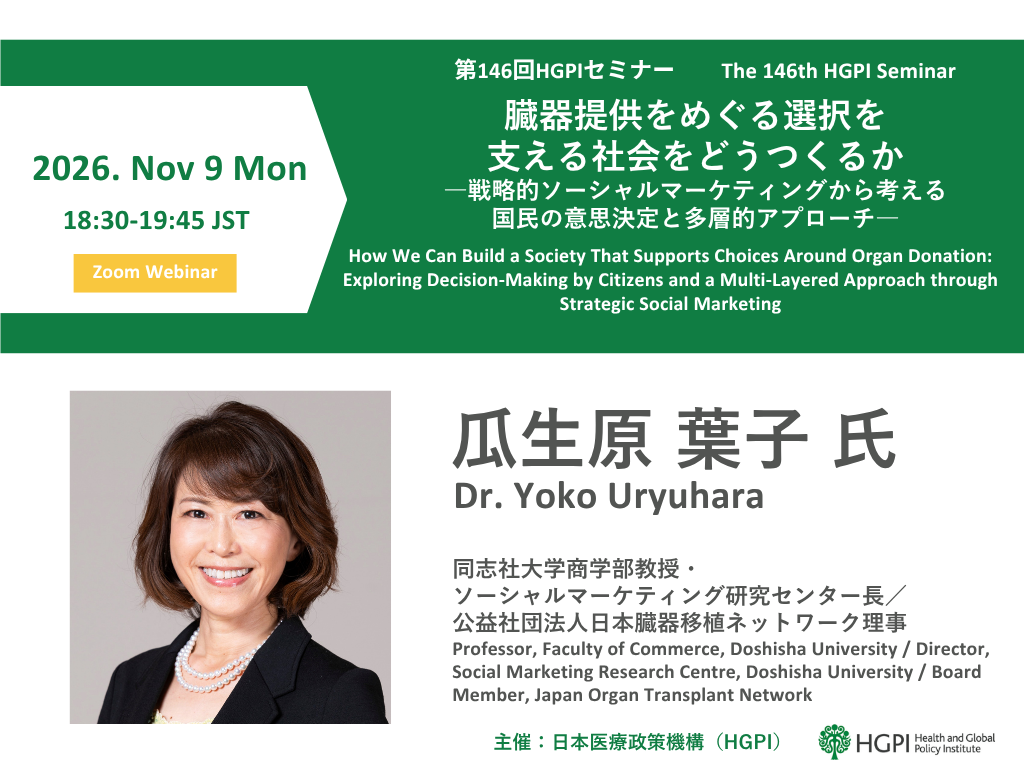
[Registration Open] (Webinar) The 146th HGPI Seminar “How We Can Build a Society That Supports Choices Around Organ Donation: Exploring Decision-Making by Citizens and a Multi-Layered Approach Through Strategic Social Marketing” (November 9, 2026)
-
2026-10-19
[HGPI Policy Column] (No.78) — From the Blood Disorders Project “Quality of Life in Long-Term Blood Cancer Care: Insights from Canada”

-
2026-10-28
[Policy Recommendations] Driving Progress in Intractable and Rare Disease Policy Through Patient and Public Voices: Towards Redesigning Healthcare Delivery Systems Across Diagnosis (September 29, 2026)