

[HGPI Policy Column] (No. 79) The History and Future Prospects of the Field of Nutrition in Health Policy (Part 1) — The History of Hospital Food Services and Nutritional Counseling and the Shift From Recommended Dietary Allowances to Dietary Reference Intakes
date : 11/16/2026

<POINTS>
- In 2005, Japan shifted its nutritional standards from recommended dietary allowances (RDAs) to dietary reference intakes (DRIs). While the RDAs aimed to address malnutrition in the postwar years, the DRIs aim to address both nutritional deficiencies and excesses. With this shift came an expansion in scope that now includes almost all Japanese people.
- The focus of hospital food services has shifted from ensuring sufficient quantities and improving quality to the distribution of the cost burden. Starting in 2024, rising prices have driven hikes in standard hospital meal costs for three consecutive years.
- Nutritional guidance was covered by an additional fee applied to the physician consultation fee, but is now covered by a separate registered dietitian consultation fee. With expanded eligibility, a shift to online services, and coverage granted for post-discharge in-home nutritional guidance in FY2026, the scope of nutritional guidance has broadened to provide seamless support from hospitalization to in-home care.
Introduction
In recent years, policies related to food and nutrition have expanded beyond disease prevention and other health or medical policies. These policies now span a broad range of areas, including food security and sustainable agriculture, and they are formulated either independently or jointly by several government ministries, including the Ministry of Health, Labour and Welfare (MHLW), the Ministry of Agriculture, Forestry and Fisheries (MAFF), and the Ministry of Education, Culture, Sports, Science and Technology (MEXT).
Among these various policies, the focus of this column is nutrition in health policy. Central to this area are comprehensive guidelines on nutrition and diet for the general public titled the “Dietary Reference Intakes (DRIs) for Japanese,” which are established by the Minister of Health, Labour and Welfare in accordance with the Health Promotion Act. The DRIs are formulated every five years with the goals of maintaining and promoting health for people living in Japan and preventing the onset and severe progression of lifestyle-related diseases. The 2025 edition, the latest version of these guidelines, has been in use since FY2025. For five years, it will serve as the basic dietary guidelines in various settings nationwide, including hospitals and schools. However, the DRIs are provided on the assumption that specialists who have read them thoroughly will interpret them as general guidelines to tailor them to each situation. This means that the DRIs fall short as a tool that citizens can use on their own to interpret numerical values and apply them directly to their diets.
Given this context, the first installment of this two-part series will review the history of nutrition in Japan’s health and medical policy. Focusing on the DRIs and the role of nutrition in healthcare, particularly hospital food services and nutritional guidance, we will explore how policies and challenges have evolved over time. Taking those developments into account, the second installment will discuss key perspectives for ensuring citizen-centered measures are included in the upcoming guidelines to be formulated in FY2026 under the tentative title, “Dietary Guide for Japanese People.” (Please note that this title is a provisional translation provided by Health and Global Policy Institute (HGPI).)
From RDAs to DRIs: A Shift from Nutritional Deficiencies to Deficiencies and Excesses
In Japan, the evolution of nutritional standards has been driven by the dietary challenges faced by citizens in each era. To begin, this column will examine how nutritional standards have changed alongside shifting dietary challenges, drawing on the DRIs and their predecessor, the recommended dietary allowances (RDAs).
Nutritional standards have existed in Japan since the late 1800s, during the Meiji era. Following World War II, many people in Japan struggled with hunger and malnutrition, and the primary concern was indicating how much people needed to eat. These challenges led to the establishment of standards that would later be known as the RDAs, which served as the foundation for the DRIs that are in use today. Designed to eliminate deficiencies by specifying necessary amounts of nutrients, the RDAs functioned as guidelines tailored to an era of scarcity.
As society changed, Japan’s dietary challenges transitioned from those caused by deficiencies to those rooted in excess. Because the RDAs were designed to meet minimum nutritional needs, they were inadequate for addressing the health consequences of overnutrition. In response, when the MHLW revised the standards in 2005, it adopted the term “DRIs” and shifted to an approach focusing on appropriate intake levels to address both nutritional deficiencies and excesses.
This shift also expanded the scope of people covered by the standards. During the era when the primary goal was to combat deficiencies, these standards mainly targeted people suffering from malnutrition. With the rise of overnutrition, they were expanded to include healthy people and people whose health checkups detected issues like hypertension. As a result of this expansion, the DRIs now target almost all Japanese people, regardless of health status. As shown by this transition to the DRIs and the expanded focus from deficiencies to both deficiencies and excesses, Japan’s nutrition policy has evolved to meet the dietary challenges of each era.
Hospital Food Services: Securing Sufficient Quantities, Improving Quality, and Redefining Cost-Sharing
Against the backdrop of shifting dietary challenges, this section will provide an overview of how the area of nutrition has been developed within the context of health policy. Two of the central pillars in this area are hospital food services and nutritional guidance. This column will examine these two items.
“Hospital food services” refers to the meals provided during hospitalization. Beyond satiating hunger for patients, these meals are also positioned as part of medical care. The hospital meal system dates back to 1948, when the enactment of the Medical Care Act first obligated hospitals to maintain food service facilities. A comprehensive meal supply system was established in 1950, under the Health Insurance Act. Amid nationwide food shortages that caused malnutrition among all citizens, this system was designed to ensure that hospitalized patients could receive their necessary nutrition from hospital meals alone. Patients began to be provided with 2,400 kcal per day. After a revision in 1958, this system became the “Standard Meal Supply System.” As dietary challenges shifted from nutritional deficiencies to excesses, the standard daily provision of 2,400 kcal per patient was abolished in 1973, and the goal of providing amounts closer to appropriate values for each patient was adopted. The February 1978 revision of the medical fee schedule increased the basic daily meal allowance from 80 to 100 points per day of hospitalization and the additional standard meal allowance fee from 28 to 31 points. That revision also established a system in which healthcare institutions certified to provide standard meals could claim 10 additional points when providing meals that meet certain criteria, which is known as the “additional fee for medical meals.”
As time passed, issues related to hospital meals grew beyond ensuring adequate nutrition and quality to determining who will bear the costs of hospital meals, and how. In 1994, meal-related benefits were recategorized from long-term treatment benefits to “long-term inpatient treatment meal fees.” Among these fees, level I of the long-term inpatient meal fee was set at 1,900 yen per day, 600 yen of which was to be paid by the patient. According to the MHLW, this out-of-pocket payment is meant to cover the cost of ingredients and was established to ensure a fair cost burden among people receiving in-home treatment and people who are hospitalized. In 2006, the method of calculating this fee was changed from a daily basis to a per-meal basis, at 640 yen per meal. Starting in FY2016, meal preparation costs were also gradually shifted to patients, with amounts based on income to ensure fairness for people receiving long-term home treatment. Standard income earners were charged a copayment of 260 yen per meal, which was later increased to 460 yen per meal in April 2018. A standard rate of 1,920 yen per day was set in April 1997. This standard per-day rate remained effectively unchanged following the switch to a per-meal arrangement of 640 yen per meal in April 2006. After rising food costs led to three consecutive annual increases starting in June 2024, the per-meal rate reached 730 yen per meal by June 2026. For standard income earners, the copayment is 550 yen per meal.
Nutritional Guidance: Evolving From an Additional Fee for Physician Guidance to a Form of Continuous Support Across Hospitalization and In-Home Care
Next, this column will discuss nutritional guidance. The “additional fee for nutritional guidance” was established with the February 1978 revision of the medical fee schedule. It granted 5 additional points when a dietitian provided concrete guidance under instruction from a physician to patients whose primary condition was a chronic disease and who required a special diet. Because this fee was established as an additional fee to the chronic disease guidance fee, it is reasonable to conclude that when it was introduced, nutritional guidance was considered supplementary to the physician guidance fee.
The outpatient nutritional guidance fee was assigned more points in the FY1994 revision, which is also when the in-hospital and in-home nutritional guidance fees were introduced. Following a directive issued in 2000, claims could be submitted for outpatient and inpatient nutritional guidance fees when a registered dietitian provided counseling for approximately 15 minutes or more and presented tailored meal plans based on the patient’s lifestyle and preferences, under physician instructions. That directive also specified that registered dietitians must provide guidance when submitting claims for the group nutritional guidance fee. While the additional fee introduced in 1978 permitted guidance by a “dietitian,” the 2000 directive explicitly restricted guidance to “registered dietitians,” indicating a clear shift in professional qualification standards for the provision of nutritional guidance under the medical fee schedule.
The FY2016 revision brought about a major expansion in the scope of eligibility and evaluation. In addition to patients requiring special diets, this revision extended nutritional guidance eligibility across outpatient, inpatient, and home care settings to include cancer patients, patients with eating or swallowing difficulties, and malnourished patients. Because nutritional guidance is often time-consuming, it also revised the outpatient and inpatient guidance fees from “130 points for sessions lasting approximately 15 minutes or more” to “260 points for initial sessions lasting approximately 30 minutes or more, and 200 points for the second and subsequent sessions (for inpatient guidance, the second session) lasting approximately 20 minutes or more.”
The FY2020 revision expanded the range of guidance providers and guidance methods, and began to evaluate the level of expertise. It extended reimbursement eligibility to guidance that is provided to patients at clinics on both an outpatient and home-care basis by registered dietitians from other healthcare institutions or nutritional care stations. That same revision also introduced a reimbursement for guidance provided via information and communication technology (ICT) from the second session. The reimbursement for guidance via ICT was extended to include initial sessions in the FY2022 revision. The FY2022 revision also introduced a new reimbursement providing 260 points per month for specialized guidance from registered dietitians to cancer outpatients undergoing chemotherapy.
The FY2026 revision made two changes related to nutritional guidance. The first was that it introduced the post-discharge home visit nutritional guidance fee, which was assigned 530 points. This fee applies when a registered dietitian from the treating hospital visits the patient at home (or another location) to provide guidance within one month after discharge. It can be claimed up to four times. The second was a revision to the outpatient nutritional guidance fee, which was given a new category for cases in which additional guidance is provided via telecommunications devices or telephone from the second or subsequent sessions.
For an overview of past developments in the area of nutrition within health policy, please refer to the excerpts provided below in Appendix 1.
(Appendix 1) Past Developments in the Area of Nutrition in Health Policy
| Year | Events |
| 1945 | The Ministry of Health and Welfare promulgated the Ordinance for Dietitians on April 13, 1945, immediately before the end of World War II. Following World War II, the National Nutrition Survey (now the National Health and Nutrition Survey) was established under a directive from the General Headquarters of the Supreme Commander for the Allied Powers (GHQ). Its original purpose was to collect baseline data for incoming overseas food aid, with the initial survey focusing on Tokyo residents. |
| 1948 | The Ordinance for Dietitians was discontinued and the Dietitians Act came into effect. The Dietitians Act defined a “dietitian” as “a person who is engaged in the service of providing nutritional guidance using the title ‘Dietitian’ under license from a prefectural governor.” The scope of the National Nutrition Survey was expanded to the entire country. The Medical Care Act was enacted. In addition to requiring hospitals to establish food service facilities, it also set penalties for non-compliance. While it left staffing levels for physicians, nurses, and other personnel to be determined by ministerial ordinance, it had no explicit provisions for dietitians. |
| 1950 | A comprehensive meal supply system was established under the Health Insurance Act, which ensured that hospitalized patients could receive their necessary nutrition (2,400 kcal per day) from hospital meals alone. |
| 1952 | The Nutrition Improvement Act was enacted. Its purpose was to clarify the nutritional status of citizens and improve health and physical fitness. Its provisions included conducting the National Nutrition Survey, establishing nutrition counseling and staffing nutrition counselors at public health centers, and introducing nutritional management at mass food service facilities. |
| 1961 | Japan achieved universal health insurance and pension coverage. At the time, National Health Insurance provided less coverage and lower benefits than Employees’ Health Insurance. It was decided that for the time being, there was no need to cover hospital meals, house calls, dental prosthetics, and bedding, and more than a few insurers had restrictions on benefits. |
| 1973 | The standard of 2,400 kcal per day for general diets was abolished to allow for the provision of meal plans better suited to individual patient needs. |
| 1978 | The basic daily meal allowance and additional standard meal allowance fees were increased and the additional fee for medical meals was introduced. The additional fee for nutritional guidance was also introduced as a supplementary fee to the chronic disease guidance fee. |
| 1994 | The long-term inpatient treatment meal fee was established, and patient copayments equivalent to the cost of ingredients were introduced. Nutritional guidance fees for both in-hospital and in-home nutritional guidance were also introduced. |
| 2000 | An amendment of the Dietitians Act clarified the duties of registered dietitians. |
| 2003 | The Health Promotion Act came into effect, replacing the Nutrition Improvement Act. Designed to comprehensively promote health for citizens, it required municipal governments to provide consultations and nutritional guidance to residents through physicians, registered dietitians, and other such professionals, and prefectural governments and similar entities to provide specialized nutritional guidance and appoint certain physicians or registered dietitians as nutrition counselors. It also required facilities such as large-scale mass food service facilities that provide meals to people requiring medical management to have registered dietitians on staff, and positioned healthcare institutions as collaborators in health promotion. |
| 2004 | The 2005 edition of the DRIs was formulated, replacing the RDAs and marking a shift to standards that address both nutritional deficiencies and excesses. |
| 2006 | The method of calculating the cost of hospital meals was changed to a per-meal basis. |
| 2016 | The scope of nutritional guidance was expanded to include patients with cancer, eating or swallowing difficulties, or malnourishment. |
| 2024 to 2026 | Rising prices drove up the standard rate for hospital meals for three consecutive years. |
| 2026 | The post-discharge home visit nutritional guidance fee was introduced. |
Conclusion
This column traced back the history of the DRIs as well as hospital food services and nutritional guidance in healthcare. In each of these areas, evolution has been driven by the dietary challenges of their respective eras. The DRIs have shifted from an approach based on addressing deficiencies to one that is based on addressing both nutritional deficiencies and excesses. The role of hospital food services has broadened from guaranteeing adequate nutrition and quality to effectively balancing cost distribution, while the role of nutritional guidance has expanded from in-hospital guidance to continuous support after discharge and during in-home care. In addition to preventing the onset and progression of lifestyle-related diseases, there are increasingly diverse dietary challenges such as addressing malnutrition and frailty among older adults and maintaining food security as prices continue to soar. Based on these developments, Part 2 of this column will examine perspectives for ensuring a citizen-centered approach is reflected in the “Dietary Guide for Japanese People,” which is scheduled to be compiled in FY2026.
[References]
- MHLW. Report of the “Dietary Reference Intakes (DRIs) for Japanese,” 2025 ed. Planning and Review Committee. Retrieved October 8, 2026, from https://www.mhlw.go.jp/stf/newpage_44138.html.
- MHLW. Working Group for the Dietary Guide for Japanese People (tentative title). Retrieved October 8, 2026, from https://www.mhlw.go.jp/stf/shingi/other-kenkou_202607.html.
- Health and Global Policy Institute (HGPI). [Event Report] The 134th HGPI Seminar “Understanding Evidence-Based Dietary Guidelines: Leveraging the Dietary Reference Intakes for Japanese” (May 28, 2025). Retrieved October 23, 2026, from https://hgpi.org/events/hs134-1.html.
- MHLW. Introduction and History of Dietary Reference Intakes. Retrieved October 8, 2026, from https://www.mhlw.go.jp/file/05-Shingikai-10901000-Kenkoukyoku-Soumuka/0000041897.pdf.
- Ikegami N. Recommendations on the Hospital Meal Service System. Hospital, 81(8), 673–675 (2022).
- Nakamura T. From the Standpoint of Clinical Nutrition. The Japanese Journal of Nutrition, 63(4), 187–190 (2005).
- Health Insurance Bureau, MHLW. Regarding Meals, Utility, and Water Charges During Hospitalization (204th Meeting of the Health Insurance Subcommittee of the Social Security Council, Document 3, November 20, 2025). Retrieved October 20, 2026, from https://www.mhlw.go.jp/content/12401000/001597708.pdf.
- MHLW. Ensuring Fairness in Housing Cost Burdens Through Healthcare and Long-Term Care Services (91st Meeting of the Health Insurance Subcommittee of the Social Security Council, Document 2-1, November 20, 2015). Retrieved October 20, 2026, from https://www.mhlw.go.jp/file/05-Shingikai-12601000-Seisakutoukatsukan-Sanjikanshitsu_Shakaihoshoutantou/0000104911.pdf.
- General Affairs Division, Health Insurance Bureau, MHLW. Regarding the Bill on the Partial Amendment of the National Health Insurance Act, etc., for a Sustainable Health Insurance System (The National Conference of Directors of Health, Labour and Welfare Departments (Welfare Subcommittee) Health Insurance Bureau Materials, February 24, 2015). Retrieved October 23, 2026, from https://www.mhlw.go.jp/topics/2015/02/dl/tp0219-16-01p.pdf.
- Japan Health Insurance Association. Dietary Treatment Expenses for Inpatients, Living Support Expenses for Inpatients, Medical Expenses Combined with Treatment Outside Insurance Coverage, and Medical Expenses for Home-Nursing. Retrieved October 20, 2026, from https://www.kyoukaikenpo.or.jp/benefit/mynumber_insurance_card/002/.
- Medical Economics Division, Health Insurance Bureau, MHLW. Outline of the FY2016 Medical Fee Schedule Revision (March 4, 2016 Edition). Retrieved October 21, 2026, from https://www.mhlw.go.jp/file/06-Seisakujouhou-12400000-Hokenkyoku/0000115977.pdf.
- Medical Economics Division, Health Insurance Bureau, MHLW. Outline of the FY2020 Medical Fee Schedule Revision (General Overview) (FY2020 Meeting of Prefectural and Other Nutrition Policy Officials, Document 3). Retrieved October 21, 2026, from https://www.mhlw.go.jp/content/10900000/000666010.pdf.
- Medical Economics Division, Health Insurance Bureau, MHLW. Outline of the FY2022 Medical Fee Schedule Revision (Nutrition Related) (FY2022 Meeting of Prefectural and Other Nutrition Policy Officials, Document 2). Retrieved October 21, 2026, from https://www.mhlw.go.jp/content/10900000/001003511.pdf.
- MHLW. FY2026 Medical Fee Schedule Revision 8. Promoting High-Quality In-Home Care (Revised Explanatory Materials). Retrieved October 21, 2026, from https://www.mhlw.go.jp/content/12400000/001686053.pdf.
- MHLW. FY2026 Medical Fee Schedule Revision 7. Functional Reorganization, Strengthening, and Related Measures for Outpatient Care (Revised Explanatory Materials). Retrieved October 21, 2026, from https://www.mhlw.go.jp/content/12400000/001681336.pdf.
- Cabinet Secretariat. The History of Policies and International Cooperation for Nutrition in Japan. March 12, 2015. Retrieved October 8, 2026, from https://www.cas.go.jp/jp/seisakukaigi/kenkouiryou/kokusaitenkai/eiyo_dai1/siryou11.pdf.
- National Institute of Health and Nutrition. Introducing the National Nutrition Survey. Retrieved October 8, 2026, from https://www.nibn.go.jp/eiken/chosa/kokumin_eiyou/abou_kokugen.html.
- MHLW. Reflecting on the Development of the Social Security System to Meet Evolving Needs. Retrieved October 9, 2026, from https://www.mhlw.go.jp/wp/hakusyo/kousei/11/dl/01-02.pdf.
[Authors]
Asako Okawa (Senior Associate, HGPI)
Shunichiro Kurita (Senior Manager, HGPI)
Top Research & Recommendations Posts
Featured Posts
-
2026-08-28
[Announcement] The 3rd Kiyoshi Kurokawa Award: Call for Nominations (Deadline: November 30, 2026)

-
2026-11-05
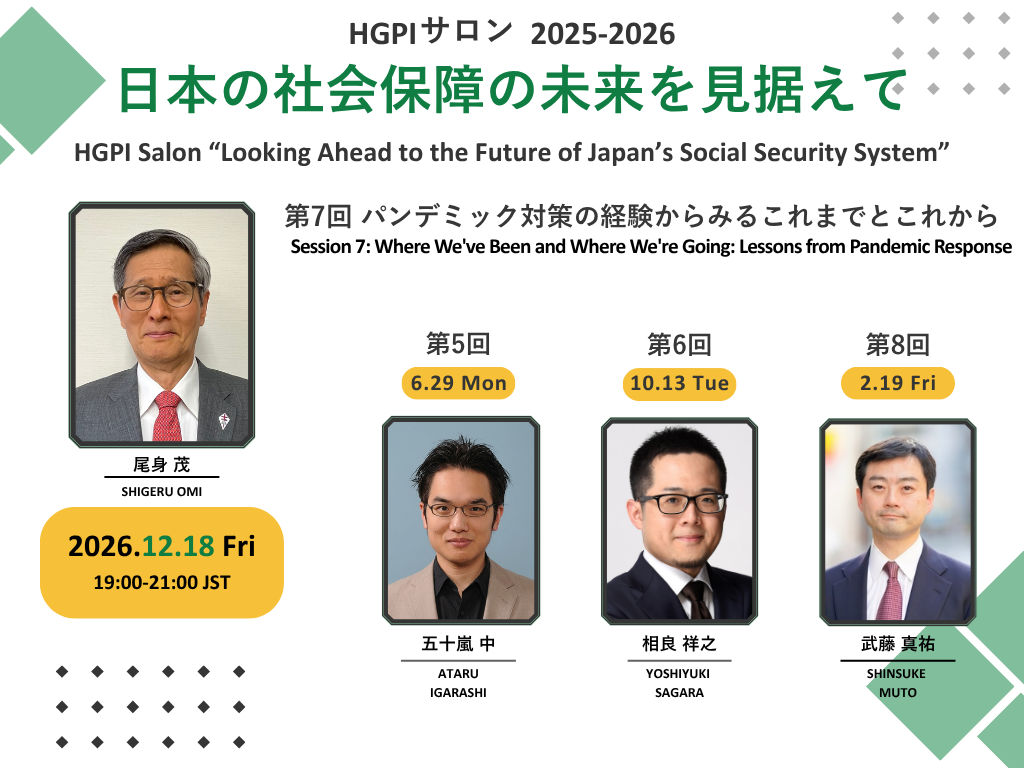
[Registration Open] HGPI Salon 2025-2026 Looking Ahead to the Future of Japan’s Social Security System “Session 7: Where We’ve Been and Where We’re Going: Lessons from Pandemic Response” (December 18, 2026)
-
2026-11-13
[Discussion Points] Addressing AMR Measures for an Era of Healthy Longevity: Ensuring Safety and Security for Older Adults in a Super-Aged Society (October 23, 2026)